37s vs 40s: Is there really a need for 40s?

I understand the desired outcome, I'm just not sure how to get there.

The tire patch to pivot around the center point... does that mean neutral backspacing (4" backspacing on 8" wide wheels, 5" backspacing on 10" wheels) or the center of the tire over the balljoint? Or something else entirely? How far off can you be before running into issues?

That's why I'm surprised going to 3.75" of backspacing was recommended when the factory was 5.5". I understand that I had to add width due to the tire size, but would it have been better to widen the axles by 3.5" rather than mess with the backspacing? Or am I completely wrong?

Do some reading on scrub radius. There are pros and cons to both positive and negative, and in general you want as little as possible but it's fairly agreed that it's better to have a little of either one than to have exactly zero. Negative would require wheels like you see on the front of a tractor trailer where it's bulged way out past the tire so that's not really practical...therefore for this discussion it's best just to consider positive.

I suspect the axle width recommendations are based on achieving a track width that keeps the tires out of things you don't want them touching, but are also based on a particular range of wheel backspacing. So a 65" WMS with 4" backspaced wheels would be equivalent to a 67" with 5" backspacing, with the caveat that the 5" backspacing combo will have closer to zero scrub radius and better road manners but 4" tends to be easier to find in the aftermarket.
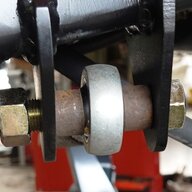
 
I haven’t built one, and really have no idea if it would work, but my feeling is that an axle for 37’s would be a high pinion Dana 44 center section 3” diameter X 1/2” wall tubes and Dana 60 inner C’s and knuckles.

It would be a very expensive axle to build, but I think it would work very well and be very durable. It would also have a good amount of clearance.

An axle I fully believed Currie should have been building for many years. But, given that up until a few years ago, their all time #1 selling axle was a TJ Dana 60 front, TJ width with TJ outers, I'm sure it would have been a hard sell.
 
Do some reading on scrub radius. There are pros and cons to both positive and negative, and in general you want as little as possible but it's fairly agreed that it's better to have a little of either one than to have exactly zero. Negative would require wheels like you see on the front of a tractor trailer where it's bulged way out past the tire so that's not really practical...therefore for this discussion it's best just to consider positive.

I suspect the axle width recommendations are based on achieving a track width that keeps the tires out of things you don't want them touching, but are also based on a particular range of wheel backspacing. So a 65" WMS with 4" backspaced wheels would be equivalent to a 67" with 5" backspacing, with the caveat that the 5" backspacing combo will have closer to zero scrub radius and better road manners but 4" tends to be easier to find in the aftermarket.

Put another way, you can put 40's on stock width axles and close to proper back spacing. It won't turn very well, but you can do it.
 
  • Like
Reactions: freedom_in_4low
I'm not sure I've ever heard clearance come up when discussing swapping a Dana 35 for a 44, but for some reason it's always brought up when discussing 60s.
 
I'm not sure I've ever heard clearance come up when discussing swapping a Dana 35 for a 44, but for some reason it's always brought up when discussing 60s.

It comes up fairly often in Super35 and 8.8 discussions.
 
  • Like
Reactions: hosejockey61
I think that's where a lot get hung up. They assume all 60 castings are the same. Unfortunately I don't have a normal 60 around to measure.
 
Comparing the clearance of a 44 to any 60 is comparing apples to oranges. If your running a 60, you are usually not running 35’s. And if you are running anything bigger than 35’s, you don’t want to be running a 44.

That said, my 14 bolt has about the same clearance as my old 60…

🙂
 
  • Like
Reactions: mudmaster
If your running a 60, you are usually not running 35’s.

1704556048212.gif
 
  • Like
Reactions: ColoJeep
That's why I'm surprised going to 3.75" of backspacing was recommended when the factory was 5.5". I understand that I had to add width due to the tire size, but would it have been better to widen the axles by 3.5" rather than mess with the backspacing? Or am I completely wrong?
Maybe an easier way to understand it. If you look at the upper and lower balljoints, you will notice if you were to draw a line through the center of them, it inclines or leans inward at the top when viewed from the front. That is the steering axis inclination. If you then extend that line down to the surface that the tire sits on, it should roughly intersect that surface near the center of the contact patch so the patch rotates around that point when the tires are turned.

Because of the inclination, as the axle moves up due to a larger tire, the line's intersection point moves outward. That means as a "general" rule of thumb, as tire size increases, you can shift it outward with less back spacing to semi-retain the relationship.

One thing to be very aware of is there is nothing on a front axle steering wise that sucks much more than tires that have to roll to turn. I've seen several cases over the years where the steering wheel will lock up on pavement hard if you apply the brakes hard and or lock up the front and then try to turn.

As the tires are compelled to turn via input to the steering knuckles, one tire has to roll forward, the other has to roll backward. When the slack gets taken up in the splines etc., the system just locks up. If you have good brakes, that can be as little as a quarter turn of the steering wheel. The obvious should also be pointed out which is the leverage against the ball joints is now through the roof and however long they were expected to last with a good relationship is now compromised by more than a little.

Another thing to be aware of is the increased wear factor to just the steering bits. At highway speeds, any impact load the tire sees will be magnified greatly into the steering links and steering gear due to the increased leverage against the system. If there was ever a case for multiple steering dampers to help slow that down, that would do it. Even then, the tie rod ends, ball joints, knuckle tapers, etc. are going to suffer.
 
Comparing the clearance of a 44 to any 60 is comparing apples to oranges. If your running a 60, you are usually not running 35’s. And if you are running anything bigger than 35’s, you don’t want to be running a 44.

That said, my 14 bolt has about the same clearance as my old 60…

🙂

If an RJ60 doesn't drop any lower than a 44 then it's kind of a moot point, but what I was getting at is whether there was an advantage for a 37-38" build on D44s with proper width and ball joints, to maximize clearance without getting super wide for tight woods trails.

I know the stock axles don't work well past 35s due to the width and the ball joints, but is that also where the housing strength and R&P becomes a liability? Maybe this is where JK swaps come in, or do they still have TJ ball joints?

I've never really even entertained going past 35s or doing an axle swap so this is not an area I've gathered any knowledge in. Mostly just further developing this thread.
 
  • Like
Reactions: NashvilleTJ
If an RJ60 doesn't drop any lower than a 44 then it's kind of a moot point, but what I was getting at is whether there was an advantage for a 37-38" build on D44s with proper width and ball joints, to maximize clearance without getting super wide for tight woods trails.

I know the stock axles don't work well past 35s due to the width and the ball joints, but is that also where the housing strength and R&P becomes a liability? Maybe this is where JK swaps come in, or do they still have TJ ball joints?

I've never really even entertained going past 35s or doing an axle swap so this is not an area I've gathered any knowledge in. Mostly just further developing this thread.

One pair is TJ, one pair is JK.

1704558032786.webp
 
I've seen several cases over the years where the steering wheel will lock up on pavement hard if you apply the brakes hard and or lock up the front and then try to turn.

Some solid front axle Ford super duty were a perfect example. I you applied the brakes on pavement you could not turn the wheels. I always wondered how it would be backing a boat down a launch ramp with one. Have to pump the brakes to turn the wheel.
 
Maybe an easier way to understand it. If you look at the upper and lower balljoints, you will notice if you were to draw a line through the center of them, it inclines or leans inward at the top when viewed from the front. That is the steering axis inclination. If you then extend that line down to the surface that the tire sits on, it should roughly intersect that surface near the center of the contact patch so the patch rotates around that point when the tires are turned.

Because of the inclination, as the axle moves up due to a larger tire, the line's intersection point moves outward. That means as a "general" rule of thumb, as tire size increases, you can shift it outward with less back spacing to semi-retain the relationship.

One thing to be very aware of is there is nothing on a front axle steering wise that sucks much more than tires that have to roll to turn. I've seen several cases over the years where the steering wheel will lock up on pavement hard if you apply the brakes hard and or lock up the front and then try to turn.

As the tires are compelled to turn via input to the steering knuckles, one tire has to roll forward, the other has to roll backward. When the slack gets taken up in the splines etc., the system just locks up. If you have good brakes, that can be as little as a quarter turn of the steering wheel. The obvious should also be pointed out which is the leverage against the ball joints is now through the roof and however long they were expected to last with a good relationship is now compromised by more than a little.

Another thing to be aware of is the increased wear factor to just the steering bits. At highway speeds, any impact load the tire sees will be magnified greatly into the steering links and steering gear due to the increased leverage against the system. If there was ever a case for multiple steering dampers to help slow that down, that would do it. Even then, the tie rod ends, ball joints, knuckle tapers, etc. are going to suffer.

OK, for once Blaine knows what he is talking about....

;)

I'm kidding, of course. But here is a little real-world experience to demonstrate his point. There are many things wrong with my rig - and here is one of them.

When I built the rear 14 bolt a few years ago, I added 2" spacers to my front '60 to match the track width of the 14 bolt (Yes, 2" spacers).

(Blaine - please look away from the post at this point)

Mea Culpa - Here it is:

IMG_9340.JPG


This of course destroys my scrub radius. My plan has always been to build a new front axle, or retube the pro-rock, to correct it.

As Blaine said, sometimes (maybe always, and I'm just used to it) when stopping it will pull just a bit to the passenger side, and I have to correct. I've never had a problem with the steering locking up as he described - but I run hydro assist which would hide that.

The other issue is that when I really get on it (which with the big Hemi, is saying something) and the front end comes up, it will also pull just a bit to the driver side, and I have to compensate. Then when you let off quickly and the front end comes back down, I have to compensate the other way. It's not horrible, but it's close.

I always thought that I had some kind of steering issue causing this, perhaps bump steer. But my geometry is good, and it does not bump steer over bumps, so I've been at a bit of a loss.

The light went off when I read Blaine's post, so this morning I pulled the spacers for a little science. Here is a before:


IMG_9341.JPG


And the after:


IMG_9342.JPG


I took it for a long drive with lots of stops, and lots of lighting it up (which never gets old...). And sure enough, no more crazy steering behavior on stopping or when lighting it up.

But, the fodeez rub without the spacers, so they had to go back on - and the steering issues returned. So I guess I need to reprioritize the new axle...

Before today, I thought my biggest issue with using the spacers was that they keep me from going to a 42, as in a full lock turn at full articulation the spacers would push a 42 into the rear of the wheel well (the 40's clear, but just). That would not be so on a 4" wider axle without spacers.

Thanks for that great post, Blaine.
 
OK, for once Blaine knows what he is talking about....

;)

I'm kidding, of course. But here is a little real-world experience to demonstrate his point. There are many things wrong with my rig - and here is one of them.

When I built the rear 14 bolt a few years ago, I added 2" spacers to my front '60 to match the track width of the 14 bolt (Yes, 2" spacers).

(Blaine - please look away from the post at this point)

Mea Culpa - Here it is:

View attachment 488873

This of course destroys my scrub radius. My plan has always been to build a new front axle, or retube the pro-rock, to correct it.

As Blaine said, sometimes (maybe always, and I'm just used to it) when stopping it will pull just a bit to the passenger side, and I have to correct. I've never had a problem with the steering locking up as he described - but I run hydro assist which would hide that.

The other issue is that when I really get on it (which with the big Hemi, is saying something) and the front end comes up, it will also pull just a bit to the driver side, and I have to compensate. Then when you let off quickly and the front end comes back down, I have to compensate the other way. It's not horrible, but it's close.

I always thought that I had some kind of steering issue causing this, perhaps bump steer. But my geometry is good, and it does not bump steer over bumps, so I've been at a bit of a loss.

The light went off when I read Blaine's post, so this morning I pulled the spacers for a little science. Here is a before:


View attachment 488882

And the after:


View attachment 488883

I took it for a long drive with lots of stops, and lots of lighting it up (which never gets old...). And sure enough, no more crazy steering behavior on stopping or when lighting it up.

But, the fodeez rub without the spacers, so they had to go back on - and the steering issues returned. So I guess I need to reprioritize the new axle...

Before today, I thought my biggest issue with using the spacers was that they keep me from going to a 42, as in a full lock turn at full articulation the spacers would push a 42 into the rear of the wheel well (the 40's clear, but just). That would not be so on a 4" wider axle without spacers.

Thanks for that great post, Blaine.

Not for nothing but I always appreciate it when folks spend the effort to learn something even if it is painful. There would be a lot more good tech out there if more folks were willing to test stuff with an open mind instead of taking the information as a personal affront. Sorry for the education, hopefully the new axle does everything you need it to and then some.
 
Is there really nothing between stock axles and tons that would be enough for 37s? Like an aftermarket 44 with the right width and ball joints? Just so you don't have to go to all the effort and expense just to end up with the same or less pumpkin clearance as 35s?

From what I can gather, you'll always be limited by the ball joints.

There are aftermarket BJs that claim to provide better strength over stock Dana 44 BJs, but any improvements will be marginal because the size is limited by the knuckles.

Like you can run 37s on D44s, but you have to either not wheel it hard enough to take advantage of the 37s, or get comfortable changing balljoints.