Novak Conversions Jeep Wrangler TJ engine mounts

Windstar Intake Clearance - Hitting Hood

That listing is lying. That is not a T-bolt clamp in the picture.
View attachment 552900

View attachment 552901

You're correct — The Picture is wrong, not the listing.

It did come with T-clamps - check out my original post. The reviews also said the same thing so I wasn't 100% certain but it did arrive with the better T-Clamps.

 
You documented it well back then ;) I did just f'up the firewall hole that I now need to solve.

While a don't advocate anyone installing a Windstar intake, mine is as close to what a proper installation might be. I would strongly encourage getting the rubber insert in there with a patched and corrected hole.
 
  • Like
Reactions: FarFire70
While a don't advocate anyone installing a Windstar intake, mine is as close to what a proper installation might be. I would strongly encourage getting the rubber insert in there with a patched and corrected hole.

Why wouldn't you advocate installing the intake?
 
Why wouldn't you advocate installing the intake?

The Windstar serves no benefit to performance. The only benefit it has ever provided me is inner fender room to fit things under the hood. And recently it being there may have made the installation of highline fenders a little less difficult and time consuming. Though, any of the real estate problems it solved for me ten years ago, I would solve very differently today.
 
The Windstar serves no benefit to performance. The only benefit it has ever provided me is inner fender room to fit things under the hood. And recently it being there may have made the installation of highline fenders a little less difficult and time consuming. Though, any of the real estate problems it solved for me ten years ago, I would solve very differently today.

Awesome. Thanks for the feedback.
 
  • Like
Reactions: FarFire70
While a don't advocate anyone installing a Windstar intake, mine is as close to what a proper installation might be. I would strongly encourage getting the rubber insert in there with a patched and corrected hole.

The Windstar serves no benefit to performance. The only benefit it has ever provided me is inner fender room to fit things under the hood. And recently it being there may have made the installation of highline fenders a little less difficult and time consuming. Though, any of the real estate problems it solved for me ten years ago, I would solve very differently today.

Your accurate that it does provide a performance benefit and being an unnecessary install unless required.

I installed GenRight inner fenders which don't allow for the stock air intake so I need an alternative. This is (when installed properly) cheaper solution.

Over time, I may migrate to a more robust aftermarket solution.... or do that sooner than later based on my assessment of my current conditions.
 
The Windstar serves no benefit to performance. The only benefit it has ever provided me is inner fender room to fit things under the hood. And recently it being there may have made the installation of highline fenders a little less difficult and time consuming. Though, any of the real estate problems it solved for me ten years ago, I would solve very differently today.

I thought someone reported lower intake temperatures.
 
I thought someone reported lower intake temperatures.

I have been reporting that for ten years. I even did it in this thread. Anyone who researches cowl induction on a TJ is going to quickly find me. For those same ten years, I have also been reporting that it doesn't amount to anything. The engine does not care.
 
Last edited:
  • Like
Reactions: FarFire70
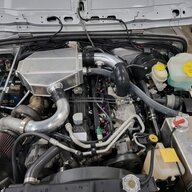
I just installed a Windstar intake. I installed Genright inners and like was just said above, there was no way to keep the stock airbox, which I was really trying to do since I plan on running Jezza's turbo at some point and it utilizes the stock airbox. I had the Windstar airbox that I had bought ages ago, but mine is not installed through the firewall, it is the same orientation as the stock box, but it fits and I still get to run a proper filter.
 
  • Like
Reactions: FarFire70
Proper CAU intake do lower temps but the reward is low. Rule of thumb number if memory serves is .9% gain for every ten degree drop the engine see below the original set up. Sooo let’s say you get a full optimistic 30 degree drop. That would be 2.7% gain and At cruising RPM of when you are at 120 ish horse power that’s about 3hp. Science says yes you have more Hp, butt dyno says not really. 😂 However I pick up pennies off the ground still so I will chase that.
 
Proper CAU intake do lower temps but the reward is low. Rule of thumb number if memory serves is .9% gain for every ten degree drop the engine see below the original set up. Sooo let’s say you get a full optimistic 30 degree drop. That would be 2.7% gain and At cruising RPM of when you are at 120 ish horse power that’s about 3hp. Science says yes you have more Hp, butt dyno says not really. 😂 However I pick up pennies off the ground still so I will chase that.

My intake temps went from slightly below coolant temps with the factory box to about 10 degrees above ambient after cowl induction. On a 100° day, that is a 100° drop in normal intake temps. None of that matters. The PCM adjusts to the lower intake temps and brings the engine back to its programmed operation.
 
  • Like
Reactions: FarFire70
I considered it, because I liked the idea of moving the intake to a safer spot.

Factory box with the horn sticking up into the hood is very safe.

The one time I had a water ingestion problem was when the cowl drain was clogged and I was driving through a very heavy downpour. The cowl filled up with water and soaked the Windstar cone filter. The engine was choked and stumbling. I pulled over, figured out what was happening and opened up the canister to drive home.
 
  • Like
Reactions: FarFire70
Factory box with the horn sticking up into the hood is very safe.

The one time I had a water ingestion problem was when the cowl drain was clogged and I was driving through a very heavy downpour. The cowl filled up with water and soaked the Windstar cone filter. The engine was choked and stubbling. I pulled over, figured out what was happening and opened up the canister to drive home.

I've had the nose under water a couple of times, never the cowl.
 
  • Like
Reactions: FarFire70
My intake temps went from slightly below coolant temps with the factory box to about 10 degrees above ambient after cowl induction. On a 100° day, that is a 100° drop in normal intake temps. None of that matters. The PCM adjusts to the lower intake temps and brings the engine back to its programmed operation.

What does the 4.0’s PCM do to adjust for 200 degree plus intake temps?
 
  • Like
Reactions: SkylinesSuck
So the PCM is an interesting variable to the equation. What is it doing when it’s see more favorable conditions I.e. cooler air that would restrain performance gains. Obviously my very roughed estimate talks to the gains if the engine management is static… but when the PCM is running on say a 30 degree day in the winter vs a 100 degree day in the summer is it trying to adjust timing/fuel to meet some benchmark performance set at say a hypothetical 70 degrees? I see the pulling the timing/fuel as temps go up, but as temps go down how does it respond? More fuel and timing and I am thinking more performance…
 
I just looked at the stock tune for my 05 Wranglerfix PCM and there are 3 modes for IAT spark hot, cold and normal. According to the data the PCM goes from normal to hot mode at around 176°F IAT. In the hot spark mode the PCM has the ability to pull up to 9° of timing from the main table. Cold spark mode enables under -22°F, so almost never for most of us. That table has the ability to add as much as 7° to the base table. Under cruise conditions the fuel will not be affected as the O2s are going to target stoich regardless of intake temps. The JTEC PCM has a more simple strategy where it uses a linear adder table to the main spark map. If I remember right it just subtracts a degree or so every 20°F of intake temp over 100°F or so.
 
Long story short, you aren't going to feel any difference by bolting on a cowl intake, so in that sense the nay sayers are correct. One difference that might be noticable is less power loss at what would otherwise be much higher IAT temps, but that's a pretty specific scenario and one I think most people still wouldn't notice. Now if you are tuning the PCM anyways and are able to dial in more timing due to your colder air, that is moving the needle a bit more. Regardless, measurable differences all around, it's just questionable it would register on a butt dyno.

Everybody who thinks the PCM sees your engine making more power and dials it back to get back to the OEM herse-pers is wrong and doesn't understand how it works.
 
....

Everybody who thinks the PCM sees your engine making more power and dials it back to get back to the OEM herse-pers is wrong and doesn't understand how it works.

Is that a fair and accurate portrayal of what is being stated? No one is claiming that the PCM sees excess horsepower being generated and is actively putting an end to that disobedience.
 
  • Like
Reactions: FarFire70
Novak Conversions Jeep Wrangler TJ engine mounts