Stumped With Cooling System Problem

Slipstreak

New Member
Original poster
Joined
Dec 13, 2017
Messages
21
Location
Texas
Hello everyone,

For the better half of 18 months, I've been chasing an overheating issue at idle that myself and reputable shops in my area can't seem to diagnose, I'm hoping there's some guidance here that someone can share that hasn't already been tried.

Problem: At idle, the Jeep temperature slowly creeps up and continues to climb if at a light too long and will peg into the red. The following has been done to attempt to remedy the issue to no avail:
  1. Fan Clutch (Multiple units were tried, including severe duty units) Hayden and U.S. Motor Works are what have been used. All units passed the "spin test" when fully warmed up and had healthy resistance.
  2. Fan Shroud (Ensured OEM Mopar shroud was properly attached by all factory hardware and was cleanly mated to the surface of the radiator)
  3. Water Pump (Multiple units were also tried, Mopar and Flowkooler) all units were confirmed to not have reverse rotating impellers and did not have loose/shot bearings. Appeared to work as intended.
  4. Thermostat (Multiple units were also tried, Stant and Mopar, all 195* units) all units were tested in boiling water and did not stick or refuse to release. Appeared to work as intended.
  5. Radiator (Multiple units tried, CSF and Denso) all were factory sized and mimicked the discontinued and sought after Mopar unit. No leaks and all units passed a pressure test and had a healthy amount of flow.
  6. Radiator Cap (Multiple units tried, AC Delco, Mopar, Stant) all units were 18lb caps and did not cause coolant boiling and did not leak or cause loss of pressure during pressure test
  7. Cooling System Burp (Done MULTIPLE times to the letter with an incline, open radiator, max heat, and idling for 30-45 minutes and follow up drives) Issue still persists.
  8. Radiator Hoses (multiple hoses tried and both upper and lower lines were replaced) lines did not collapse during testing and appeared to move coolant within spec.
  9. Complete Engine Rebuild (full overhaul utilizing quality parts. The only parts reused were the valve cover and oil pan. New core, pistons, rings, valves, TUPY head, head gasket, crank, bearings, seals, etc.) I was really hoping that it was an issue with the head gasket, block or the head itself but the issue still persist. engine has been fully inspected and no contamination is present after flushing the engine with Prestone since the engine is brand new.
  10. Cleaned Condenser & Radiator Fins (Thoroughly cleaned with water and a brush while careful to not bend fins.) No changes in the vehicle's behavior.
  11. Catalytic Converter Back Pressure Test (Tested thoroughly at idle and at 2500 RPMS+, less than 1lb of backpressure and flow seemed within spec)
  12. Checked Oil for Coolant Contamination (Oil was super clean and has hardly any miles on it as this vehicle is no longer my daily driver)
  13. Head Gasket Test Post-Rebuild (tested with multiple test kits, no exhaust gasses present)
  14. Cooling System Pressure Test (Tested myself and done at Jeep specialty shops, system tested within spec and no leaks or air pockets were found)

A lot of the threads I've read had talked about parts being defective out of the box which I have tried to combat by replacing parts usually most suspect to this problem multiple times like the fan clutch, thermostat, and water pump which I've tried but I just can't seem to figure out why this Jeep continues to overheat at idle. I've even caved in and taken it to multiple reputable shops within my area and none of the shops can pinpoint the issue but acknowledge that it is definitely present. As it sits right now, the Jeep drives fantastic at highway speeds its just at long traffic lights and trails where the vehicle's temperature begins to creep up. I usually end up opening the hood when I get home which is usually scorching hot to the touch and letting it air out in case I want to drive it again.

Thoughts on where to proceed from here?

Vehicle Info:
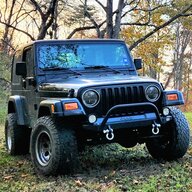
2002 Jeep Wrangler X
4.0L In-Line 6
32RH 3-Speed
184,800 Miles
 
Seems as though you have addressed just about everything.

Since it overheats at idle and is OK at speed, it seems to be the old air flow at idle issue. Have you verified the AC condenser fins aren’t bent and restricting air flow? That’s about all I can come up with.
 
Seems as though you have addressed just about everything.

Since it overheats at idle and is OK at speed, it seems to be the old air flow at idle issue. Have you verified the AC condenser fins aren’t bent and restricting air flow? That’s about all I can come up with.

Correct, I checked the fins when I cleaned the condenser and radiator. all were pretty straight with none bent beyond what would be considered normal wear and tear of bugs and leaves hitting them.
 
The only thing I didn't see you mention is the heater core (unless I overlooked it). Maybe bypass the heater core and see if the problem persists? Also, has the coolant temp sensor been replaced? Are there any other indications of overheating besides the gauge on the dash? Nothing mounted to the front of the jeep that would restrict airflow?

I'm just throwing out ideas here, because you literally replaced the entire engine and at least 90% of the cooling system and for that to not solve the problem is a bit baffling.
 
  • Like
Reactions: Steel City 06
The only thing I didn't see you mention is the heater core (unless I overlooked it). Maybe bypass the heater core and see if the problem persists? Also, has the coolant temp sensor been replaced? Are there any other indications of overheating besides the gauge on the dash? Nothing mounted to the front of the jeep that would restrict airflow?

I'm just throwing out ideas here, because you literally replaced the entire engine and at least 90% of the cooling system and for that to not solve the problem is a bit baffling.

Heater core has not been replaced, there's been no usual hints of a failing heater core like weak heat during the winter and a sweet smell coming through the AC vents. I suppose its possible? but to overheat an engine to the point where it pegs into the red doesn't seem like something a heater core could do.

The two temperature monitoring sensors on the motor have not been replaced I assume the one on the back of the block would be the sensor that could cause problems with faulty readings on the dash? but it doesn't explain how hot to the touch the engine and hood become after shutting off.

To add, a DEI fiberglass insulation kit on the fuel rail and injectors has also been added as well as the heat shield on the intake manifold from the old TSB.
 
How are you monitoring temperature? Dash gauge? Have you checked the engine temp using an ODB reader/scanner and confirmed the temperature read out with an IR thermometer a few inches away from the thermostat housing?

Has it puked coolant?

Who did the engine build? It's pretty damn hard to screw up a 4.0 but from watching DeXJs videos on YouTube he's found wild stuff like cheap knockoff Chinese cams.

What's the stamping on the head and block? Sometimes you can see stamping on top of the head through the oil cover.

Have you tried removing the AC condenser?

Winch or other obstructions in front of the grill? Grill inserts?

-Mac
 
How are you monitoring temperature? Dash gauge? Have you checked the engine temp using an ODB reader/scanner and confirmed the temperature read out with an IR thermometer a few inches away from the thermostat housing?

Has it puked coolant?

Who did the engine build? It's pretty damn hard to screw up a 4.0 but from watching DeXJs videos on YouTube he's found wild stuff like cheap knockoff Chinese cams.

What's the stamping on the head and block? Sometimes you can see stamping on top of the head through the oil cover.

Have you tried removing the AC condenser?

Winch or other obstructions in front of the grill? Grill inserts?

-Mac

Haven't put an OBD2 scanner to pull the computer readings of the coolant, I can try that and report back what I find.

It has not puked coolant and there's no boiling coolant in the overflow tank or the radiator.

The rebuild was done by a Jeep specialist here in the DFW metroplex who specializes in 4.0L engines. A Clegg rebuild kit with good quality parts was utilized.

As mentioned earlier, its a TUPY head. Block is 53010328AB.

Have not tried removing the AC condenser. My initial reason for this is because the AC still blows pretty cool and an obstructed condenser would likely create warmer AC right?

This TJ utilizes an AEV/Mopar Rock Crawler front bumper with a winch that is shorter than the Warn 9.5 that is usually paired with it. Based on how Jeeps in Arizona are regularly crawling in 105+ degree heat with winches I'm not sure this is the cause.
 
  • Like
Reactions: macleanflood
I built my stroker with a Clegg stroker stage 2 kit. Good stuff.

Doubt anything is obstructing the front but just gathering more info for folks to process. I have a 9.5 in front of my 97...I did relocate the control pack...but again...doubt it's the cause. I'm running a Koyorad radiator, Robert Shaw thermostat, Napa/Gates water pump...Oregon...so not really a torture test like the AZ crowd.

When you say pretty cool have you put a thermometer in the diffuser and measured the temp and it's within the proscribed range in the factory service manuals? They're available in the resources section.

Might also want to see if the heater is also putting out the correct heat. More you can rule out with hard data the better.

-Mac
 
I built my stroker with a Clegg stroker stage 2 kit. Good stuff.

Doubt anything is obstructing the front but just gathering more info for folks to process. I have a 9.5 in front of my 97...I did relocate the control pack...but again...doubt it's the cause. I'm running a Koyorad radiator, Robert Shaw thermostat, Napa/Gates water pump...Oregon...so not really a torture test like the AZ crowd.

When you say pretty cool have you put a thermometer in the diffuser and measured the temp and it's within the proscribed range in the factory service manuals? They're available in the resources section.

Might also want to see if the heater is also putting out the correct heat. More you can rule out with hard data the better.

-Mac

I have not directly measured the temps coming off the condenser or the AC vents. I agree that taking measurements of the ECT, heater, and actual readings from the OBD2 port.

Ideally I'd like to compile several suggestions from experienced members of this thread to try and work through one by one.
 
I agree that taking measurements of the ECT, heater, and actual readings from the OBD2 port.

I feel like this is the next move. I'd want to at least verify the temps are correlating with the dash gauge and that you are in fact overheating. I know you say you can physically feel the heat under the hood, but under hood temps are hot.... Because the gauge is showing you it's overheating, and you feel some heat, it may be your brain making you think there's a bigger issue than there really is. (not at all trying to insult your intelligence)

A friend of mine did that exact thing for 2 months trying to diagnose an "overheating" engine because his gauge kept pegging in the red. Ended up being the temp sensor and nothing else. I've nearly done the same to myself when my oil pressure sending unit went out and showed no oil pressure. I convinced myself momentarily the engine was making more noise than usual. It wasn't 😂. I replaced the sending unit and all was well.
 
  • Like
Reactions: macleanflood
I


This seems contradictory. I am confused.

If I'm understanding correctly, it seems the only indicator of overheating is the dash gauge. That makes me suspicious that there's actually an overheating issue. Definitely could be, but with everything OP has done, I'd want to make sure my gauge is accurate before taking any further steps.
 
  • Like
Reactions: macleanflood
If I'm understanding correctly, it seems the only indicator of overheating is the dash gauge. That makes me suspicious that there's actually an overheating issue. Definitely could be, but with everything OP has done, I'd want to make sure my gauge is accurate before taking any further steps.

It's worth mentioning that when attempting to diagnose this issue doing a field test at a nearby trail it completely shuts itself off from excess heat at low crawl speeds even with the AC off and the temp gauge was all the way in the red and the traditional symptoms of vapor lock (could be an entirely different issue all together but thought it's worth mentioning) Could be fuel evaporating in the rail or too much heat trapped under the hood:unsure:

You are correct that the dash gauge (which is not always accurate) has been the primary source of believing there is an overheating issue along with stalling out and vapor lock symptoms.
 
I'm assuming this is due to the vapor lock symptoms?

It's a place to start. I've added a fuel pressure gauge to my fuel rail and I plan on adding a Glowshift pressure and temp gauge so I can monitor both easily in the cab.

Already doing pressure and temp for my oil.

I can't recall if you have the Schrader valve on your rail...but you should be able to slip the fuel pressure gauge under the edge of the hood so you can monitor while you drive.

The DEI fuel rail kit is highly recommended...

https://www.amazon.com/Design-Engineering-010378-Injector-1997-2004/dp/B015NOKWQY?tag=wranglerorg-20

-Mac
 
I built my stroker with a Clegg stroker stage 2 kit. Good stuff.

Doubt anything is obstructing the front but just gathering more info for folks to process. I have a 9.5 in front of my 97...I did relocate the control pack...but again...doubt it's the cause. I'm running a Koyorad radiator, Robert Shaw thermostat, Napa/Gates water pump...Oregon...so not really a torture test like the AZ crowd.

When you say pretty cool have you put a thermometer in the diffuser and measured the temp and it's within the proscribed range in the factory service manuals? They're available in the resources section.

Might also want to see if the heater is also putting out the correct heat. More you can rule out with hard data the better.

-Mac

My 4.0L doesn’t have the service port so I’ll have to rent a kit to test the fuel pressure and then measure the heat at the temp sensors and go from there.

Leaving town for a little over a week so it’ll unfortunately be on the back burner until I get back. Hopefully one or both of these tests lead me closer to finding a solution.
 
Considering all that you have already done.....I would question in accuracy of gage? You need to verify that it is actually overheating before any further parts thrown at it.
 
  • Like
Reactions: Moglocker