Clevite vs Rubber vs Poly

Eddie Greenlee

TJ Addict
Original poster
Supporting Member
Joined
Mar 5, 2016
Messages
2,732
Location
Mississippi
i hear a lot about how rubber is the pick of choice on one end of control arms to help with shock and vibration. Ive heard it flexes ok and longevity is almost for ever.
Then i hear the term Clevite, now that was the name of a company that built automotive parts and been bought and traded many years. so im not sure if its a material or a brand name. but for our purpose I think its harder than rubber , but I am a little confused to actually what it is.
Then there is poly , a hard plastic im guessing. it doesnt hold up with ware for a long time ,its easily rebuildable and adjustable.

if I have any of this right could you confirm it or deny or educate me. Ive done some research but not a very good job i guess.
just the facts . ha
 
i hear a lot about how rubber is the pick of choice on one end of control arms to help with shock and vibration. Ive heard it flexes ok and longevity is almost for ever.
Then i hear the term Clevite, now that was the name of a company that built automotive parts and been bought and traded many years. so im not sure if its a material or a brand name. but for our purpose I think its harder than rubber , but I am a little confused to actually what it is.
Then there is poly , a hard plastic im guessing. it doesnt hold up with ware for a long time ,its easily rebuildable and adjustable.

if I have any of this right could you confirm it or deny or educate me. Ive done some research but not a very good job i guess.
just the facts . ha

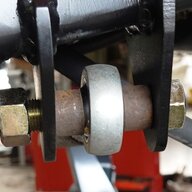
Clevite is the brand name on the rubber control arm ends we have in the stock TJ control arms. They are available in various degrees of hardness or durometer depending on application. The key point about that style of end is the rubber isolation element is bonded to the outer shell and the inner bolt sleeve.

Poly is typically short for polyurethane, a synthetic rubber that is also formulated in different levels of hardness or durometer. It can be as soft as a marshmallow or so hard that it will almost not give. The challenge is finding the right level of durability to work with the softest formulation for the most isolation with the highest level of wear resistance.

Poly is also sometimes slang for the engineering grade plastics used in control arm end races like UHMW, polyethylene, Acetyl, Delrin, etc.

Those are not cast products and have to be machined to their final shape generally. That isn't to say they can't be injection molded because many are, but that's an expensive process for joint races and low production numbers.
 
i have found that terminology is used loosely and a lot of times when asking about the type of ends on say a control arm you get brand name or what they have named it, instead of actual compound makeup.

In my case occasional trail rider and more road traveler a rubber bushing on one end and Johnny joint on the other for control arms may be the right combo for me. or maybe rubber on both ends.
Ive heard how good the Currie JJ is and several companies use them to make their on control arms, so im guessing the way Curries are manufactured and the compounds used to derive at Currie specifications is what makes theirs so good???
 
i have found that terminology is used loosely and a lot of times when asking about the type of ends on say a control arm you get brand name or what they have named it, instead of actual compound makeup.

In my case occasional trail rider and more road traveler a rubber bushing on one end and Johnny joint on the other for control arms may be the right combo for me. or maybe rubber on both ends.
Ive heard how good the Currie JJ is and several companies use them to make their on control arms, so im guessing the way Curries are manufactured and the compounds used to derive at Currie specifications is what makes theirs so good???
Rubber on one end and JJ on the other is pure mythology promoted by those that don't know crap about JJ's. There is no improvement in ride quality doing it that way and all you are doing is depriving yourself of a good joint.

JJs have a urethane race that is a mix of high durability and good isolation. It is a masterful display of the challenge I referenced above.
 
i looked closely at the Currie and the Savvy, and of course Savvy uses Currie JJ . one is Steel 1" DOM and the other is a hardened aluminum 6061-T651 @ 1.25" thick. Do you know if they are equally strong and are both a top of the line buy? I was looking at the rear upper control arms. for a 97 tj
 
What is your take on Metalcloak's duroflex joint @mrblaine? Any benefits over a JJ? Or are they trying to fix an issue that simply doesn't exist with their claims of superior NVH?
 
i looked closely at the Currie and the Savvy, and of course Savvy uses Currie JJ . one is Steel 1" DOM and the other is a hardened aluminum 6061-T651 @ 1.25" thick. Do you know if they are equally strong and are both a top of the line buy? I was looking at the rear upper control arms. for a 97 tj

You can't go wrong with either, I just prefer the Savvy's, since they are aluminum.

Make certain you get double adjustable uppers. It will make life so much easier when adjusting pinion angles. Believe me, the price difference is justified.
 
  • Like
Reactions: Eddie Greenlee
What is your take on Metalcloak's duroflex joint @mrblaine? Any benefits over a JJ? Or are they trying to fix an issue that simply doesn't exist with their claims of superior NVH?

Uh oh... You opened a huge can of worms here :D

In all seriousness though, Blaine and I have had this conversation before (though it was on the phone). I can't remember how it went, but Metalcloak has a video of them testing out the Duroflex joint, and Blaine had mentioned that that video is quite deceptive (or something along those lines).

I'll await Blaine's reply. I'm sure he can explain it in a professional manner.
 
  • Like
Reactions: PStov98TJ
I actually welcome a educational comparison of the JJ and Duroflex joints.

Because to be quite honest, I don't know what the exact differences are. Someone knowledgable like @mrblaine will likely have tested them both firsthand. Therefore he could point out the differences.
 
I actually welcome a educational comparison of the JJ and Duroflex joints.

Because to be quite honest, I don't know what the exact differences are. Someone knowledgable like @mrblaine will likely have tested them both firsthand. Therefore he could point out the differences.

I wish I had something knowledgeable to say here.
 
i looked closely at the Currie and the Savvy, and of course Savvy uses Currie JJ . one is Steel 1" DOM and the other is a hardened aluminum 6061-T651 @ 1.25" thick. Do you know if they are equally strong and are both a top of the line buy? I was looking at the rear upper control arms. for a 97 tj
For your application, does it matter which one is stronger? Have you ever heard of a bent rear upper?

I prefer the Savvy Double adjustable.
 
  • Like
Reactions: Eddie Greenlee
Well, I welcome the day that someone can do a side-by-side comparison of the two joints and put them through the same sort of tests. I'd be curious to see if either one of them has an advantage.

I've been using the JJ for years now though, and I absolutely love it.

No NVH to speak of!
 
Both provide a degree of misalignment, both are rebuildable(well, technically, you are replacing the Duroflex joint within the barrel, not rebuilding it), both provide a degree of NVH. Having run the Currie's in the front of my Jeep, then switching to Duroflex joints, I felt no noticeable difference. The JJ takes a little more work to rebuild, but costs less to do so, and the grease makes them messy. That's my take on it.
 
  • Like
Reactions: Chris
What is your take on them?
Having only ever run the rear upper Metalcloak control arms, and never a JJ, I have no basis for any comparison. Nor will replacing 2 of 8 control arms make any sort of a noticeable difference in anything other than the ability to adjust the pinion angle. So anything I have to say is purely speculation.

Personally, I don't see a control arm, regardless of the type of joint, making any sort of noticeable difference in ride quality. Because of the angle the control arms function at, the forces imparted through it would be somewhat minimal compared to those delt with by the spring and shock. Also, I really can't see the duroflex joint lasting Longer than a JJ simply because the way it is designed the joint seems to be under many more stresses than a JJ as the "rubber" (lack of a better term) twists and stretches with the movement of the control arm. I have no idea which joint has a higher misalignment, or if that even matters, as clearly the JJ has proven itself to have more than enough to function on even some of the most extreme rigs, although I believe a higher misalignment is another one of Metalcloak's claims to fame. More than likely, Metalcloak has made all these improvements on the JJ that Probably make almost no difference at the end of the day, but what do I know, these are all just random thoughts off the top of my head.
 
  • Like
Reactions: Jerry Bransford