
You are using an out of date browser. It may not display this or other websites correctly.
You should upgrade or use an alternative browser.
You should upgrade or use an alternative browser.

What tire pressure are people running for on-road driving?
- Thread starter funckmaster flash
- Start date

I think I may be the lowest: 22 PSI on 35" MTR's. Those sidewalls are stiff. I also have Bilstein shocks. So far, no kidney damage.


1997JeepTJ
Member

33s were at about 26psi. 35s are 24ish.
All of you with tires over 30psi are nuts.
All of you with tires over 30psi are nuts.

DickD1911
Member
When I got my 33's mounted it rode like a lumber wagon. Checked the pressure and realized the idiot at the garage had inflated them to 40psi. Lowering to 26 made all the difference.
When I got my 33's mounted it rode like a lumber wagon. Checked the pressure and realized the idiot at the garage had inflated them to 40psi. Lowering to 26 made all the difference.
Same experience. I got 32s installed and later noticed the shop filled them to 38psi. I dropped them to 26 and they feel much better
Mobusaki
TJ Enthusiast
It's kind of eye opening when you get your Jeep back from a mount and balance to find they inflated them to the max psi rating shown on the sidewall. Don't assume you know more than other people, but don't assume they know more than you either!
I have to tell you guys something......I would have never in a million years thought I would learn so much about something so little like tire pressure. And another thing I am very new to this whole jeep thing but I find myself learning so much from the people here. So I have to say thank you to everyone who chimes in on just about anything and everything. I have bought a shit ton of stuff in my life time and this might be the most favorite. Its bad when you stay awake at night looking for cool shit to buy.....looking at what everyone else is doing on this forum.....SO AGAIN THANK YOU!!!!
......I would have never in a million years thought I would learn so much about something . . . like tire pressure.
I run 12 on the beach....started at about 18 and just not like the way it handled. So far at the 12 seems to be alot better.
Your original question was about tire pressure on the street. Here is what a true expert on tire pressures and airing down has to say on the subject of airing down in the sand. I've been airing down in the sand for all of the 55 years I've been driving jeeps, and I learned something new when I received this article in an email a few weeks ago:
QUESTION: I’m planning a 4WD trip where there’s lots of sand. What do I do if I get stuck?
ANSWER: Relax, Mother Nature shows you what to do. She gave camels and polar bears big feet, so copy her. Give your 4X big feet by letting air out of the tires.
What I have learned through conducting more than 1.5 million injury free passenger miles worth of off road tours is that anything above 12 PSI will get you more vertical (undesirable) than horizontal (desired) travel in tough sand. This graphic shows air down-benefits and some words of caution:
Determine how this information works for you at home in the safety of your driveway. Also note that I have only extensively tested the above for 15 inch rims. Past tours and participants have had success using the percentages shown for 16 and 17 inch rims.
The procedure is to let the air out of your tires until you are at lower, rim-percentage height. Then measure your new sand tire pressure.
Regarding the rolling radius, it gives your 4X the equivalent of having lower gears. However, it is accompanied by disadvantages. It lowers your ground clearance and your 4X can more easily squish down into undercarriage damaging hazards. Stylish, low profile tires accentuate these issues even further.
When you leave the trail, you should keep your trip out to a compressor, wherever one is located, to below 10 MPH. Highway speeds at low pressure can lead to catastrophic tire failure or worse. Off road adventures should always be accompanied by safe and responsible driving.
https://www.coyoteents.com/stuck-in-sand/

I'm still seeking to understand - you guys that run 20-something on the street because its "more comfortable" - to me, that's about "half flat" and it affects handling in a negative way. Or at least, I don't like the feeling of soft sidewalls swaying - maybe that's just me. Granted, I didn't feel any difference between 40 and 32 on the Jeep and someone here pointed out that I wouldn't. But I *can* tell the difference between 32 and the 35 I run on the Mercedes - that car just feels better at 35.
I know Americans in general tend to like softer rides, hence Mercedes - and probably others - recommend lower pressures for this market; I think they recommend 26 or 28 in the front, and 32 in the rear if I remember correctly. Myself, I prefer a firmer "more controlled" ride, guess its because its what I grew up with - OTOH, I won't be racing around and "taking the curves" in the Jeep either! My dad always kept tires pumped up pretty firm as well.
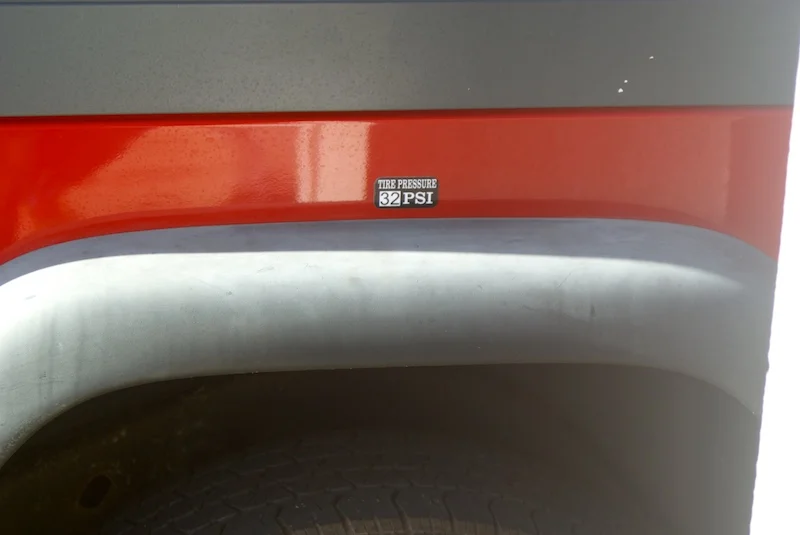
I'll now run 32 on the Jeep because I'm not feeling any difference with these tires on this vehicle, and the spare fits on its carrier better which is why I started asking questions in the first place. I solved the tire installer issue (although I'll still check):
I know Americans in general tend to like softer rides, hence Mercedes - and probably others - recommend lower pressures for this market; I think they recommend 26 or 28 in the front, and 32 in the rear if I remember correctly. Myself, I prefer a firmer "more controlled" ride, guess its because its what I grew up with - OTOH, I won't be racing around and "taking the curves" in the Jeep either! My dad always kept tires pumped up pretty firm as well.
I'll now run 32 on the Jeep because I'm not feeling any difference with these tires on this vehicle, and the spare fits on its carrier better which is why I started asking questions in the first place. I solved the tire installer issue (although I'll still check):
Here’s a pic of when I first put on my 35’s. Notice the gravel dust doesn’t extend across the width of the tire. Discount tire had them at 35psi or so. At 26psi I get a very nice contact patch.I'm still seeking to understand - you guys that run 20-something on the street because its "more comfortable" - to me, that's about "half flat" and it affects handling in a negative way. Or at least, I don't like the feeling of soft sidewalls swaying - maybe that's just me. Granted, I didn't feel any difference between 40 and 32 on the Jeep and someone here pointed out that I wouldn't. But I *can* tell the difference between 32 and the 35 I run on the Mercedes - that car just feels better at 35.
I know Americans in general tend to like softer rides, hence Mercedes - and probably others - recommend lower pressures for this market; I think they recommend 26 or 28 in the front, and 32 in the rear if I remember correctly. Myself, I prefer a firmer "more controlled" ride, guess its because its what I grew up with - OTOH, I won't be racing around and "taking the curves" in the Jeep either! My dad always kept tires pumped up pretty firm as well.
I'll now run 32 on the Jeep because I'm not feeling any difference with these tires on this vehicle, and the spare fits on its carrier better which is why I started asking questions in the first place. I solved the tire installer issue (although I'll still check):
View attachment 175561
Looks nice - I am, of course, talking about on-road only - and "normal sized" tires as I have yet to put larger tires on mine - this certainly isn't happening with my current stockers. But you gave me something to look for when I do! {BOW HERE}
I'm still seeking to understand - you guys that run 20-something on the street because its "more comfortable" - to me, that's about "half flat" and it affects handling in a negative way. Or at least, I don't like the feeling of soft sidewalls swaying - maybe that's just me. Granted, I didn't feel any difference between 40 and 32 on the Jeep and someone here pointed out that I wouldn't. But I *can* tell the difference between 32 and the 35 I run on the Mercedes - that car just feels better at 35.
I know Americans in general tend to like softer rides, hence Mercedes - and probably others - recommend lower pressures for this market; I think they recommend 26 or 28 in the front, and 32 in the rear if I remember correctly. Myself, I prefer a firmer "more controlled" ride, guess its because its what I grew up with - OTOH, I won't be racing around and "taking the curves" in the Jeep either! My dad always kept tires pumped up pretty firm as well.
I'll now run 32 on the Jeep because I'm not feeling any difference with these tires on this vehicle, and the spare fits on its carrier better which is why I started asking questions in the first place. I solved the tire installer issue (although I'll still check):
View attachment 175561
Larger tires require fewer psi to support the vehicle.
My TJ weighs about 4200lbs. Here is some quick and dirty math.
4200lbs/4 tires = 1050lb per tire
1050lb / 24psi = 43.75 sq.in.
That's about a 10 x 4.375" contact patch.
Now, go out look at your 35" tires as they sit in the ground. Should be close.
This is good to know - which is why I ask the questions. I currently only have the stock 29s, I'll obviously need to re-evaluate when I go to the planned 31s.Larger tires require fewer psi to support the vehicle.
My TJ weighs about 4200lbs. Here is some quick and dirty math.
4200lbs/4 tires = 1050lb per tire
1050lb / 24psi = 43.75 sq.in.
That's about a 10 x 4.375" contact patch.
Now, go out look at your 35" tires as they sit in the ground. Should be close.
This is good to know - which is why I ask the questions. I currently only have the stock 29s, I'll obviously need to re-evaluate when I go to the planned 31s.
Monster trucks only run single digit psi in their tires because the contact patch is so large.
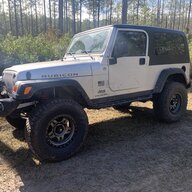
When I got my metric 35 inch KO2s from Discount tire a couple of weeks ago they were at 35-37! I figured they would be over pressurized and fixed it when I got home but they did not seem to be terrible at that pressure. 27 now.All of you with tires over 30psi are nuts.
When I got my metric 35 inch KO2s from Discount tire a couple of weeks ago they were at 35-37! I figured they would be over pressurized and fixed it when I got home but they did not seem to be terrible at that pressure. 27 now.
Whenever I go in for a balance, I just assume that I will be draining air out of the tires in the parking lot. It's easier than trying to explain to a different kid each time. Sometimes a manager will come out and ask why and then we'll talk about it.
Similar threads

- Replies
- 5
- Views
- 1,271


- Replies
- 7
- Views
- 1,415

- Replies
- 7
- Views
- 2,852


- Replies
- 20
- Views
- 3,294


