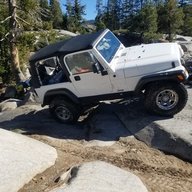
The difference is that I can use two different shocks, properly sized in length for the application and commonly available (say a rancho 5000x and a bilstein 5100) and they will ride MUCH differently. Certainly it will be something someone will notice.The manufactures also make the shocks. Following your line.... shocks don't matter. Any shock that correctly fits your Jeep is made to work properly. Ergo shocks don't matter.
Yet they do. They all vary in their valving the same way springs vary in their travel rates. THEY BOTH MATTER. Irregardless how soft a spring, a shock with too stiff valving will restrict it from moving. Irregardless how soft a shock valving, a spring with too high a rate (for YOUR application) won't compress.
I think the springs are fine if you are happy with the ride height. You just need the next size up shocks for the rear.
Won't compress (AS MUCH)Who sells TJ springs that won't compress?
Assuming you have functioning jounce bumpers (the spongy cushion thingy in the top of the steel cup), measure how much up you have until the lower spring pad hits the jounce bumper. Keep in mind, the jounce bumper compresses almost to the steel cup under hard events. If you have added more bump stop extension, this will decrease the amount of up you have under normal driving conditions. You need a symbiotic relationship between the amount of up your shocks will give you and the amount of up you can get under free spring compression before hitting the jounces.

They are in there and intact. I did add bump stops at the rear and cycled the suspension during the lift install. Took a quick measurement now, to the bottom of the jounce and the coil pad its ~4". From the coil pad to the metal cup lip/opening (where jounce slides into) ~6". The rear bump stop extension was approx. 2" I used round aluminum stock.
The bottom of the jounce is irrelevant. Measure between the cup and pad.