How much stronger is crossover steering?

i see that . ya know I respect anyones opinion. Myself? i just like knowing the WHY and HOW things work , it just intriques me . I have never been one to just accept a one word answer.
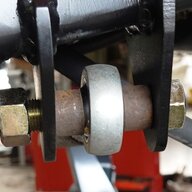
Alright, a few basics. Crossover or a knuckle to knuckle tie rod is inherently prone to death wobble. The inverted Y was invented by a gent named Haltenberger to combat that by providing a disconnect or not direct connection between the two knuckles. It is not and should not ever be confused with inverted T where the draglink connects to the tie rod. There is no way to control or limit tie rod roll when steering input is delivered to the tie rod. Key point and one that is oft overlooked by the steering ignorant is if there was no need for angular misalignment between the ends of the two steering arms, we would simply use bolts, straight hole rod ends, suitable bushings and stop it that way cheaply and effectively. The reason we don't do that and instead band-aid it with various implements is steering axis inclination. That is defined by the upper and lower ball joints being inclined or leaned inward which is easy to see when viewed from the front or back of the Inner C. SAI causes one steering arm to rise and the other to lower every time the knuckles are turned. That also means we have to have some sort of ball joint in the rod ends or tie rod end to prevent binding. That causes the tie rod to roll to the limit of the misalignment at each occurrence of steering effort input. A vague spot at the center of the steering wheel is the result since there is nothing to stop the tie rod from rolling long term and can't be.

As to which is stronger, that really isn't the correct question. The correct question is whether or not the commonly available options like the Currie and similar are strong enough and the answer to that is absolutely for anything up to and including 35" tires.

No properly designed and installed hydro-assist should be able to be noticed in normal or trail driving with the single exception of being able to turn where you couldn't before. The rest of the characteristics should be wholly invisible with no ability to discern the existence of assisted steering under any normal driving conditions.
 
Last edited:
Alright, a few basics. Crossover or a knuckle to knuckle tie rod is inherently prone to death wobble. The inverted Y was invented by a gent named Haltenberger to combat that by providing a disconnect or not direct connection between the two knuckles. It is not and should not ever be confused with inverted T where the draglink connects to the tie rod. There is no way to control or limit tie rod roll when steering input is delivered to the tie rod. Key point and one that is oft overlooked by the steering ignorant is if there was no need for angular misalignment between the ends of the two steering arms, we would simply use bolts, straight hole rod ends, suitable bushings and stop it that way cheaply and effectively. The reason we don't do that and instead band-aid it with various implements is steering axis inclination. That is defined by the upper and lower ball joints being inclined or leaned inward which is easy to see when viewed from the front or back of the Inner C. SAI causes one steering arm to rise and the other to lower every time the knuckles are turned. That also means we have to have some sort of ball joint in the rod ends or tie rod end to prevent binding. That causes the tie rod to roll to the limit of the misalignment each at each occurrence of steering effort input. A vague spot at the center of the steering wheel is the result since there is nothing to stop the tie rod from rolling long term and can't be.

As to which is stronger, that really isn't the correct question. The correct question is whether or not the commonly available options like the Currie and similar are strong enough and the answer to that is absolutely for anything up to and including 35" tires.

No properly designed and installed hydro-assist should be able to be noticed in normal or trail driving with the single exception of being able to turn where you couldn't before. The rest of the characteristics should be wholly invisible with no ability to discern the existence of assisted steering under any normal driving conditions.
other than a phone call YES ive been reading this with a stock steering diagram infront of me several times. thanks for the definiations.
 
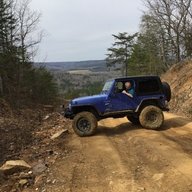
I stand corrected you are right it was an inverted t, not y. You are correct, in the beginning I had no idea what pieces went with what. The stock steering geometry is not ideal for hydro assist (based on the research i've done and the people i've talked to ) But since the inverted t is better suited for the assist. I had problems with my currie with bumpsteer and hitting the ox locker diff which is thicker than stock so my problems came from pieces not fitting together. But to talk about track bar. I made my own since I made my mounts (axle side and frame side) to allow the bar to be the same length as my custom drag link. Had to make the custom drag link since I made my own frame in the front. I raised the frame and got rid of the front body mount under the grill, took an inch out of the whole front clip, inch out of the steering shaft, rotated my steering box, and made my own pitman arm (similar to the genright one but mines not rotated like theirs) . The whole front end is completely custom besides copying the ruff stuff inverted t set up . and @jjvw my front axle isn't pushed forward, arms are set at stock length and hence why I cut an inch out of the front clip to help the tires clear the back of the fenders
View attachment 213003Stock frame cut
View attachment 213004 starting the front half
View attachment 213005 inverted t
View attachment 213010View attachment 213011 cut out an inch
View attachment 213007 track bar installed
View attachment 213008 View attachment 213012View attachment 213013seems to work pretty well my opinion
View attachment 213009 and sits lower than my buddies on 35's with a 4 inch lift so I think its set up pretty well for rock crawling and daily driving.

And to answer the op, if you are looking for a new steering setup, i personally recommend the inverted t. Both jeeps in the bottom pic are daily driven with it and we both have no complains and both run no stabilizer. (My hydro comes off when the jeep gets home from the trail)

Checking all the boxes in one post. Even got the concrete blocks set up as expected.