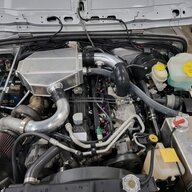
Modification of OEM Air Box

Y'all think a Ford bottle and paper filter might hinder air flow vs a stock TJ box and paper?

fairly sure it came off an intake sys for at least a 6 cyl, so i didn't even think about it .
 
That's what was used for all motocross bikes in the old days (90s). Oil stops dirt from entering and air too. Didn't effect anything back then when people didn't know any better. People listen to too much internet shit and believe half of it. How else can Biden/Harris be explained?

I have a feeling you haven’t seen an oil bath filer before. Don’t think they would be great in a motor cross environment due to jumps etc lol


1633033398938.webp
 
So I was looking at this blog: (https://jeepm62superchargerkit.blogspot.com/p/blog-page_15.html). It has a whole bunch of dyno results on stock and modified 4.0Ls (including strokers and boosted engines) sent in by readers which are interesting. It also has the reprinted dyno results of an April 2008 JP Magazine intake shoot out that would seem to suggest there ARE some modest gains to be had with intake upgrades (10-13hp and 9-10 ft.lbs.). This seems to refute the idea that the stock airbox and paper filter flow more than the 4.0 can ingest. They used an 01 TJ 4.0, 5-spd as their test mule. Have you seen this @Jerry Bransford?View attachment 280466
Nope, those numbers aren’t big enough to measure. That difference in HP can be chalked up to nothing more than variables such as time of day, ambient temp, engine temp, etc.

JP magazine is also getting paid by sponsors to promote garbage like intakes. They aren’t going to tell you they’re useless. Their sponsors would like you to buy them.
 
I've only had any of my vehicles on dynos 3 times (so minimal). Looking over those results, 2-3% variation between pulls was typical. The JP test showed 9% variance in HP. I agree financial bias must be considered. I also agree the results do NOT support any effect of a TB spacer. Personally, my butt dyno has never said intake mods made a difference on any vehicle and currently I have stock air boxes and paper filters on all my rides, including my TJ. Just food for thought/conversation.
2-3% on that day. Go back another day with a different temp and barometric pressure and humidity and see if you can duplicate the results. Pretty hard to do. Also why the typical dyno session includes several runs averaged out.

You could easily do 5 stock runs, do 5 with the filter, pick the lowest stocker and the highest mod run and make some really good claims. Not reality, but good claims nonetheless. That and if the factory could get a 10% horsepower boost with an air filter, they'd be all over that.
 
I've only had any of my vehicles on dynos 3 times (so minimal). Looking over those results, 2-3% variation between pulls was typical. The JP test showed 9% variance in HP. I agree financial bias must be considered. I also agree the results do NOT support any effect of a TB spacer. Personally, my butt dyno has never said intake mods made a difference on any vehicle and currently I have stock air boxes and paper filters on all my rides, including my TJ. Just food for thought/conversation.

+1

The notion that the stock intake "flows more than the 4.0 can use" is overly simplistic, much like discussions on carb sizing. We're talking fluid flow here, not discrete solids. It all creates restrictions that affect power. Maybe not enough to easily measure. Probably not enough to be worth the cost of upgrading, or in reduced filtration efficiency. But it is possible to improve on the factory setup.
 
The unrestricted (open) made more HP than factory but not as much as aftermarket filter media. Interesting.
 
Dynos are not the precise instruments some have been lead to believe they are. Not even close.
Depends on the dyno. I have an old 248 Dynojet that will lay all the traces within 1-2hp of each other on a consistent car. It's an old simple dyno that only relies on the mass of the drum and an optical sensor. Other units that use eddy load cells, multiple rollers, belts, etc. have a higher margin of error. That is assuming of course all other factors remain relatively constant.
 
  • Like
Reactions: Woodrow
The general consensus among most major tuners I've found is that a Mustang dyno is the one they prefer since it doesn't tend to overreport like others do.

I've had many vehicles on the dyno. It is not uncommon whatsoever to see differences sometimes up to 10 HP or more on the same day, back-to-back. Again, there are so many variables to consider for why this is. The bottom line though is that if an advertiser says their intake provides a 5-10 HP gain, they are saying that for a reason. Because they know damn well that you can't measure that sort of a gain with any sort of realistic results.

It helps to understand from the get go that while some vehicles suffer from restricted air intakes, the TJ is simply not one of them.

It's also helpful to understand that if you want more air into your engine that can equate to more power. However, it needs to be done in conjunction with a bigger intake, ported plenum, ported heads, tuning, etc.

An engine is a gigantic air pump. Simply opening up the air box a little will do absolutely nothing in most cases. Same thing as putting on a bigger throttle body. Why? That doesn't change the fact that the rest of the air intake path is still corked off.

 
Tuners like Mustang dynos because they are easy to manipulate the numbers on.
 
This picture was posted last night and now I see there are three more pages of this thread. I just went to the refrigerator for another Diet Coke while I read.
I'm on my third bag of popcorn
Can't believe I read six pages of banter. You guys are hysterical, but I want the last fifteen minutes of my life back.

That said.. I am afraid EVERY TIME I hit Post Thread
 
Last edited:
  • Haha
Reactions: srimes and chimmike
So dirt goes in, air/gas/dirt mixture explodes, exhaust valve opens, exhaust leaves. Correct so far?
To an extend, you are correct.
However not all the dirt/debris will be expelled out the exhaust. Small amounts can mix with the sludge in the ring groove and act as an abrasive. Slowly it can cause damage to the rings, piston and the cylinder bore.
Eventually the engine will start to consume oil and have increased blowby.
Will it cause catastrophic engine failure, probably not.
 
  • Like
Reactions: chimmike
To an extend, you are correct.
However not all the dirt/debris will be expelled out the exhaust. Small amounts can mix with the sludge in the ring groove and act as an abrasive. Slowly it can cause damage to the rings, piston and the cylinder bore.
Eventually the engine will start to consume oil and have increased blowby.
Will it cause catastrophic engine failure, probably not.
You've seen the same dirt from a K&N in the air tube and throttle body, no?