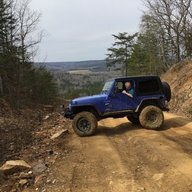
Any reason I should not run wheel spacers on my Dana 30 and ford 8.8
They are Synergy1.25 thick spacers and they are hub centric.
Thanks !
They are Synergy1.25 thick spacers and they are hub centric.
Thanks !



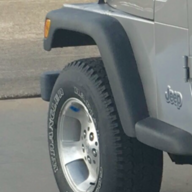

Now you can’t just whip out that statement to me without explaining why that happens. It helps me to understand your reasoning. Thanks.Cause your scrub radius will be turned to shit. Steering and handling will go down the toilet. But nobody here cares. Carry on

Thanks !!You can run spacers, without issues. People do it all the time. You do need to be diligent about checking torque. How wide a spacer are you thinking?
The scrub radius thing can be a factor if you go to extremes. I wouldn't run anything less than 3.75 inches of effective backspacing (backspacing of the wheel plus minus the spacer). For instance...I have JK wheels on my TJ. They have a designed backspace of 5.25." My adapters are 1.25" thick, so my effective backspacing is 4" (5.25-1.25)
Do some Google searching on scrub radius. It's basically the distance from the center of your tire to the imaginary point on the road where the steering axis intersects. The larger (or smaller) scrub radius is, the more the tire will "scrub" when you need to turn. Larger tires will affect scrub just like going with a wider wheel with less offset.
Making a blanket statement like "handling and steering will go to shit" is simply not true. It might... But there are 100s of people here running big tires on less than factory backspacing without issue.
Thanks for your explanation!! The more I read it the more I get out of it.Here...this is a pretty decent explanation of SAI and Scrub radius, taken from another forum
Steering axis inclination - This is the angle that runs through the centers of your ball joints down to the ground when viewing it from the front of the vehicle(same way you view camber). Do NOT get this confused with camber, it is the angle of the wheels in relation to each other, SAI is through the ball joints to the ground. While the angle itself isn't necessarily important, where it lands on the ground is. It ideally will end up right in the center of or slightly inside of the contact patch of the tire, resulting in a small scrub radius.
http://img.photobucket.com/albums/v294/flatlander757/Misc/sai-scrub.gif
The scrub radius is measured from the tire centerline to the point on the ground that intersects the SAI angle. This should be an inch or two wide ideally (from what I have gathered). Any more would cause excessive steering effort/feedback and too close to zero kills nearly all feeling of the road causing a very unstable feeling. It is the single point of SAI on the ground that the tire actually wants to pivot on (or the pivot radius).
http://img.photobucket.com/albums/v294/flatlander757/Misc/scrubradius.gif
The scrub radius and pivot radius are affected by larger tires and aftermarket wheels with [numerically] less backspacing. I'm not necessarily sure as to whether TJs have a positive or negative SAI in stock form, I would have to guess negative (SAI intersects ground OUTSIDE of center of tire contact patch). Mainly because that is pretty much the norm for every vehicle I've seen. Reason that the pivot radius is generally on the OUTSIDE of the tire contact patch center line is because the road will not have as much leverage on the wheel. Also should a brake caliper seize on one side, a positive scrub radius/pivot radius will transmit less force back through the steering wheel. In general both positive and negative have the same effects on steering stability and feel, except negative SAI will result in more feedback and will be more likely to follow imperfections in the road.
It is possible that with small tires(30") and aftermarket wheels(say less than 4.5" of backspacing) that you would be putting steering stability in jeopardy; reason being as you are moving the wheel centerline outwards, the SAI stays the same, and keeping tires the same or similar diameter, causes a smaller scrub radius. The scrub radius should remain fine provided you have larger tires AND less backspacing to keep the steering pivot point similar in relation to the tire centerline.
Now that I think about it, this also explains why my TJ on 33" tires w/ stock offset (5.5") wheels has a relatively strong return to center feeling in comparison to stock TJs.
For all intents and purposes, the SAI is not adjustable. Here is an excerpt from my 03 TJ FSM:
STEERING AXIS INCLINATION ANGLE is
measured in degrees and is the angle that the steering
knuckles are tilted. The inclination angle has a
fixed relationship with the camber angle. It will not
change except when a spindle or ball stud is damaged
or bent. The angle is not adjustable, damaged
component(s) must be replaced to correct the steering
axis inclination angle
Why the Caster line/SAI points where it does:
Technically SAI and caster are different angles, but they are also one in the same(SAI is viewed from the front of the vehicle, caster is viewed from the side).
These angles are each laid out in two separate dimensions (think of SAI being measured along the X and Y axis, and caster on the Y and Z axis in 3 dimensions).
While I can't explain the scientific reasoning with numbers and formulas and stuff (I'm sure you know though), it works the exact opposite way that shopping carts' front wheels are set back.
The shopping cart has it's wheels set behind the pivot's centerline as it is the cart that determines where the wheels go.
In vehicles, it is the wheels that we need to determine where the vehicle goes(ie, the vehicle shouldn't control what the wheels do). Because of this, the caster is set to put the wheels' pivot radius in front of the axle and tire contact patch centerline.
Ever ride a bicycle with the handlebars turned backwards? It is much less stable and it makes it far more difficult to ride with no hands.
I see it like this: the weight of the vehicle is supported by the front and rear tires. With the caster pointed behind the contact patch centerline, the vehicle weight makes the front wheels want to pivot about the steering axis causing instability.
With the caster pointed in front of the contact patch centerline(like it is supposed to be), the vehicle weight keeps pressure on the steering axis, and with the caster behind, it is naturally going to want to self-correct steering itself to some degree.
Kind of hard to explain, but from the side, draw a triangle from the upper ball-joint, to the tire contact patch centerline, and to the point on the ground at which caster intersects. The weight is supported by the ball joints, and thus is transferred to the wheels through them, so with the weight being pushed from the upper ball joint to the caster/ground point, you can see why a super low caster angle would want the steering axis to rotate about itself.

Not sure about the presumably Yukon c-clip elim I thought he installed (don’t think there are other brands) but back in the day the superior kit that Yukon copied basically made up for the lack of 8.8 width once the housing end adapters were added on. So it might not be a problem though I’m not 100% sure on that.We agree that the front does not need a spacer. What about on the 8.8 rear axle, which is narrower than stock?
Doesn’t installing the c-clip eliminator extend the width of the axle back to original width if a stock tj axle ??We agree that the front does not need a spacer. What about on the 8.8 rear axle, which is narrower than stock?
Doesn’t installing the c-clip eliminator extend the width of the axle back to original width if a stock tj axle ??
The kit eliminates the factory c/clips and increases the overall axle width 1" per side.
It probably would help with outboarding rear shocks. But will probably outboard first then determine if 8.8 needs spacers.We agree that the front does not need a spacer. What about on the 8.8 rear axle, which is narrower than stock?
