Coolant boiling in overflow

Brad in FLA

New Member
Original poster
Joined
Feb 26, 2019
Messages
6
Location
Florida
Primary issue is after driving the coolant in the overflow tank is boiling/bubbling. The temperature gauge is slightly elevated but definitely not in the red zone. I have just now replaced radiator cap, thermostat and fan clutch and issue remains. Water pump and radiator were replaced 2 yrs ago. Typically occurs when I have the A/C on. No sign of oil in the coolant or coolant in the engine oil. When starting a cold engine with the radiator cap off - there are no bubbles and when the engine begins to warm up coolant begins to rise and slowly overflow from the missing cap location. Thoughts , suggestions and hopefully answers would be greatly appreciated as I am stumped. Many thanks

4.0 engine / automatic transmission

 
Just a possibility, You may have air trapped in the system. It’s common when draining/filling or working on the cooling system. Remove the cap when cold and start engine letting it warm up to where you see the coolant circulation in the radiator. I squeeze and release the upper radiator hose several times to help move air out of the system. if the radiator is full to the bottom of the opening it may push a little coolant out with the air. You will see the coolant level in the radiator fluctuate up and down as it circulates and pushes air out. I have not had that issue again since following this process.
 
EF57FFE2-5C81-45D6-86C4-060F6EC5C2E7.webp

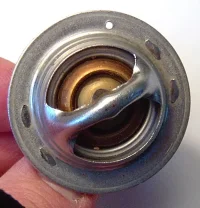
On the T-stat (we) usually drill a hole for it to burp.
If it’s boiling it’s not full
 
Just a possibility, You may have air trapped in the system. It’s common when draining/filling or working on the cooling system. Remove the cap when cold and start engine letting it warm up to where you see the coolant circulation in the radiator. I squeeze and release the upper radiator hose several times to help move air out of the system. if the radiator is full to the bottom of the opening it may push a little coolant out with the air. You will see the coolant level in the radiator fluctuate up and down as it circulates and pushes air out. I have not had that issue again since following this process.
Thanks Matt - just did what you suggested and then took it on a short but aggressive drive - temperature gauge never went above 211 or 212 and when came back home all seemed to be good. Shut engine off and then a minute or 2 later……overflow began bubbling.
 
Last edited:
Thanks Matt - just did what you suggested and then took it on a short but aggressive drive - temperature gauge never went above 211 or 212 and when came back home all seemed to be good. Shut engine off and then and minute it 2 later……overflow began bubbling.

My son and I been through the same scenario on our Jeeps that you’re describing. For us it has always been air in the system. It may take a couple attempts to get all air out. Let it run awhile with the cap off and increase rpm’s using the throttle body and watching the coolant level. Don’t be I a hurry, this takes a little time. Make sure the coolant level is full when done.
 
I take it the reservoir was bubbling before you replaced the T-Stat? Make certain you’ve purged any air from the system. Parking on a decent incline and running it without the cap will also allow the air to rise to the high point at the radiator fill. The thermostats bleed is always a good idea to prevent trapped air pockets which can be stubborn to bleed.
My next move would be to pressure test the system. A small leaking head gasket or crack may not rear its ugly head until warm. Test under both conditions.
 
I take it the reservoir was bubbling before you replaced the T-Stat? Make certain you’ve purged any air from the system. Parking on a decent incline and running it without the cap will also allow the air to rise to the high point at the radiator fill. The thermostats bleed is always a good idea to prevent trapped air pockets which can be stubborn to bleed.
My next move would be to pressure test the system. A small leaking head gasket or crack may not rear its ugly head until warm. Test under both conditions.

Yup - same issue prior to replacing thermostat. Thanks for info/insight
 
My son and I been through the same scenario on our Jeeps that you’re describing. For us it has always been air in the system. It may take a couple attempts to get all air out. Let it run awhile with the cap off and increase rpm’s using the throttle body and watching the coolant level. Don’t be I a hurry, this takes a little time. Make sure the coolant level is full when done.

Understood - I will keep trying - thanks
 
If it is air In The system causing this then your coolant level will drop as the air escapes. If it continues to bubble without dropping the coolant level you may want to do a test for combustion gas in your coolant.
 
  • Like
Reactions: ColoJeep
Hmmmm I’m unfamiliar with this - is there a potential downside to this? Do any thermostats already come with the hole? Thanks

They used to come with the hole but there is no downside to having the hole.
Hole should be at the top

Edit
I also drill the hole towards where the T-stat opens so the hole doesn’t interfere where it seats in the housing
 
Last edited:
Most common cause of bubbling or boiling in the overflow is a bad radiator cap. The center spring corrodes and breaks so the center part doesn't seal so the system doesn't hold pressure. Check the cap, especially the little center part that is spring loaded. If it's loose and free it's probably busted and causing your issues.
 
  • Like
Reactions: Thunderhead and R49
After replacing the heater core in my Jeep, I played hell getting the air out of the system. I finally picked up a radiator purge funnel kit like this: https://www.eastwood.com/eastwood-c...kedid=580522474071&wickedsource=google&wv=3.1
This made the job super easy. Mine wasn't overheating, I just wasn't getting good heat.
When I was boiling coolant in the overflow, I was overheating due to a worn fan clutch, but it sounds like you replaced that already.
And just like you, when the Jeep was boiling over, the temp gauge had barely moved. I switched to an OBD reader and the Torque app on my phone and the actual temp was much higher than the gauge was indicating. I don't trust that gauge much anymore.