
You are using an out of date browser. It may not display this or other websites correctly.
You should upgrade or use an alternative browser.
You should upgrade or use an alternative browser.

Does weight help in the snow?
- Thread starter Zedd
- Start date

Anyway you could describe what that feels like so I know? Or what I wouldnt feel/hear? EtcSo long as your back tires aren't slipping it's fine to pull the transfer case into 4hi on the move. Just coast while you do it to make sure all the tires are spinning at the same speed.
xxdabroxx
TJ Addict
Nimbley
TJ Enthusiast
Really if you’re worried about it just put it in 4 hi before you start driving. It’s not going to hurt anything to drive in 4hi. The key is watching your speed. 4 wheel drive helps you get started and steer but doesn’t help much for stopping. If the tires start to skid let off the brakes. It might be hard to get used to doing that at first but it’s the only way you’ll have any steering control.
Thank you. Good advice. I’m sure I’ll be fine, but I wanted to know all the just in case infoReally if you’re worried about it just put it in 4 hi before you start driving. It’s not going to hurt anything to drive in 4hi. The key is watching your speed. 4 wheel drive helps you get started and steer but doesn’t help much for stopping. If the tires start to skid let off the brakes. It might be hard to get used to doing that at first but it’s the only way you’ll have any steering control.
Nimbley
TJ Enthusiast
PatMc
TJ Enthusiast
Idk what number followed by # that means
He was summoning the old people, but put the hashtag on the wrong end.
Fuckin' kids these days.

4 wheel drive helps you get started and steer but doesn’t help much for stopping.
4wd can help with braking. Not only do you get 4 wheel engine braking, but it keeps all four wheels turning the same speed, which keeps any one wheel from locking up. Also, there is a front bias, so having it in 4wd allows the extra front braking to aid the rear wheels.

4WD as soon as you hit snow. Shift on the fly is the best way... especially with the automatic. Read the manual, watch the Jeep videos at jeep.com
4WD because you have lots of weight on the front axle. I often shift into 2WD entering a parking lot or parking stall since 4WD will try to push you in a straight line. Shift on the fly works.
Anticipate when you need to shift and do it early while driving straight on level ground. Shifting into 4WD will be instant but shifting back to 2WD will only happen once there is no binding in the transfer case gearing. It should be fairly instant and consistent if you are driving straight but not if you shift into 2WD while turning, which creates a bind..... easiest way to remove that bind is by turning gently the other way.
4WD because you have lots of weight on the front axle. I often shift into 2WD entering a parking lot or parking stall since 4WD will try to push you in a straight line. Shift on the fly works.
Anticipate when you need to shift and do it early while driving straight on level ground. Shifting into 4WD will be instant but shifting back to 2WD will only happen once there is no binding in the transfer case gearing. It should be fairly instant and consistent if you are driving straight but not if you shift into 2WD while turning, which creates a bind..... easiest way to remove that bind is by turning gently the other way.
Last edited:

Fughuert
TJ Enthusiast
Pick ups have retarded weight bias to the front so it makes sense for them to throw some weight in the bed while empty.the back seat weight is not gonna make a significant difference.
look at pick-up's, they put several heavy sand bags in the rear for weight.
maybe a couple 80# tubes of sand along each wheel well in the rear. but 60# ain't really gonna help.
this is what 2wd vehicles do. weight over the drive wheels.
we have that funny 4wd thing, that tends to negate the need for this extra weight.
and it also works 2 directions. the weight helps get you going, but you also have to stop it. extra 300# of momentum when you hit that ice patch.
I would argue tjs don’t need it at all since we’re pretty close to a 50/50 bias as is, and we have that 4wd thing.
No weight in the rear and you loose traction, too much rear bias and now you have a pendulum.
Pick ups have retarded weight bias to the front so it makes sense for them to throw some weight in the bed while empty.
I would argue tjs don’t need it at all since we’re pretty close to a 50/50 bias as is.
I don't remember seeing an engine (or transmission) in the rear of my Jeep.
You should practice, so You will know what it feels/sounds like. Especially on the fly. What if you're on the highway and it changes from clear to snowy or vice versa. Not always time or a place to pull over.Anyway you could describe what that feels like so I know? Or what I wouldnt feel/hear? Etc
The rear seat weighs so little that it makes almost no difference one way or the other. It seems to me that adding weight for travel on snow is a good thing as long as the idea is to equally weight the front and rear axles. It works for pickups because their empty weight distribution is heavily biased toward the front. Jeeps? I don't know how they are biased. And no, adding a few hundred pounds won't significantly increase stopping distance. The added weight is somewhat (completely?) compensated for by the increased ground pressure.
That doesn't make any sense.i don't ever engage mine on the fly , but that's just me.
READ YOUR MANUAL !!!I’m sure I’ll be fine, but I wanted to know all the just in case info
That is your best source of info.
Fughuert
TJ Enthusiast
Ya that’s how vehicle weight distribution works...I don't remember seeing an engine (or transmission) in the rear of my Jeep.
Simple googling will show some we’re right around 50/50 and SE (like op has) being lighter up front than rear by some scales.
Do m3’s have two engines? Miatas? Corvettes? Well the vette’s have a rear transaxle but you get the point.
Speaking from experience of driving in many years of snow in a Jeep TJ and LJ:
1) Don't worry about shifting between 2hi and 4hi. Depending on the road, I've been known to do it several times per minute.
2) You don't need weight in the back once you learn how the Jeep handles and assuming you have good winter tires. A Jeep works best when it floats and doesn't dig.
1) Don't worry about shifting between 2hi and 4hi. Depending on the road, I've been known to do it several times per minute.
2) You don't need weight in the back once you learn how the Jeep handles and assuming you have good winter tires. A Jeep works best when it floats and doesn't dig.
This ^Speaking from experience of driving in many years of snow in a Jeep TJ and LJ:
1) Don't worry about shifting between 2hi and 4hi. Depending on the road, I've been known to do it several times per minute.
2) You don't need weight in the back once you learn how the Jeep handles and assuming you have good winter tires. A Jeep works best when it floats and doesn't dig.
xxdabroxx
TJ Addict
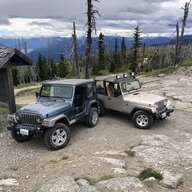
Air down if you need to and don't be afraid of switching on the fly. It doesn't look like much here but the shady spots had fairly deep snow.
Aired down to 8psi used my locker some and had to get a run at a couple spots on this road today.
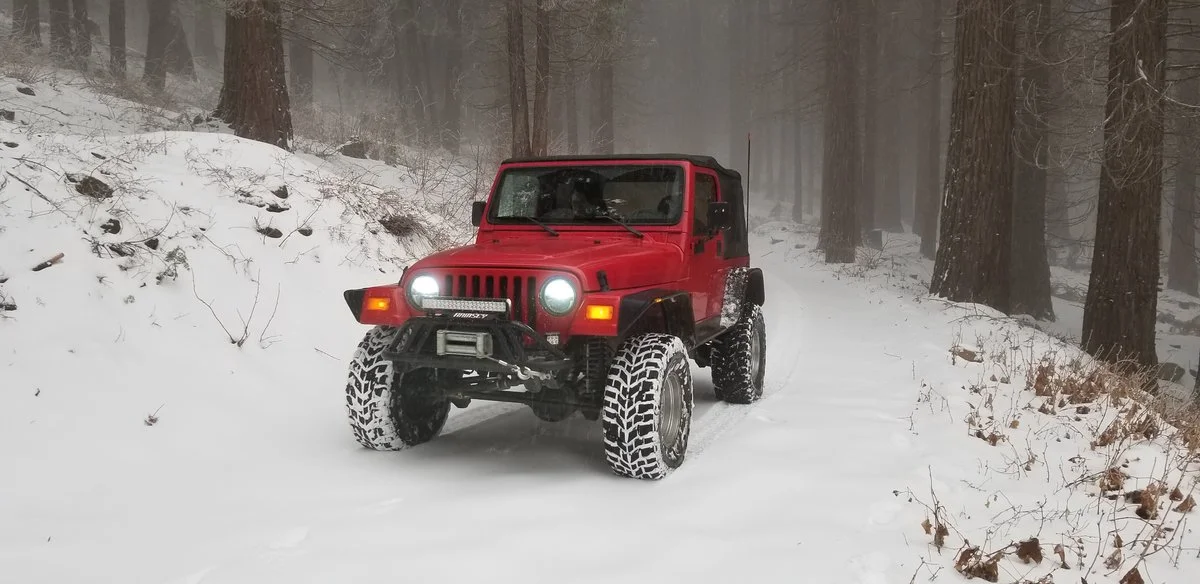
Aired down to 8psi used my locker some and had to get a run at a couple spots on this road today.
Similar threads

- Replies
- 48
- Views
- 15,603


- Replies
- 16
- Views
- 13,423

- Replies
- 16
- Views
- 3,384

- Replies
- 6
- Views
- 5,962

