Novak Conversions Jeep Wrangler TJ radiator

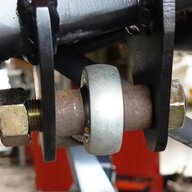
Double shear trackbars

The link behavior is the same.

If you mounted one joint of a control arm vertically instead, it would limit the travel on that side would it not? Having both ends mounted horizontally allows the link itself not to be a limiting factor in up and down travel, thus allowing the wheelbase to increase and shrink during that travel. Therefore it stands to reason that having a trackbar with two horizontally mounted ends, would also allow the axle to travel enough to shift it side to side during its normal travel. Maybe I'm wrong, but I guess the actual issue is the trackbar being horizontal mount, and not the joint thats being used itself.
 
Agreed, a double sheer track bar is a bad idea.

Looks like you ran a double shear back in 2015 (https://wranglertjforum.com/threads...est-clearance-on-a-wrangler-tj.340/#post-5251). But then sold it for a currie. Just curious what the problems are/were. Aside from what @tworley mentioned. So in other words, is a double shear style like the OP has so bad it warrants cutting off and welding on new OEM style frame side mounts?


If you mounted one joint of a control arm vertically instead, it would limit the travel on that side would it not? Having both ends mounted horizontally allows the link itself not to be a limiting factor in up and down travel, thus allowing the wheelbase to increase and shrink during that travel. Therefore it stands to reason that having a trackbar with two horizontally mounted ends, would also allow the axle to travel enough to shift it side to side during its normal travel. Maybe I'm wrong, but I guess the actual issue is the trackbar being horizontal mount, and not the joint thats being used itself.

I will say for a long time I wondered about the joint (bolt) being in a vertical position, thinking that during articulation the joint might get to the end of its range of motion (I think it has 30 degrees of movement) - but remember the axle side joint is horizontal still so even if the frame side did reach the end of its allowable movement, the axle side has free movement as far as the rest of the suspension components will allow. That said, my TJ has had currie JJ track bar up front for 10 years and I've never had an issue or even seen signs of stress or excess movement.
 
  • Like
Reactions: Sensei
If you mounted one joint of a control arm vertically instead, it would limit the travel on that side would it not? Having both ends mounted horizontally allows the link itself not to be a limiting factor in up and down travel, thus allowing the wheelbase to increase and shrink during that travel. Therefore it stands to reason that having a trackbar with two horizontally mounted ends, would also allow the axle to travel enough to shift it side to side during its normal travel. Maybe I'm wrong, but I guess the actual issue is the trackbar being horizontal mount, and not the joint thats being used itself.

Mine has 12" travel shocks front and rear. The front uses a Currie/RockJock track bar on the factory frame mount. There is more room left in that joint for more travel. Very few are running the front shock travels I am on the factory axle and track bar mounts.
20240810_141041.jpg
 
Does anyone have any advice on what joints are safe to use in a trackbar that is in a double shear configuration? It seems any trackbar with the adjust-ability on the frame end link can be used in a double shear configuration without effecting the way the body of the trackbar interferes with the rest of the components, but if the adjustable link is on the axle end, then this is not the case, as youll have to twist the entire body of the trackbar to get it to line up in normal double shear frame mount. So to that end, what are good candidates for joints to use on the frame end? How well does a johnny joint perform with its bolt in a horizontal position for a trackbar? To me it seems like mounting the joint in such a way would not allow it to behave the way it was intended in terms of articulation and shock absorption, but I'm really no expert. I ultimately wanted to use the rockjock trackbar with johnny joint end, but it seems this product may not work in double shear due to both issues I mention above 1. adjust-ability being on the axle end, 2. johnny joint with bolt in horizontal orientation (as seen in most double shear trackbar mounts), rather than vertical
The joint, any joint, does not know whether the bolt is vertical, horizontal, or some combination thereof. All that matters is you create a home for it that allows some level of movement of the joint body fore and aft with the width of mount which will be far less than a joint mounted with the bolt vertical.

The RJ joint does and will work fine with a horizontal bolt since it is the same orientation then as a control arm. It will not work without cutting and rotating the joint barrel. If I've repeated anything other folks have mentioned, my apologies.
 
  • Like
Reactions: Sensei and Tob
Looks like you ran a double shear back in 2015 (https://wranglertjforum.com/threads...est-clearance-on-a-wrangler-tj.340/#post-5251). But then sold it for a currie. Just curious what the problems are/were. Aside from what @tworley mentioned. So in other words, is a double shear style like the OP has so bad it warrants cutting off and welding on new OEM style frame side mounts?
Double shear does not encompass all types of double shear mounts.
I will say for a long time I wondered about the joint (bolt) being in a vertical position, thinking that during articulation the joint might get to the end of its range of motion (I think it has 30 degrees of movement) - but remember the axle side joint is horizontal still so even if the frame side did reach the end of its allowable movement, the axle side has free movement as far as the rest of the suspension components will allow. That said, my TJ has had currie JJ track bar up front for 10 years and I've never had an issue or even seen signs of stress or excess movement.
You should stop talking, you don't understand any of this.
 
Idk for some reason in my head it seems like as the axle travels up and down, the axle would also travel side to side as the joint itself wouldnt be articulating properly with the travel if the joint is mounted horizontally. In control arms, this would equate to wheelbase shrinking and increasing as the axle travels down or up, which definitely does happen.

I don’t mean to alarm you, but the axle housing does in fact move laterally throughout the travel of the suspension.

And for the last time, the rear RockJock trackbar, which uses Johnny joints at both ends, and is mounted in double shear, and is mounted with horizontal through-bolts, works flawlessly.

Maybe the source of your confusion is that you think the control arms are double-triangulated to prevent lateral movement. This is not the case. The control arms allow for the slight lateral movement of the axle associated with the trackbar arc without binding. In any suspension linkage that employs a trackbar, the axle housing will move laterally in relation to the frame throughout the suspension travel.
 
  • Like
Reactions: Sensei
Double shear does not encompass all types of double shear mounts.

This does not explain the reasoning why Chris said it is a 'bad idea'. Provide context if you want people to understand and learn. Simple statements dont help anybody.

You should stop talking, you don't understand any of this.

I will not stop talking. Thats not a very kind thing to say. What do you have against me Blaine? Maybe you dont understand the point I was making, perhaps I wans't clear in my explanation. I'm getting pretty tired of these attacks on all angles instead of people here actually helping others learn. Provide some meaningful information for people to read instead of telling people to shut up. Kinda like what you did here, with the link to the bolt document (https://wranglertjforum.com/threads/knowledge-does-not-equal-understanding-yet-again.38518/page-2). That was a great thread with really good information.
 
  • Like
Reactions: Sensei
Sorry not double sheer steering. Steering will remain the same. Its the trackbar itself that will be a double shear mount on the frame.

Sorry, I misunderstood.

You’d have to get a custom trackbar to get the clearances you want. Doable. JJ should be no issue. Congrats on the new rig.
 
  • Like
Reactions: Sensei
This does not explain the reasoning why Chris said it is a 'bad idea'. Provide context if you want people to understand and learn. Simple statements dont help anybody.

Some double shear mounts build off of the existing structure of the factory track bar bracket and actually lower the mounting point of the trackbar. This increases the leverage on the factory trackbar bracket, which is already prone to cracking. Not to mention bump steer issues if used without a dropped pitman arm.
 
This does not explain the reasoning why Chris said it is a 'bad idea'. Provide context if you want people to understand and learn. Simple statements dont help anybody.


I will not stop talking. Thats not a very kind thing to say. What do you have against me Blaine? Maybe you dont understand the point I was making, perhaps I wans't clear in my explanation. I'm getting pretty tired of these attacks on all angles instead of people here actually helping others learn. Provide some meaningful information for people to read instead of telling people to shut up. Kinda like what you did here, with the link to the bolt document (https://wranglertjforum.com/threads/knowledge-does-not-equal-understanding-yet-again.38518/page-2). That was a great thread with really good information.
If you can dig that up, then dig up a picture that shows a front axle at full droop with the track bar connected and use that to educate yourself some so you don't make the same mistakes again with how the joints move.

My little picture is of a double shear trackbar mount, Chris would never say that is a bad way to do it in that context. But, it is a double shear trackbar mount so it must be bad, right? What Chris actually meant was the dramatically extended style that bolts to the frame that has too much leverage against the bolts that also requires the use of a drop pitman arm is a shit way of doing things. They don't stay tight, drop pitmans suck, and there are far better less problematic ways of doing things. As for what I have against you, nothing at all. I just tend to be annoyed by folks who are unable to step out of their own skin for a few seconds and butt into things they have no business with. You don't know shit about trackbars, joints, how they work, etc. and yet, here you are again.
 
...

I will say for a long time I wondered about the joint (bolt) being in a vertical position, thinking that during articulation the joint might get to the end of its range of motion (I think it has 30 degrees of movement) - but remember the axle side joint is horizontal still so even if the frame side did reach the end of its allowable movement, the axle side has free movement as far as the rest of the suspension components will allow. That said, my TJ has had currie JJ track bar up front for 10 years and I've never had an issue or even seen signs of stress or excess movement.

Look at the picture I posted. What is your best guess at the angle of the axle relative to the frame?

Before you get nitpicky, that axle twists up like that both ways.
 
  • Like
Reactions: ChadH
Why not? what's the problems with it? There seems to be several companies going that direction.
Because you have to line the draglink up with the track bar or put up with bumpsteer. No company makes a spring perch relocation kit to go with the steering so you wind up with a shorter trackbar and that's never as good as it should be. And, Haltenberger was designed to slow down the propensity for DW to occur and something which is exacerbated by a knuckle to knuckle tie rod. Don't fall into the stupidity trap of just because a company or companies offer something that also makes it something good.
 
  • Like
Reactions: Tob and ChadH
Look at the picture I posted. What is your best guess at the angle of the axle relative to the frame?

Before you get nitpicky, that axle twists up like that both ways.

Oh looks like about 20 degrees, kinda hard to tell if the frame is relatively level or if it's slightly tilted the opposite direction of the front axle. But that just reinforces what I was saying earlier with the axle side track bar joint not showing any signs of over travel to be concerned with since it has 30 degrees of movement per spec. And I'm assuming your fully flexed out there so there wouldn't be any worry of the joint reaching its max movement amount.
 
Because you have to line the draglink up with the track bar or put up with bumpsteer. No company makes a spring perch relocation kit to go with the steering so you wind up with a shorter trackbar and that's never as good as it should be.

Now thats something I had forgotten about to be honest - with the track bar and drag link needing to be in alignment. But now that I went back and read a few threads from years ago I'm reminded that I had to actually argue with the shop that installed my lift to NOT put in a drop pitman arm. They were all about it and had to be told not to do it.

Don't fall into the stupidity trap of just because a company or companies offer something that also makes it something good.

This is the reason it is good to ask questions. I would like to think most people know at least enough to know that just because a company says somethings good doesnt necessarily mean that it is.
 
Oh looks like about 20 degrees, kinda hard to tell if the frame is relatively level or if it's slightly tilted the opposite direction of the front axle. But that just reinforces what I was saying earlier with the axle side track bar joint not showing any signs of over travel to be concerned with since it has 30 degrees of movement per spec. And I'm assuming your fully flexed out there so there wouldn't be any worry of the joint reaching its max movement amount.
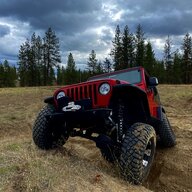
17.8° relative to the frame/bumper, give or take a tiny amount. And yes, this is full articulation with 12" travel shocks.

All this concern about exceeding the misalignment of a Johnny Joint is unfounded.

20210904_133942.jpg
 
17.8° relative to the frame/bumper, give or take a tiny amount. And yes, this is full articulation with 12" travel shocks.

All this concern about exceeding the misalignment of a Johnny Joint is unfounded.

Nice measurement. Yeah that's exactly the conclusion I had come up with several years ago. At first look one might be a little nervous without having measured numbers. I never did such measurements but I did keep an eye out for odd wear or impact marks and never found any, thus just never worried about it. I was always more worried about the welds on the bracket-to-frame cracking.
 
I will say for a long time I wondered about the joint (bolt) being in a vertical position, thinking that during articulation the joint might get to the end of its range of motion (I think it has 30 degrees of movement) - but remember the axle side joint is horizontal still so even if the frame side did reach the end of its allowable movement, the axle side has free movement as far as the rest of the suspension components will allow.
The axle side movement has exactly zero to do with the angle needed at the frame which is why I told you to stop talking. The only way your explanation makes any sense whatsoever is if you magically put a vertical slider at the axle end so when the frame side joint reaches maximum misalignment, then the axle side releases and lets the end of the track bar slide upward or remain static and the axle drops further. That can't and doesn't happen so your explanation that the frame side problem is alleviated by remembering the horizontal orientation will relieve that bind is wrong and only put forth by one who has no understanding of how this works.
 
  • Like
Reactions: Larrybortz
Now thats something I had forgotten about to be honest - with the track bar and drag link needing to be in alignment. But now that I went back and read a few threads from years ago I'm reminded that I had to actually argue with the shop that installed my lift to NOT put in a drop pitman arm. They were all about it and had to be told not to do it.


This is the reason it is good to ask questions. I would like to think most people know at least enough to know that just because a company says somethings good doesnt necessarily mean that it is.

I'm starting to sense a trend here.
 
Haltenberger was designed to slow down the propensity for DW to occur and something which is exacerbated by a knuckle to knuckle tie rod.

This has always made me wonder why the Jeep engineers then switched to a knuckle to knuckle setup for the later generations. Does the wider track better cope? As far as I know the propensity to get DW hasn't varied much generation to generation so just wondering what else changed.
 
Novak Conversions Jeep Wrangler TJ radiator