
You are using an out of date browser. It may not display this or other websites correctly.
You should upgrade or use an alternative browser.
You should upgrade or use an alternative browser.

KO2's in severe snow?
- Thread starter Reinen
- Start date
-
- Tags
- ko2 snow snow tires

I have had KO2s on several different trucks (many sets) and think they perform better than any other truck tires (ATs) that I have owned. We run them on two of our plow trucks (2500s) and like how they perform.
The width is key.
Run something more narrow than you might chose for a jeep in other conditions.
The width is key.
Run something more narrow than you might chose for a jeep in other conditions.
Hey, a local! Hi neighbor!I can't directly answer your KO2 question but I live a short distance from the mouth of LCC and I do travel it in the winter. Hundreds of thousands of cars a year go up and down that canyon in all kinds of conditions. My Goodyear MTRs do fine. I'm sure the Goodrich KO2s will do fine as well.
It sounds like your bigger issue will be the driveway. Does it get any sun? Do you keep it cleared off from snow and ice? I can't think of any large tire that would hold traction on a 45 degree sheet of ice. The physics are just working too much against it. It would require at least a narrower tire either studded or possibly a dedicated winter in my opinion.
It doesn't seem like 650" of snow this year so perhaps you can take a year to make this decision...
With an Outback and Blizzaks I don't even need to clear the driveway. I primarily clear it so I'm not "that house" in the neighborhood and of course on a pow day I have other priorities. The driveway does get some sun but it doesn't matter, I know I'm going to drive it in the worst of conditions. I'm on the bench east of Wasatch so I have some pretty steep hills to navigate. It's one thing to not make it up them, it's another thing to lose traction going down. Something I don't want to find out the hard way, hence my "will KO2s be good enough" question.
Do you know what is everyone else using for winter tires? My go-to Blizzak WS80s or DM-V2s aren't quite big enough or are a bit short in load capacity compared to the stock KO2s so TireRack doesn't list them as compatible. They say only the Blizzak LTs can be used on the Rubi and I can't find any reviews/tests of that tire to know if the performance is comperable.
Wire4money
Member
I never had good luck with 3pms kos in our snow. They packed with snow, then I was on slicks. I have had much better luck with duratracs and wild peaks.
I’ve too live up a sketchy steep road + driveway and have an Outback and Wrangler (Falken AT3W summer tire)... I throw blizzaks on both for the winter. They are better than the Falkens in icy conditions and, in my experience, the Falkens have been way better KO2s in wet/icy conditions. IMHO a dedicated set of winter tires is tilting the scales on the old “luck favors the prepared” line of thinking if you’re playing against mother nature and gravity...
Doctor Bone Smash
TJ Enthusiast
I’ve used Winterforce and Blizzak. I’d go with a skinny profile as well. I’m due to get another round of tires and thought about Cooper M&S.
Rubicon88
TJ Addict
Geberal grabber AT/x or AT/2 and stud them.
No more problems.
Enjoy.
I wish people would move away from the thought that studded tires are the best winter tire, and realize that studless winter tires are better than studded on cold wet/dry/snowy/slushy roads, and even on ice outside a narrow temperature band (colder ice gets too hard for the studs to penetrate).
Not only are studless winter tires a better overall traction device and last longer (studs wear down to a useless point fairly quickly), they also don't eat at the roads forcing us to pay more in road repair taxes/tolls.
Washington and Alaska studied this in 2002 and again in 2012, their summary read:
The precise environmental conditions under which studded tires provide a traction benefit are rare. On smooth ice near the freezing mark they are great. As the temperature drops, so does the effectiveness of studded tires. Studless tires seem to offer an excellent alternative. Good on ice, great on snow, but definitely more expensive.
https://www.wsdot.wa.gov/research/reports/fullreports/551.1.pdf
Rubicon88
TJ Addict
Good lord...that article is hilarious.I wish people would move away from the thought that studded tires are the best winter tire, and realize that studless winter tires are better than studded on cold wet/dry/snowy/slushy roads, and even on ice outside a narrow temperature band (colder ice gets too hard for the studs to penetrate).
Not only are studless winter tires a better overall traction device and last longer (studs wear down to a useless point fairly quickly), they also don't eat at the roads forcing us to pay more in road repair taxes/tolls.
Washington and Alaska studied this in 2002 and again in 2012, their summary read:
The precise environmental conditions under which studded tires provide a traction benefit are rare. On smooth ice near the freezing mark they are great. As the temperature drops, so does the effectiveness of studded tires. Studless tires seem to offer an excellent alternative. Good on ice, great on snow, but definitely more expensive.
https://www.wsdot.wa.gov/research/reports/fullreports/551.1.pdf
If you want to dissect it like that hell perhaps he can get some tires for every day of the week. No no...hour.
The OP is not talking about deep snow prowess. Or worried about studs on a wet road. Nopr.
I believe talking about some high danger areas that are slick with no guard rail..some steep areas as in the driveway.
Now...odds are these roads will be mostly becoming a slick hardpack quickly from plowing too.
To make sure it doesn't hurt your asphalt feelings the OP by law will have to chabge to a more friendlier weather set by a certain date I'm sure and I'm also betting if they're still on the vehicle when it's dry he's not racing.
Doctor Bone Smash
TJ Enthusiast
A high aspect ratio providing more downward pressure (think a 75 or 85 aspect ratio like 215 or 235/85R16) and large amounts of siping (the more snow and ice a tire can hold to get snow on snow contact) from a dedicated snow tire I s going to help the OP in the most situations. I spent years commuting long distances in snow and ice (thanks lake effect) in all sorts of vehicles: FWD compact cars, RWD trucks, and now a Jeep. It makes a big difference. Before last winter I replaced my worn snow tires with Grabber AT/Xs, and although I love the tire they are definitely much less confident.
If it's packed snow or just cleared roads the KO 2's will work just fine, they excel on packed snow. Toyo makes a decent all terrain as well.cleared with heavy machinery several times per week, sometimes several times per day.
Thanks for the replies everyone, very helpful. The bottom line impression I'm getting is that I probably won't be satisfied with KO2s all winter, I like being sure footed and will want some winter pizza cutters. However I'll probably find the KO2s to be good enough to let me use them later/earlier into the shoulder seasons when winter tires have high treadwear. That's great as I have a long "double-dip" spring season where it's winter in the mountains and summer in the valleys.
I'm looking at Blizzak LTs to fit the '21 Rubi. Does anyone have experience with them? Would I find them just as good as WS80/90s or DM-V2s? The LTs seem a bit different and there isn't much reviews/testing of that tire.
I'm looking at Blizzak LTs to fit the '21 Rubi. Does anyone have experience with them? Would I find them just as good as WS80/90s or DM-V2s? The LTs seem a bit different and there isn't much reviews/testing of that tire.
I'm by Hill AFB in N Utah, I run KO2s on my TJ & my DD truck. I don't take my TJ out much in the snow so I can't comment on those specifics, but my full-size Silverado wears KO2s & I haven't had a problem once. I take the kids skiing up over the North Ogden Pass & up to Powder Mountain almost every weekend in the winter, we go up over Strawberry Pass to Vernal for hockey tournaments, been out I-80 to Rock Springs in some gnarly stuff... I wasn't sure whether or not they'd cut it at first, but so far they've done just fine.I was hoping to find some Utah locals here, Utahns do like their Jeeps. I took a look at TireRack and they have very few LT winter tires to fit the Rubi and only for 18" wheels with no user ratings, while off-road places don't seem to care much about dedicated winter tires. So I'm not sure what I'm going to do. It would be blasphemy if my Outback is more winter capable than my Rubi.
Good lord...that article is hilarious.
If you want to dissect it like that hell perhaps he can get some tires for every day of the week. No no...hour.
The OP is not talking about deep snow prowess. Or worried about studs on a wet road. Nopr.
I believe talking about some high danger areas that are slick with no guard rail..some steep areas as in the driveway.
Now...odds are these roads will be mostly becoming a slick hardpack quickly from plowing too.
To make sure it doesn't hurt your asphalt feelings the OP by law will have to chabge to a more friendlier weather set by a certain date I'm sure and I'm also betting if they're still on the vehicle when it's dry he's not racing.
You have clearly missed the entire point of the message... in nearly any conditions below 40 degrees out, the studless winter tire is better than studs.
Not sure why you got so personally butthurt about it, I'm just trying to educate others so they can actually use the safest and most sure footed tire.
Good to know, I just went out & looked at mine.Are the above references to KO2's on ice and snow referring to the 3PMSF rated version or to the M+S designated version?
Until earlier this year, BFG offered two versions of the KO2 - 3PMSF rated and "DT" (different tread) with M+S designation, harder compound and mileage warranty. Since July 2020 all KO2's are 3PMSF.
The two versions would perform differently in snow and on ice.
Two thoughts: 1) Lots of Blizzak for dedicated winter tires. I did read a story recently about a new tire that was even better but the details are escaping me at the moment; 2) I don't run dedicated winter tires because I try not to drive my TJ in snow or on roads that are salted/sanded. The frames are vulnerable to rust and I want to have the TJ for a very long time--hopefully without needing to replace the frame. If your Subaru handles it well then I'd stick with it as much as possible and enjoy the TJ as a 3 season vehicle.Hey, a local! Hi neighbor!
With an Outback and Blizzaks I don't even need to clear the driveway. I primarily clear it so I'm not "that house" in the neighborhood and of course on a pow day I have other priorities. The driveway does get some sun but it doesn't matter, I know I'm going to drive it in the worst of conditions. I'm on the bench east of Wasatch so I have some pretty steep hills to navigate. It's one thing to not make it up them, it's another thing to lose traction going down. Something I don't want to find out the hard way, hence my "will KO2s be good enough" question.
Do you know what is everyone else using for winter tires? My go-to Blizzak WS80s or DM-V2s aren't quite big enough or are a bit short in load capacity compared to the stock KO2s so TireRack doesn't list them as compatible. They say only the Blizzak LTs can be used on the Rubi and I can't find any reviews/tests of that tire to know if the performance is comperable.
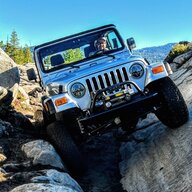
We've had 3 snow days so far this year, I still love the KO2s in the snow. They certainly are not a dedicated snow tire, but I wouldn't think they're any less good in UT than CO (I lived near Liberty Park in SLC, so I know at least a little)  .
.
.
The key difference between a tire that performs well in the snow vs one that does not is that tire’s ability to pack in snow. Having snow packed in is a good thing. That is why dedicated snow tires like blizzaks have an insane amount of siping. KO’s had minimal siping and thus did not get great snow traction. Ko2’s on the other hand have very aggressive siping for an all terrain/all season. The first picture is my spare which is a Ko. The second is a ko2. Note the difference in the amount of siping.I never had good luck with 3pms kos in our snow. They packed with snow, then I was on slicks. I have had much better luck with duratracs and wild peaks.
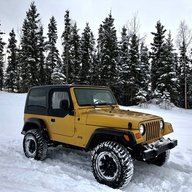
We run Blizzaks on the wife’s JK rubicon. But we have a very different winter.
when I was in Utah (Ogden/Logan) I ran my MTRs without any complaint. I would pass slower traffic on the highway.
of course any time you change trajectory you have to worry about losing traction. So slow down.
when I was in Utah (Ogden/Logan) I ran my MTRs without any complaint. I would pass slower traffic on the highway.
of course any time you change trajectory you have to worry about losing traction. So slow down.
Similar threads

- Replies
- 4
- Views
- 4,579


- Replies
- 96
- Views
- 24,949


- Replies
- 51
- Views
- 6,802

- Replies
- 11
- Views
- 2,448
