Rear disc brake conversion question(s)

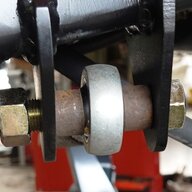
That is the spread. How far above the center of the tube are the holes?

Not sure, but it’s odd that isn’t dimensioned.


You're overlooking one thing and it is critical. The rear drum brakes on a TJ are servo style or self actuating which is why they have the very stout return springs at the top to stop the self actuating nature and pull the shoes away from the drum surface. Also why there is a primary and secondary shoe which also has the effect of the parking brake function always working better one direction than the opposite.

The drum in hat rotor versions are non servo in nature and work equally both directions. And, if you seeing a difference in how one holds the vehicle against its weight on an incline, then you don't have the DIH working properly. I know for a fact that when they are bedded and adjusted properly, they will shear the anchor lug off if you try and drive off in 4 low.
I can vouch for this as well, I broke an anchor lug by not releasing the brake while in 4 low.
 
Not sure, but it’s odd that isn’t dimensioned.


I can vouch for this as well, I broke an anchor lug by not releasing the brake while in 4 low.
I am making progress though. I had an epiphany today and if I can pull it off, it will be very cool. Since I have control of all design aspects, I can move the bits inward with some creative machining and eliminate the need for the disc brake retainers. Since they exist purely to compensate for the difference in thickness between the cast disc backing plate and the thinner drum brake backing plate, I can thin down the section either on the inside and fit over the housing or on the outside and cut a recess for the retainer to fit into.

That would mean a drum brake guy converting would just unplug the axles, remove the brake bits, swap on new brake bits, plug the axles back in and not have to change out 150 bucks worth of bearings just to get a disc brake retainer swapped on.
 
Since we haven't been able to get parts going on a year now, I'm going to follow one of my older ideas through to fruition and build my own rear disc brake conversion so I am not dependent upon others to supply me with parts I can't get.

How many of ya'll know what the dust shield and little rubber boot on the actuator lever do?

Or put another way, if you saw a rear disc conversion without them, would that bother you enough not to buy them?

For those that don't know the above function answer, the dust shield is fairly useless. It won't keep mud, muddy water or water out of the brake shoes.

The dust boot is basically an anti-rattle device because it can't seal well enough and it is out of the way in a recess enough that it can't really do much more than that.

To answer your original question, for me no, it wouldn’t matter.

After watching people argue things I find stupid, like “Don’t change your ATF because the shavings make it shift better” there are people that will argu no matter what, so someone will bitch about it, and have no logical reason other than “the OEM had it”. They won’t answer why they have adjustable CAs that the OEM didn’t.

I’ve heard that the dust guard is to keep brake pad dust off components, I’d say get better pads. I’ve heard it shields heat off other components, and I’d ask why it’s not called a heat shield.

Boot I’m indifferent as well.

 
To answer your original question, for me no, it wouldn’t matter.

After watching people argue things I find stupid, like “Don’t change your ATF because the shavings make it shift better” there are people that will argu no matter what, so someone will bitch about it, and have no logical reason other than “the OEM had it”. They won’t answer why they have adjustable CAs that the OEM didn’t.

I’ve heard that the dust guard is to keep brake pad dust off components, I’d say get better pads. I’ve heard it shields heat off other components, and I’d ask why it’s not called a heat shield.

Boot I’m indifferent as well.
To be fair, I call it a dust shield because that is what everyone knows it as. If you search for backing plate, the same parts come up as a dust shield. I suspect the OEM refers to it as a debris shield, but lot of brakes front and rear don't have them. And some like the Ford 8.8 get way too carried away with them.
 
  • Like
Reactions: R49
I am making progress though. I had an epiphany today and if I can pull it off, it will be very cool. Since I have control of all design aspects, I can move the bits inward with some creative machining and eliminate the need for the disc brake retainers. Since they exist purely to compensate for the difference in thickness between the cast disc backing plate and the thinner drum brake backing plate, I can thin down the section either on the inside and fit over the housing or on the outside and cut a recess for the retainer to fit into.

That would mean a drum brake guy converting would just unplug the axles, remove the brake bits, swap on new brake bits, plug the axles back in and not have to change out 150 bucks worth of bearings just to get a disc brake retainer swapped on.
This would be cool because then you could more easily change the bolt pattern to match the XJ/MJ 44 as well.
 
This would be cool because then you could more easily change the bolt pattern to match the XJ/MJ 44 as well.
I've got to do some very careful math. Right now I'm having a hard time convincing myself that a 1/8" thickness in the middle of the backing plate will work. I know it does on drums so I just have to get over it.
 
  • Like
Reactions: Blackjack
I've got to do some very careful math. Right now I'm having a hard time convincing myself that a 1/8" thickness in the middle of the backing plate will work. I know it does on drums so I just have to get over it.
I guess the question becomes what reason the OEs had for the thicker bracket? Cost I am sure is part of it and maybe a better choice in materials would make up for it.
 
I guess the question becomes what reason the OEs had for the thicker bracket? Cost I am sure is part of it and maybe a better choice in materials would make up for it.
Thicker bracket being cast iron is the main reason for which that choice is cost, ease of manufacture, and durability.
 
  • Like
Reactions: Blackjack
I am making progress though. I had an epiphany today and if I can pull it off, it will be very cool. Since I have control of all design aspects, I can move the bits inward with some creative machining and eliminate the need for the disc brake retainers. Since they exist purely to compensate for the difference in thickness between the cast disc backing plate and the thinner drum brake backing plate, I can thin down the section either on the inside and fit over the housing or on the outside and cut a recess for the retainer to fit into.

That would mean a drum brake guy converting would just unplug the axles, remove the brake bits, swap on new brake bits, plug the axles back in and not have to change out 150 bucks worth of bearings just to get a disc brake retainer swapped on.
This would be pretty great in general for guys looking to swap. I’m guessing the current disc guys wanting to run your parts would need to convert back to drum retainers in order to run your stuff if you build it that way? Not that that’s a deal breaker, just something to be aware of.

I do like that Spicer sells their axle shafts with drum retainers for much less than the disc alternatives, because I don’t need chromoly shafts. So, for me buying some drum shafts with your future brake parts would be a nice setup that is decently cost effective.
 
I have the 8.8 swap on my TJ and the parking brake is useless. Is there a fix or upgrade for this issue?

Diagnose and repair with good parts usually does it. You need to figure out which parts are deficient, replace them, adjust the shoes, then break them in a bit, readjust, and then adjust the cables correctly. The shoes are adjusted with slack in the cables and only then should the slack be removed to set the adjustment to the parking brake handle inside.
 
  • Like
Reactions: Gambaholic