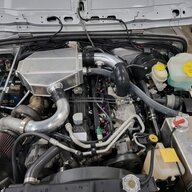
Thinking about deleting the smog system

I had a friend who had an FJ 40 with smog pump inop and he could not get it registered in Colorado. In TX it does not matter after 22 years. You might want to consider the ramifications of your actions.
Even in Colorado it only matters in about 6 counties, and those are the counties least attractive to me to live in.
 
  • Like
Reactions: notnsuv
I had a friend who had an FJ 40 with smog pump inop and he could not get it registered in Colorado. In TX it does not matter after 22 years. You might want to consider the ramifications of your actions.
24 years in Texas emission counties, however that could be changing here and nationwide in the near future as the internal combustion engine is under continued assault.
 
  • USA Proud
Reactions: TheBoogieman
I gotta ask - would you please explain this one?
Sure. Your ecm gets info from your upstream o2 sensor. A o2 sensor works by varying resistance by exhaust temperatures. So if you manipulate the voltage let's say by means of a potentiometer you can lean the the mixture and gain mpg. The consequence is nox goes up like really up and if your cat is still in place it will be a light bulb under the jeep. ( very very hot) . This is not uncommon on race vehicles.
 
Sure. Your ecm gets info from your upstream o2 sensor. A o2 sensor works by varying resistance by exhaust temperatures. So if you manipulate the voltage let's say by means of a potentiometer you can lean the the mixture and gain mpg. The consequence is nox goes up like really up and if your cat is still in place it will be a light bulb under the jeep. ( very very hot) . This is not uncommon on race vehicles.
Lol, that's not how it works at all.
 
My brother deleted his cats and 02,s on his JK an exhausts specialist who used to race TJ,s did it, there is no smell with the cats gone, no fuel advantage but a bit more HP so he says.
We don't have to get our vehicle's smogged and it only becomes an issue if you get a police work order and then they would have to spot the cats missing. Not sure of the TJ-JK systems difference?
 
here learn something. Now this simulates signal now change a fixed resistor to a variable or multiple for channels for your driving needs.
I want my 5 minutes back. There are so many things wrong with this. First off if you hook that to your upstream sensor you will get codes immediately. The PCM monitors the O2 circuit for faults. A 555 timer chip is not going to report back the proper circuit values to keep the PCM happy. Not to mention the PCM looks at O2 cross-counts relative to the engine run time. Your fixed output signal will not be able to replicate those cross count changes which will result in a code. Then you have the issues relating to the O2 heater codes. Also there is a period where the upstream sensor output is compared to the downstream output to determine proper downstream operation. Then there is the question of why. The factory O2 generates a signal when there is oxygen present in the exhaust stream. The general idea is to maintain a consistent and ideal fuel mixture for the overall proper operation of the engine. That ideal value is 14.7:1 air to fuel ratio. This is the ratio used by almost all manufacturers for years. It is a balance between power, economy and emissions. Sure you can run rich foul plugs and wash rings, or you can lean it out and detonate the crap out of it, but the best balance is in the middle where the factory O2 puts it. Then there is the issue of fuel trims. The fuel trim system works off of the feedback from the upstream O2s to adjust the injector pulse width to run that stoichiometric ratio under varying RPM and load conditions. Your one value system will force all the trims to max either one way or the other. The PCM will adjust the long and short term trim in any trim block outside of an average O2 value of 0.45v. If your "hack" system generates an average value of 0.55v the PCM will determine that block is lean and keep adding trims in an attempt to reach 0.45v. It will never get there and will max at 28% or so and your exhaust will be rolling coal and your cats will be glowing orange. Or if you set the voltage lower than 0.45. The engine will continue to pull fuel until it dies or reaches -28% or so. Finally if you are building this to make more power at full throttle just know the PCM ignores all the O2 inputs above 75% throttle or so.

 
I want my 5 minutes back. There are so many things wrong with this. First off if you hook that to your upstream sensor you will get codes immediately. The PCM monitors the O2 circuit for faults. A 555 timer chip is not going to report back the proper circuit values to keep the PCM happy. Not to mention the PCM looks at O2 cross-counts relative to the engine run time. Your fixed output signal will not be able to replicate those cross count changes which will result in a code. Then you have the issues relating to the O2 heater codes. Also there is a period where the upstream sensor output is compared to the downstream output to determine proper downstream operation. Then there is the question of why. The factory O2 generates a signal when there is oxygen present in the exhaust stream. The general idea is to maintain a consistent and ideal fuel mixture for the overall proper operation of the engine. That ideal value is 14.7:1 air to fuel ratio. This is the ratio used by almost all manufacturers for years. It is a balance between power, economy and emissions. Sure you can run rich foul plugs and wash rings, or you can lean it out and detonate the crap out of it, but the best balance is in the middle where the factory O2 puts it. Then there is the issue of fuel trims. The fuel trim system works off of the feedback from the upstream O2s to adjust the injector pulse width to run that stoichiometric ratio under varying RPM and load conditions. Your one value system will force all the trims to max either one way or the other. The PCM will adjust the long and short term trim in any trim block outside of an average O2 value of 0.45v. If your "hack" system generates an average value of 0.55v the PCM will determine that block is lean and keep adding trims in an attempt to reach 0.45v. It will never get there and will max at 28% or so and your exhaust will be rolling coal and your cats will be glowing orange. Or if you set the voltage lower than 0.45. The engine will continue to pull fuel until it dies or reaches -28% or so. Finally if you are building this to make more power at full throttle just know the PCM ignores all the O2 inputs above 75% throttle or so.

You're still wrong. Give it some time it will eventually come to you.
 
Last edited:
You're still wrong.

tenor.gif
 
You're still wrong. Give it some time it will eventually come to you.
Clearly.

Jezza has much more than an elementary understanding of the subject, and took the time to try and explain it to you. Even after you took some entirely inappropriate jabs directed at him.

You have demonstrated no understanding of the subject. Evident by your statement that the O2 sensor measures temperature, and that leaning out an engine creates a large increase in fuel mileage (Well, I guess it may result in a small increase - right up until the moment you smoke the engine).

I also find it quite ironic that you stated that people will believe anything they see on Youtube, and then you go on to demonstrate just that.

So please Ditch, elucidate. Why is Jezza wrong?
 
Sure. Your ecm gets info from your upstream o2 sensor. A o2 sensor works by varying resistance by exhaust temperatures. So if you manipulate the voltage let's say by means of a potentiometer you can lean the the mixture and gain mpg. The consequence is nox goes up like really up and if your cat is still in place it will be a light bulb under the jeep. ( very very hot) . This is not uncommon on race vehicles.
The oxygen sensors produce a voltage relative to the oxygen in the exhaust, usually between 0-1 volts. If you lean the mixture you will create a lean misfire and light off the cat. The box’s produced from a high combustion chamber temp which can be a result of the lean mixture. That is why egr valves are used
 
Interesting, if you're mechanically inclined enough it's OK. You'll have to add some resistors to replace downstream o2 sensor if you have one. Upstream you'll install a viable resistor to adjust your fuel mixture. If you want things can get really cool and get crazy mpg
Unfortunately resistors will not work for downstream o2 sensor removal on old 2 vehicles due to the computer using active tests to test the integrity of systems vs just sensors. The downstream o2 (also called cat monitor sensors) are only used to monitor the Function of the Cat. The computer will go into a self test mode when conditions are right ( steady throttle 45-60 mph) during this self test the computer will cycle the injectors rich to lean, verify this with the front o2’s and monitor the waveform of the rear o2s to verify the cat is operating properly. There are some companies that make bypasses but I have never used them. The resistors would cause a fixed voltage and the computer would never clear the monitor. In California all but one of the monitors must be cleared to pass emission testing. With obd2 they just plug in the tester and see if the monitors are cleared and it passes. When obd2 came out it was due to the emission law that stated if a vehicle emits more than 1& 1/2 times the allowable emissions the check engine light must turn on. When this law went into effect the manufactures had to start actively testing systems and system integrity vs components as they did with obd1 .
 
  • Like
Reactions: pc1p
PO on my 97 removed char can etc & cat. Not sure what he did. I put a cat back on it because of the sound and smell. Runs fine...great in fact, but mpg blows