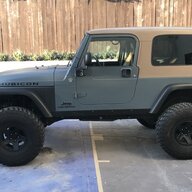
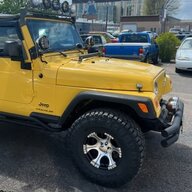
Re-gearing for 33's

JML

New Member
Original poster
Joined
Jul 4, 2023
Messages
5
Location
Southern California
Had my 2005 TJ with 4.0L automatic lifted and added 33’s. It has Dana 30/186mm front and 35/194mm rear. 373 rear axle ratio. Which would make it feel more like original in terms of power/response? 4.11 or 4.56 ?
Any firsthand experience would be appreciated.
Thanks
 
X2, 4.88 at a MINIMUM for 33's but 5.13 would be my personal choice too. The recommendations you'll find for 4.56 and 33's is only correct for a manual transmission. Your 4-speed 42RLE automatic has a stupid-steep .69 Overdrive ratio that drops the engine rpms way too low with normal gear ratios.

5.13 will give you perfect highway rpms for you 33's and 42RLE automatic transmission, they will not be too low as a clueless parts store salesman might claim.

I'm running 5.38 for my 35's with the same transmission and I wish I could have gone one deeper than 5.38 as my highway rpms at 70 mph are barely adequate.
 
  • Like
Reactions: AndyA and PNW_LJ
Any idea what the 5.13 would mean in terms of RPM’s with 33’s, say at 70 mph. In overdrive?
Perfect, right at 2554 at 70 mph in OD. And don't forget, the bigger the tire diameter the more rpms from the engine it needs. The same rpms that work perfect, for example, with 30" tires would be nowhere adequate/high enough for 33's or 35's.
 
Any idea what the 5.13 would mean in terms of RPM’s with 33’s, say at 70 mph. In overdrive?

2,500 RPM per the Grimmjeeper calculator assuming the tires are actually 33” diameter. Higher RPM at 70 mph is ideal but this is the best you can do with those axles.
 
Any idea what the 5.13 would mean in terms of RPM’s with 33’s, say at 70 mph. In overdrive?

http://www.grimmjeeper.com/gears.html
* don't enter 33" for the tire size. For more accuracy, measure from the ground to the middle of the wheel and double it.

roughly:
20230816_112053.jpg
 
Last edited:
I dunno how three of us are coming up with three different 70 mph rpms using the same Grim Reaper calculator.

I based mine off selecting its Dodge 42RLE transmission, 5.13, and 32.6" diameter tires which is very close to average for a 33" tire.

Capture.JPG
 
I dunno how three of us are coming up with three different 70 mph rpms using the same Grim Reaper calculator.

I based mine off selecting its Dodge 42RLE transmission, 5.13, and 32.6" diameter tires which is very close to average for a 33" tire.

View attachment 450357

Because your measurements are not based on 2x the hub height
 
I dunno how three of us are coming up with three different 70 mph rpms using the same Grim Reaper calculator.

I based mine off selecting its Dodge 42RLE transmission, 5.13, and 32.6" diameter tires which is very close to average for a 33" tire.
My 33s at 28 PSI are 31.5". Andy
 
I dunno how three of us are coming up with three different 70 mph rpms using the same Grim Reaper calculator.

I based mine off selecting its Dodge 42RLE transmission, 5.13, and 32.6" diameter tires which is very close to average for a 33" tire.

View attachment 450357

Virtually all 33's measure 31.5". You can figure this out via hub height x2 or you can take the manufacturer's listed revs per mile (not advertised diameter, only revs per mile) and backwards calculate. They pretty much all come out to right at 31.5". Goodyear MTR might be more around 32" but they aren't very popular in a 33" size anymore anyways.

And to contribute to the original post, 5.13 is the only way to go and I still don't think it's ideal.
 
Measuring from the ground to the center with the tires on the ground at normal inflation gives an erroneous diameter. Especially since the hub height would vary with tire pressure which of course does not affect the tire's true diameter. Go to the tire manufacturers website to get its true accurate diameter which won't vary by air pressure which does not affect its circumference. Its circumference is what dictates the tire's rpm while driving.

This is the BFG 33x12.50 tire whose actual diameter is 32.7"
Screenshot_20230816-153904.png
 
Measuring from the ground to the center with the tires on the ground at normal inflation gives an erroneous diameter. Especially since the hub height would vary with tire pressure which of course does not affect the tire's true diameter. Go to the tire manufacturers website to get its true accurate diameter which won't vary by air pressure which does not affect its circumference. Its circumference is what dictates the tire's rpm while driving.

This is the BFG 33x12.50 tire whose actual diameter is 32.7"

I would have thought that changes in pressure cause the rubber to stretch and therefore change the circumference. Isn't that why the term "rolling circumference" exists instead of just "circumference"?

From a quick web search:

Increasing the pressure in a tire changes not only its circumferemce, it also changes it “cord” profile, that shape you’d get should you cut across the tire and look at the shape. Just as increasing the pressure in a balloon makes it get rounder, increasing the pressure in a tire causes the “cord profile” to get rounder. That increases the rolling circumference and reduces the width of the tread that’s in contact with the tarmac.

Here is a calculation for rolling circumference that I found:

https://mechguru.com/vehicle-design/tire-rolling-circumference-calculation-example/
Andy
 
Last edited:
Measuring from the ground to the center with the tires on the ground at normal inflation gives an erroneous diameter. Especially since the hub height would vary with tire pressure which of course does not affect the tire's true diameter. Go to the tire manufacturers website to get its true accurate diameter which won't vary by air pressure which does not affect its circumference. Its circumference is what dictates the tire's rpm while driving.

This is the BFG 33x12.50 tire whose actual diameter is 32.7"
View attachment 450382

If you were to go drive with a 33" BFG KO2 and did the rpm vs speed calculations, 32.7" will not be correct.

I would like for you to back calculate the advertised revs per mile (640) and tell me what you get. It will not be 32.7" and clearly both specs can't be right if they're different, right?

BTW, Blaine does not agree that the hub height x2 gives erroneous information and I have never known any method Blaine uses to be erroneous.
 
X2, 4.88 at a MINIMUM for 33's but 5.13 would be my personal choice too. The recommendations you'll find for 4.56 and 33's is only correct for a manual transmission. Your 4-speed 42RLE automatic has a stupid-steep .69 Overdrive ratio that drops the engine rpms way too low with normal gear ratios.

5.13 will give you perfect highway rpms for you 33's and 42RLE automatic transmission, they will not be too low as a clueless parts store salesman might claim.

I'm running 5.38 for my 35's with the same transmission and I wish I could have gone one deeper than 5.38 as my highway rpms at 70 mph are barely adequate.

Thanks for all the feedback. Sounds like 5.13 is the way to go.
 
If you were to go drive with a 33" BFG KO2 and did the rpm vs speed calculations, 32.7" will not be correct.

I would like for you to back calculate the advertised revs per mile (640) and tell me what you get. It will not be 32.7" and clearly both specs can't be right if they're different, right?

BTW, Blaine does not agree that the hub height x2 gives erroneous information and I have never known any method Blaine uses to be erroneous.

Hub height x2 is different than whatever rpms per mile the tire manufacturer came up with. Hub height x2 will be more specific to the vehicle because it accounts for variances in tire pressure and vehicle weight. The tire manufacturer does not know these things.

Hub height x2 can also be verified by recording the gps speed at a given engine rpm and adjusting the tire diameter in a gear ratio calculator until the rpm and speed match what was recorded.

Hub height x2 will be the same as the adjusted tire diameter used in the gear ratio calculator.