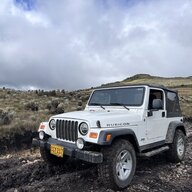
Rubicon lift project 3 inch for 33s

Mo' articulation, mo better? I mean there's no reason why you couldn't do 31s and 3 inch lift.

I almost feel like we are chasing the wrong rabbit when it comes to ride height because suspension travel is the more important thing to analyze. You could use for example the Rancho Rs55239 with a 2.5 inch lift, or with a 3.5 inch lift. The 3.5 inch lift results in roughly 5.25 uptravel and 4.25 down, the 2.5 I think would be the inverse of that.

There are many rabbits to chase, some of which are often ignored by most. If we disregard ground clearance provided by tires, a 100% stock TJ Rubicon with an automatic transmission will significantly out perform the typical TJ 35" tire build with open diffs and a manual.
 
  • Like
Reactions: 97' 4 Popper
It has a lot to do with shocks and the pivot point at the axle where the control arms attach. More lift necessarily leads to shocks with longer travels. The longer the shock travel, the greater the axle articulation. The greater the axle articulation, the more the raised tire will pivot up into the fender and tip in towards the frame.

These recommended lift heights for a given tire size are not hard numbers. There are many contributing factors and variables that will add up into a tire fitting and the suspension being able to move without interferences. Or not. However, these lift heights are good approximations for what typically works.

This is why a 4" spring lift does not automatically provide room for a 4" taller tire. It is also why a 4" spring lift doesn't automatically result in 4 additional inches of shock travel over stock. The tires are moving through their travel arcs far more than one might expect because of the locker shocks.

So it means: If I have a 3 lift kit and my falcon piggy shocks are recommended for lifts from 3 inches to 4 inches, in order to have the best possible flex and have the best possible effect on my expensive shocks; I definitely should have a 1 inch lift kit (for total 4) ?
 
So it means: If I have a 3 lift kit and my falcon piggy shocks are recommended for lifts from 3 inches to 4 inches, in order to have the best possible flex and have the best possible effect on my expensive shocks; I definitely should have a 1 inch lift kit (for total 4) ?

My answer to that is to cycle the axle without springs installed using a floor jack. This will show you how the axle and tires move within the suspension and steering travels in a controlled environment. Doing this shows you where the interferences are.
 
You might be surprised that factory arms flex better than many aftermarket arms.

...

Agreed. Stock arms are not limiting suspension travel. A primary issue with using stock control arms on lifted suspensions is the additional rotation at the bushings as allowed by the longer shock travel. This will shorten the life of the bushings when the bonded rubber eventually tears free of the inner sleeve and outer shell.
 
Last edited:
My answer to that is to cycle the axle without springs installed using a floor jack. This will show you how the axle and tires move within the suspension and steering travels in a controlled environment. Doing this shows you where the interferences are.

We could really benefit from a simple,direct, how-to for choosing shocks and bumpstops for any given spring length(lift). Something with pictures and a 1,2,3 approach we can point to for the many people in need of the basics.

Guys show up with the idea of kits or ask "what shocks do i buy" and it goes all over the map.not always in a helpful direction. It would save a lot of effort to just point at a thread.
 
  • Like
Reactions: Danarch