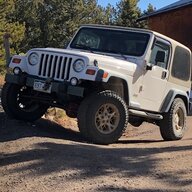
97 TJ frame stretch to LJ

All the cool kids add 15" after the rear wheels 😉

14816037-1984-jeep-cj8-scrambler-std.webp
:eek:
 
Whats a good way to weld the extension pieces for max strength? I am seem people weld like on the attached images, weld a longer piece on the sides.

Screenshot_20240529_201335_Chrome.webp


Screenshot_20240529_201324_Chrome.webp


Screenshot_20240529_201319_Chrome.webp


Screenshot_20240529_201313_Chrome.webp
 
I do lots of plug welds, I use frame material or a very close approximation, and then my inner plates are cut and ground to fit very tightly.

View attachment 531357
Green line is the rear joint, the front joint is 8" forward of it. A bit of metal finishing, and done.
View attachment 531358


The side parts with red arrow are inserted into the frame and the extension is welded to the frame at the blue lines?

Screenshot_20240601_153612_Chrome.jpg
 
Are those plates 1/8 or 3/16? What are the measurements?
 
Are those plates 1/8 or 3/16? What are the measurements?

Judging by the frame thickness, the plates look to be at least 3/16". The LxW is going to be slightly less than the inside dims of the frame and the length appears to be about the same length as the frame filler piece with half the length positioned on either side of the cut line.

Are you sure you are up to this type of fabrication work?
 
  • Like
Reactions: Rickyd and myjeep3
Are those plates 1/8 or 3/16? What are the measurements?
Measurements of which part? Whether they are 1/8" or 3/16" is of no consequence. 1/8" is more than plenty since we are not relying purely on the strenth of the inner plates. They are merely an additional bit of support with the rest being done by proper butt welds at the joint. This is just some additional support for good welds. If I could find it, I'd use nothing but 9 gauge but it is too hard to source, so I use either 3/16" or 1/8".
 
  • Like
Reactions: myjeep3
Judging by the frame thickness, the plates look to be at least 3/16". The LxW is going to be slightly less than the inside dims of the frame and the length appears to be about the same length as the frame filler piece with half the length positioned on either side of the cut line.

Are you sure you are up to this type of fabrication work?

Doesn't seem to be a complex fabrication, if anything I will ring a buddy with more skills for help.
 
Doesn't seem to be a complex fabrication, if anything I will ring a buddy with more skills for help.
There is no complexity at all. It is basic and simple but the execution done well requires some thought, a solid game plan, and a high level of accuracy.
This is my average frame cut. I use a scribe to make the lines and follow them very closely.

1717296184483.webp

1717296273386.webp
 
There is no complexity at all. It is basic and simple but the execution done well requires some thought, a solid game plan, and a high level of accuracy.
This is my average frame cut. I use a scribe to make the lines and follow them very closely.

View attachment 531461
View attachment 531463

That is a very clean cut. Do you weld a piece across the frame so it doesn't move after the cut?
 
That is a very clean cut. Do you weld a piece across the frame so it doesn't move after the cut?
Yes, no, maybe. I measure the width so I know where it "should" be when we are done. If I weld and it needs to move because it isn't straight when I clamp it up, then I have to cut and clean the welds. I will generally clamp a piece across the frame to kinda hold it, but that stuff generally has to move out of the way when we clamp it all back up to put it back together and being straight is far more important than controlling the width to a sixteenth or less.
 
  • Like
Reactions: NashvilleTJ