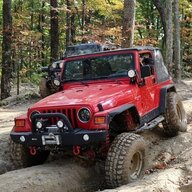
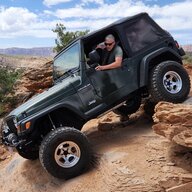
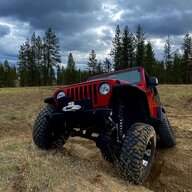
Cut off for well mannered, street-able TJ?

Am I reading y'all correctly that overall driveability gets better when moving to 35/17s from 35/15s?

I noticed the largest difference with 17s when aired down to my normal 8psi. The tires lost a lot of that squishy feeling and the Jeep felt more stable and controlled.
 
Correct me if I'm wrong, but didn't you upgrade only the rear to Fox 2.0 w/DSCs, which means your front corners haven't been upgraded yet to match the tuned rears?

If that's the case, then I'd complete the suspension build. Otherwise, I'd consider dialing in the tune or going for a ride in a rig built by Blaine before poo pooing the comparison as being ridiculous. The handling at speed, especially when pushing it in boost, is the biggest thrill of the experience.
...

I outboarded rear for 12" remote reservoirs with a nice tune almost ten years ago. It was a very noticable improvement that also highlighted how mushy and uncontrolled the front 5000Xes were. Several years later, I got the fronts done and a re-tune on both ends.

The difference having both ends working together with good shocks was a much larger improvement than only the rears. This is part of designing a harmonious system that works together. The front shocks have a direct influence on the rear shocks, and vice versa.

The DSCs were an entirely different type of improvement that has no real comparison to a regular remote reservoir. Everything about how the Jeep handles is different. And it would be even more critical to have both ends functioning at that level.
 
  • Like
Reactions: Woodrow
Interesting. I've been looking for some new tires for my rig and 35s on 17s are much easier to find on marketplace. I will definitely keep that in mind.

The shorter sidewall is a very real benefit and is contrary to the common beliefs. It is also one of the many small incremental improvements that add up to building an overarching unified system.
 
  • Like
Reactions: speeding_infraction
Correct me if I'm wrong, but didn't you upgrade only the rear to Fox 2.0 w/DSCs, which means your front corners haven't been upgraded yet to match the tuned rears?

If that's the case, then I'd complete the suspension build. Otherwise, I'd consider dialing in the tune or going for a ride in a rig built by Blaine before poo pooing the comparison as being ridiculous. The handling at speed, especially when pushing it in boost, is the biggest thrill of the experience.

To a much lesser extent, I noticed an improvement in handling after pairing 35s with 17" wheels instead of 15" wheels. It all adds up.
Ha, ha. Yep, I’m only 1/2 dun😂. Ridiculous is perhaps the wrong word. I did not mean to offend. I ran out of time last winter to do the front stretch/mid-arm/coilover like I did in the rear. My TJ build has been a slow evolution for 7 years and it gets regular road driving between modifications. So it has been interesting picking out the subtle and not so subtle differences each time I make a change to suspension, steering, weight balance or wheelbase. Separating the front and rear has also been revealing because I can really feel how uniquely the 2 ends of the rig behave (the rear is better).

We (you and I and others in this discussion) may not have the same definitions of sporty. For me, a proper sports car has quick and composed reactions to both driver and road inputs and, crucially, communicates to the driver what’s happening at the contact patch. Much of that comes from low mass located close to the ground. Engine power, though welcome and fun, actually has little to do with how sporty a vehicle is in my estimation. Some examples of cars I have driven that I consider sporty:
911GT3, C8 Z06; I expect little argument on those.
Mazda Miata; If hp is an important metric, you may disagree.
1985 VW golf; I throw this one in because I owned one for quite a while (base model with manual transmission, manual brakes, manual steering and a whopping 85hp). That car was a riot at 10/10ths which was easily approachable on the street because of it’s very modest limits. It would rotate if you lift the throttle in a turn so you could drift on command using momentum rather than hp. Most importantly to me, putting your hands on the steering wheel was akin to running them along the surface of the pavement, allowing you to walk the car upto and beyond the adhesion limit and easily back again.

My jeep, while very fun in its own way and still improving, will always suffer in a road driving comparison to any of those (not a criticism, its just not a sports car). But maybe I’m not doing it right🤷‍♂️
 
...

My jeep, while very fun in its own way and still improving, will always suffer in a road driving comparison to any of those (not a criticism, its just not a sports car). But maybe I’m not doing it right🤷‍♂️

The difference is that when you get the fronts done and you go through learning the adjusters, you will be able to drive the Jeep fast and hard in ways no one would imagine possible in a vehicle like this. The good brakes and steering really begin to matter because you can utilize the precision and control they offer. The shocks allow you to use the rest of the Jeep to a greater potential.
 
The shorter sidewall is a very real benefit and is contrary to the common beliefs. It is also one of the many small incremental improvements that add up to building an overarching unified system.

That makes sense. I guess my tire search is now gonna be for 35x11.5/12.5r17, load range c. Then I can start saving for the big brake kit👀
 
One significant reason I beg to differ is that any reasonable build on 31s will not have the shocks I have on mine with a 4" spring lift and an 1.25 body lift. Shocks have an overarching impact on the handling, steering and braking. And being able to fit those shocks effectively is more than a few steps away from a build for 31s.

What shocks do you run? I have never liked the Ranchos on my 4.5" lift.
 
I bought my 2006 Rubicon LJ new. It came stock with 31s and the six speed manual.
The road manners were decent(for a jeep) with acceptable power and 16mpg.
I've never been pleased with the road manners after I had a 4.5" Rubicon Express lift on 33 x 12.5 x 15.
The larger tires also killed the what little fuel mileage I had with the smallest of grades requiring a downshift.
I've talked to some folks who had similar experiences with their Rubicon Express lift.
The lift is probably why it only has 56,000 miles on it.
After financially recovering getting my kids through college the jeep will probably get a suspension upgrade next year.
 
Last edited:
  • Like
Reactions: rasband and Woodrow
I bought my 2006 Rubicon LJ new. It came stock with 31s and the six speed manual.
The road manners were decent(for a jeep) with acceptable power and 16mpg.
I've never been pleased with the road manners after I had a 4.5" Rubicon Express lift on 33 x 12.5 x 15. I've talked to some folks who had similar experiences with their Rubicon Express lift.
The lift is probably why it only has 56,000 miles on it.
After financially recovering getting my kids through college the jeep will probably get a suspension upgrade next year.

The biggest improvement would be to address the shocks. The presumed long arms can stay as is, unless you feel the need to change the behavior of the suspension geometry.
 
The difference is that when you get the fronts done and you go through learning the adjusters, you will be able to drive the Jeep fast and hard in ways no one would imagine possible in a vehicle like this. The good brakes and steering really begin to matter because you can utilize the precision and control they offer. The shocks allow you to use the rest of the Jeep to a greater potential.

I would not be surprised if the whole is greater than the sum of the parts
 
  • Like
Reactions: jjvw
What shocks do you run? I have never liked the Ranchos on my 4.5" lift.

If you want to run real good shocks you're going to need to outboard the shock mounts.

At that point you'll be able to run some custom tuned shocks like many do on this forum. I can tell you hands down beyond a shadow of a doubt that properly tuned shocks make all the difference in the world in regard to the way your TJ handles and drives both on-road and off-road. When I drove my TJ after picking it up from Blaine it drove like someone had turned it into a sports car. I was doing 90mph on the sweeping highway on ramp turns and the thing barely had any body roll whatsoever. It was planted to the road and the steering was sharp and precise. It completely transformed that vehicle.

People don't pay attention enough to this. The difference is so profound that you'll smack yourself in the head after wondering why you didn't do it sooner.

It's a costly project but it's worth every penny if you plan on keeping your TJ for a long time and drive it frequently.
 
Hey man!

Thanks for the info. With my last TJR, it was stock 4.10s with 33”s so power wasn’t overwhelming by any means lol.

I think what I was most disappointed with that TJR was just the performance at hwy speed. It was much better than the few other TJs I rode in but they were cobbled together so not a fair comparison.

Most of my vehicles have been half ton trucks. Currently mine is on 35”s (comes from the factory with that size) so I’m not accustomed to say a sports car ride but the TJs I’ve had felt somewhat unsafe at high speeds (no death wobble) so I simply didn’t do much of that driving which limited by use case to around town

I was considering either going the route of a TJ or something like a 4 runner for a vehicle that is capable on basic trails, fun to drive around town (big win of the Jeep) and in the mountains but can also be reasonably driven a 100 or so miles on the freeway/hwy

I commute between Northern Az and Ca routinely. The 33s killed the hill pulling at 70mph with the 4:10s but mpg and hill performance aside it is still good for a 100 mile commute. The F150 is the weapon of choice for the longer runs and coyote engine pulls 19 mpg if I keep it under 75.
 
  • Like
Reactions: speeding_infraction
I commute between Northern Az and Ca routinely. The 33s killed the hill pulling at 70mph with the 4:10s but mpg and hill performance aside it is still good for a 100 mile commute. The F150 is the weapon of choice for the longer runs and coyote engine pulls 19 mpg if I keep it under 75.

Regear to 4.88 for your 6 speed and 33s and the Jeep will start to be able to get out of it's own way.
 
  • Like
Reactions: LJ owner
Hmm...based on the original post I didn't expect this thread to go this way.
One thing I’ve been disappointed with my past TJs has been any kind of highway/freeway driving.less than confidence inspiring

Granted, I’ve purchased my TJs “modified” that both had some sort of cheaper lift setup. 03 rubicon with stock control arms, 2.5” spacer lift, skid plate drop, 33” tires. 06 TJ, 4” coil lift, 1.5” body lift, 33” tires, fixed aftermarket control arms.

Now I’m wondering what/where is the cut off for lift/tires for acceptable hwy speed (65-70mph)?

Is it stock TJ? Stock LJ? Is it a small lift with quality parts? Larger lift with quality parts? Tires size?

So where do you think the cut off for lift/tires is that still allows for an acceptable highway speed for a decent amount of time (say 1-2 hours)?

Improvement is cumulative and relative to the proper component availability for a decided upon tire size/lift height. All the proper components for maximum ride quality are not available for all tire size/lift heights. Figure out what you want and how much work and money it will cost.

Assuming you do everything properly. The moment you leave that principle ride quality declines.
 
  • Like
Reactions: LJ owner