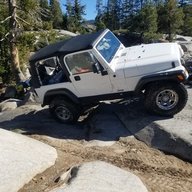
Here's part of it:
TJ SE's and the 2.5 liter engine
There's a lot of discussion around the Jeep 2.5 liter engine and how to increase horse power and torque.
The short answer is, you can't. No one likes that answer, but it's the truth. The 2.5 is what it is. There are a lot of reasons to purchase an SE. Lighter weight, lower purchase price, successfully burns anything that looks and smells like regular pump gas, simpler and slightly less expensive to maintain are among of them. Oh, and they last bloody forever!
The common modifications that are attempted to gain performance are:
4.0 Throttle body
Throttle body spacer
Cold air induction
High flow air filters
IAC sensor relocation
Ford yellow top, 4 hole injectors
Headers
Cat back exhaust system
Power chips
Electric fans
Some of the less common modifications are:
Roller rockers
High performance cams
Ported and polished heads
Stroker kits
CPS modifications
Turbocharging
Wet shot nitrous injection
Let's start with the common modifications first.
Intake modifications:
The TJ SE intake system is designed, and comes from the factory, to flow more air than the 2.5 liter engine needs to produce maximum HP and torque at wide open throttle and maximum load. True fact. There are no meaningful restrictions to air flow. The engineers did a good job of designing the intake system from the start. The only way to get additional air and fuel into the combustion chambers is to put a cam with higher lift and / or longer duration in, bigger intake valves, some form of forced air induction or a wet shot nitrous system on the engine.
Putting a 4.0 throttle body on will give me an extra 10 HP, right? Nope, sorry. Even with port matching the TB to the intake manifold, all you are gaining is the potential to flow more air. The 2.5 is really only an exotic air pump. The head will only flow so much air, and that amount is the air required to fill the combustion chambers at bottom dead center. That is especially true at lower RPMs, where our TJ SE's normally operate on the trail.
Putting a throttle body spacer in has got to improve performance, right? Nope, with the port injection there are no gains to be had with increasing plenum volume with a throttle body spacer. This is especially true of the magic throttle body spacers that promise miracle gains from swirling the intake air. That trick is a left over from the days of carburetors, and even then it wasn't effective. The length of the intake runners and the plenum volume needs to be matched to the engine's displacement, HP and torque bands. The Jeep engineers did that already. No gain to be had there.
Cold air induction has got to give me something, right? After all, cold air is denser than warm air! This is a true statement, as far as it goes. BUT, the difference in air temperature and air density going into the engine with a cold air induction system compared to the stock system is minimal at best. I have never seen or heard of a temperature difference greater than about 10 to 15 degrees F between a cold air system and the stock system. Most of the time the temperature difference is lower than that. The engine realistically doesn't see a difference and any power gains are unnoticeable.
High flow air filters will get more air into my engine, right? Sorry, the stock paper element and air box flow as much air as the engine needs. It also does a much better job of filtering the intake air than any of the aftermarket air filters. It's cheaper as well, and readily available.
So, how about relocating my IAC sensor to the air box? Again, this is only going to show a difference of a few degrees in temperature between the relocated position and the stock position. Once the engine reaches operating temperature and the ECM goes into closed loop mode, the O2 sensor takes over anyway as the ECM controls the air fuel mixture at 14.something to 1. No gains to be had there.
High flow four hole fuel injectors are the clear ticket, right? More fuel = more power! Not going to happen, sorry. Once the engine warms up and the ECM goes into closed loop operation, the amount of fuel injected is based off of the signal from the O2 sensor. The ECM will maintain that roughly 14/1 ratio no matter how much the injectors will potentially flow.
Now about the exhaust system:
Headers will give me more power! Uh, no. The TJ SE exhaust system is not restrictive. It will easily flow all of the exhaust gasses that the 2.5 will generate. The only thing you will gain is noise. And probably exhaust leaks from gasket mis-matches and failures. Headers will also put more heat into your engine compartment. The chances of the tube diameter and tube length matching the power band are also probably lower than the stock cast header.
Cat back exhaust systems are the cat's meow for performance gains. Not really. The Jeep engineers designed the exhaust system to flow the right amount of exhaust and generate the correct amount of back pressure for the 2.5. You can over scavenge the cylinders and kill performance and gas mileage with an ill designed exhaust system.
What about an electric fan? Let's get rid of all that parasitic drag! All the new cars have them. There are reasons to have an electric fan, but for the most part, no. It takes X amount of energy to move Y amount of air through the radiator to keep the 2.5 engine properly cooled. The stock fan does a good job of that, and doesn't generate a ton of parasitic loss at normal speeds. That's what the fan viscous coupling does. There's just not enough gain there to make it worthwhile.
A power chips will rock my 2.5! Nope, not really. You're already getting optimal air flow and the correct fuel mixture. Any gains from additional spark advance are minimal at best and will restrict the octain requirements for the 2.5.
Still working on this...I'll add more later and get through the list!