Line of sight on CB with the normal legal power is limited simply by the curvature of the earth. You might not have a clue about what you are talking about.With all due respect to Mr. Walraven, he is not right about the power just bouncing back and forth until all of it is radiated. Most transmitters will have a 50 Ohm output impedance (or close to it) and a signal reflected from the antenna will largely be absorbed by the transmitter. All other things remaining the same, a 3:1 VSWR will result in 1.25 dB power loss and about 13% reduction in line of sight range.

You are using an out of date browser. It may not display this or other websites correctly.
You should upgrade or use an alternative browser.
You should upgrade or use an alternative browser.

CB Antenna Help
- Thread starter Jewinters
- Start date
If anybody is interested it's all in the document I linked to, if not play all you want with the SWR meter. Just trying to save people some time.
Yes indeed, some here may not have a clue on what they're talking about. Line of sight is more of VHF/UHF or higher frequency trait and not nearly as much of a factor on the HF 27 MHz CB band. 4 watt HF CB signals can travel much further than line of sight in the right atmospheric conditions. HF transmissions often get past line of sight in even imperfect conditions, like from canyon to canyon during the day like I commonly use while wheeling. Sky waves are what causes that to happen during imperfect conditions for HF signals. VHF, UHF, and higher frequencies are strictly line of sight.Line of sight on CB with the normal legal power is limited simply by the curvature of the earth. You might not have a clue about what you are talking about.

Line of sight on CB with the normal legal power is limited simply by the curvature of the earth. You might not have a clue about what you are talking about.
Ha ha. Probably not. But I have been a designer of radios of all sorts at Bell Labs for several decades. Occasionally they work.

Ha ha. Probably not. But I have been a designer of radios of all sorts at Bell Labs for several decades. Occasionally they work.
Frequently when folks list their credentials it's right before or after they've said something ridiculous. Have you ever noticed that. Please, tell me more about RF power and line of sight range.
I enjoy the discussion. This is my SWR meter. You probably wont find one like it in a store.Yes indeed, some here may not have a clue on what they're talking about.
These days if I care I just use this thing to measure the reflected power vs transmitted. Same deal.
Who cares what SWR meter you are using? Yes that is a Bird SWR meter in the last photo, nothing special. What is your point in all this? You're dragging this thread down a rat hole.I enjoy the discussion. This is my SWR meter. You probably wont find one like it in a store.
View attachment 156233
These days if I care I just use this thing to measure the reflected power vs transmitted. Same deal.
View attachment 156235
Good point, let's hope he is using something like RG-59 (looks similar to RG-58) which could account for the problem and present an easy fix. RG-58 or RG-8x being good correct choices.What cable are you using?
Good point, let's hope he is using something like RG-59 (looks similar to RG-58) which could account for the problem and present an easy fix. RG-58 or RG-8x being good correct choices.
I will take a look at the cable in the morning and let you know. It came in a kit from Right Channel Radios.
That's good (but disappointing lol) news as they almost certainly shipped you the right stuff. Radio companies don't use RG-59 which is more for video applications.I will take a look at the cable in the morning and let you know. It came in a kit from Right Channel Radios.
Even if it's the right cable, make sure you test it for continuity. It may still be defective.I will take a look at the cable in the morning and let you know. It came in a kit from Right Channel Radios.
That's good (but disappointing lol) news as they almost certainly shipped you the right stuff. Radio companies don't use RG-59 which is more for video applications.
It’s an RG-8x
Even if it's the right cable, make sure you test it for continuity. It may still be defective.
I did that yesterday afternoon, all good. I performed the checks using this And everything seemed to check out.
The rabbit hole is playing with an SWR meter for zero gain. Isn't that obvious, what performance gain are you trying to achieve. You run a 2m unit, are you always on high power on the trail? Tuning SWR on a system that runs good enough is the rabbit hole, how difficult is that to understand?You're dragging this thread down a rat hole.
I posted the pics because I thought you'd enjoy seeing the equipment but I see you're too caught up in the discussion to have fun with it.

The rabbit hole is playing with an SWR meter for zero gain. Isn't that obvious, what performance gain are you trying to achieve. You run a 2m unit, are you always on high power on the trail? Tuning SWR on a system that runs good enough is the rabbit hole, how difficult is that to understand?
I posted the pics because I thought you'd enjoy seeing the equipment but I see you're too caught up in the discussion to have fun with it.
Usually, you hold good opinions. This one may work for you but, maybe, not for all. To an extreme, it's like saying that your jeep is only running on 5 cylinders and the tires are out of balance, but it gets me to the corner store and back. I would rather know, at least, what is causing the high SWR reading. If I can't readily fix it, because it's an inherent systemic issue, that's one thing. An easily corrected problem is another. At this point, we don't know what is causing the issue.
That's my .02
What have you done so far?
Disconnect the cable at the radio, leave it connected to the antenna. Measure resistance from the shield/ground of the antenna to the center conductor. Measure resistance from the shield/ground to ground of the vehicle. Measure resistance from the center conductor to vehicle ground.
Disconnect the cable at the radio, leave it connected to the antenna. Measure resistance from the shield/ground of the antenna to the center conductor. Measure resistance from the shield/ground to ground of the vehicle. Measure resistance from the center conductor to vehicle ground.
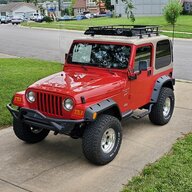
I can not get my SWR below 3.0 on 1 or 40 matter of fact they are practically the same no matter how I adjust the Antenna.
Sometimes it can be the antenna. I had an older Kawasaki touring bike....ungh...long story. Short version: I was experimenting with aftermarket antennas on my motorcycle. Started with a Wilson Flex due to its lightweight and having to hit the top of the garage door every time I pulled in or out of the garage. Horrible, horrible SWR. Like mid-high 2s. Tried a Firestik and getting 1.1 across the range was no problem. But built like a tank. No flex. Went back to an original style and mothballed the 2 experimental antennas.
Fast forward some years, and I'm installing a cb on my Jeep. New CB, new coax, new mount, but I grabbed the old Wilson just to see. Yep. Horrible SWR. Grabbed the same old Firestik.....perfect.
So, I'd suggest trying a different antenna.
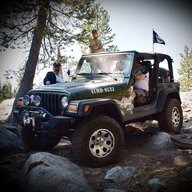
My late father always ran the 8 foot-ish stainless steel whip on his trucks - any experiences with them on Jeeps?
I would not recommend running a 102" whip. They can whip around quite a bit on the trail and hit spotters next to your vehicle. I run a fiberglass 5' or 4' or a Wilson 5000 on my Jeep. The Wilson 5000 gets the best SWR's pretty much flat across the band.
Similar threads

- Replies
- 9
- Views
- 2,291


- Replies
- 43
- Views
- 9,819


