Disconnecting

StG58

TJ Guru
Original poster
Supporting Member
Joined
Oct 29, 2015
Messages
7,782
Location
On the road.
Here's a really dumb question.

I don't disconnect my sway bars, and never have. There's lots of discussion from time to time about quick disconnects, anti-rocks and variants, etc.

What's the deal? Am I missing something? Right now, if I lift a wheel, I lift a wheel and keep on going. Is it because the terrain that I wheel in is just not technical enough to require that little bit of extra articulation or am I really not getting the maximum traction to be had out of my little TJ? What's the theory and practice of disconnecting the front sway bar. And why not the rear, if disconnecting is so good?

Inquiring minds want to know...
 
  • Like
Reactions: LTTJ
Take a look at your rear sway bar and compare it to the front. The rear doesn't hinder you enough to be an issue when articulating. As far as the front sway bar is concerned, the AR is supposed to give your jeep better control when offroad situations require a lot of articulation. Using disco's like JKS quicker discos gives you that articulation, but at a cost of the jeep sometimes feeling tippy when flexing at off camber angles. It's doable, but you just need to be cautious of the lines you pick at slopes. My guess is your territory just doesn't require a lot of flex to negotiate the terrain. Pics never do justice, but here's a quick example for a trail we ran last weekend. My buddy's jeep was negotiating a 3 ft. drop off. He disco'd his front sway bar which helped him keep his tires on the ground.
20170820_141448.webp
 
  • Like
Reactions: Rob5589 and StG58
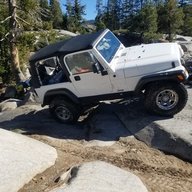
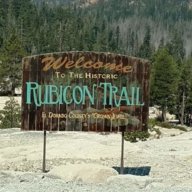
Another example here. This is on the Rubicon trail. Notice my right front stuffed and rear unloaded. Wheels are still touching the ground which gives me more traction and stability.
25.webp
 
You're missing something, trust me.

However, that only applies if you're in a lot of flex situations. If you're just doing forest service roads, you don't need to disconnect.
 
  • Like
Reactions: Ron505 and StG58
Interesting. Thanks for the pictures and explanation.

Not that many rocks around here, at least not like that anyway. We do have logs and stumps and tree roots and big divots though. And ledges. I may have to invest in a set of $40 quick disconnects and play with this.

So the theory is that by disconnecting and getting more articulation, you are keeping the tires in contact with the ground more, right? But aren't you loading the stuffed tire(s) and only marginally loading the drooped tires? Doesn't that effect traction on the drooped tire?
 
  • Like
Reactions: Fouledplugs
Interesting. Thanks for the pictures and explanation.

Not that many rocks around here, at least not like that anyway. We do have logs and stumps and tree roots and big divots though. And ledges. I may have to invest in a set of $40 quick disconnects and play with this.

So the theory is that by disconnecting and getting more articulation, you are keeping the tires in contact with the ground more, right? But aren't you loading the stuffed tire(s) and only marginally loading the drooped tires? Doesn't that effect traction on the drooped tire?
Yes the belief is that the more tires you have contacting a surface, the more likely your Jeep will go where you point it all while being more stable. It can also be looked at as a way to build confidence in your adventures with your Jeep.
 
Take a look at your rear sway bar and compare it to the front. The rear doesn't hinder you enough to be an issue when articulating. As far as the front sway bar is concerned, the AR is supposed to give your jeep better control when offroad situations require a lot of articulation. Using disco's like JKS quicker discos gives you that articulation, but at a cost of the jeep sometimes feeling tippy when flexing at off camber angles. It's doable, but you just need to be cautious of the lines you pick at slopes. My guess is your territory just doesn't require a lot of flex to negotiate the terrain. Pics never do justice, but here's a quick example for a trail we ran last weekend. My buddy's jeep was negotiating a 3 ft. drop off. He disco'd his front sway bar which helped him keep his tires on the ground.
View attachment 21002
It would be interesting to see a TJ navigating an obstacle not disco'd and then disco'd.
Another example here. This is on the Rubicon trail. Notice my right front stuffed and rear unloaded. Wheels are still touching the ground which gives me more traction and stability.
View attachment 21003
I wonder what the load distribution is there. And how it effects traction on each tire in contact with the ground.
You're missing something, trust me.
However, that only applies if you're in a lot of flex situations. If you're just doing forest service roads, you don't need to disconnect.
I do do a little more than FS roads. ;) What I'm trying to do is go back and understand the basics to make an informed decision. I lift a tire on a pretty regular basis, and I'm trying to get the theory and practice of removing or reducing the effects of the front sway bar from the traction equation. You know me, @Chris, I'm not afraid to ask the seemingly dumb questions or challenge the common wisdom to get a better understanding of what makes our TJ's work the way they do.
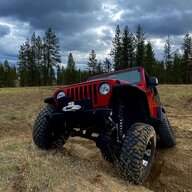
Yes the belief is that the more tires you have contacting a surface, the more likely your Jeep will go where you point it all while being more stable. It can also be looked at as a way to build confidence in your adventures with your Jeep.
That's the catch. The "belief is that the more tires you have contacting a surface, the more likely your Jeep will go where you point it". Empirical evidence is better than belief in my book.

I would seriously like to see and understand the theory of disconnecting (I'm getting there) and then see the evidence that supports that theory. @bobthetj03's pictures helped a lot, as did his explanation.

This is all very interesting and I would like to explore it further and in more detail.
 
Interesting. Thanks for the pictures and explanation.

Not that many rocks around here, at least not like that anyway. We do have logs and stumps and tree roots and big divots though. And ledges. I may have to invest in a set of $40 quick disconnects and play with this.

So the theory is that by disconnecting and getting more articulation, you are keeping the tires in contact with the ground more, right? But aren't you loading the stuffed tire(s) and only marginally loading the drooped tires? Doesn't that effect traction on the drooped tire?

It's more than just traction you're trying to gain, it's also stability of the jeep in an off camber situation. That is where the AR shines. Not only does the AR let you articulate similar to not having the sway bar connected, it also relieves some of that tire load on one side and transfers a bit of the load to the other side for a more stable feel. At least that's how I understand it on the AR. Personally, I have JKS Quick discos and have been wheeling like that for years, but if $$$ happens to fall in my lap, I wouldn't hesitate to install an Antirock setup. Let's use this next picture as reference. Imagine in this pic if my sway bar was connected. Not only would my driver wheel not travel as far into the wheel well, my passenger would also not drop as much due to the force of the sway bar holding it back. You'd actually be loading the driver even more with the force of the sway bar in play, but would also be unloading the passenger side more as if it were stopping at the bumpstops. Now with the driver side not articulating as much, and the passenger side not dropping as much, which direction do you think the jeep is going to start tipping?
20150729_093741.webp

In this pic, I'm on Metal Cloaks CTI ramp measuring max articulation at all 4 wheels. The #'s they provide are mostly marking gimmick stuff, but it does give you the opportunity to get a look under your jeep to see what's hitting and what's fitting. Bumpstop length, tie rod/drag link clearance to diff covers, etc. If that same ramp setup were to have scales at each wheel pad, then your question to the loaded/unloaded forces could be quantified, well to a point I guess.
7.webp
 
Theory: Anti-Sway bars are meant to keep the axles and the body in reasonably the same plane. This is an advantage on road and at higher speeds where lifting a tire is not an advantage. Off road and at lower speeds disconnecting the front anti-sway bar allows the front tires to remain in contact with the road surface with a greater angle between the body plane and the axle plane. The stuffed tire loads more slowly and the drooped tire unloads more slowly because the anti-sway bar is not trying to transfer the weight of the vehicle from the loaded to the unloaded side. The anti-rock doesn't eliminate this transfer, but limits it to a more off road friendly degree.

Sound about right?
 
Last edited:
  • Like
Reactions: bobthetj03
Theory: Anti-Sway bars are meant to keep the axles and the body in reasonably the same plane. This is an advantage on road and at higher speeds where lifting a tire is not an advantage. Off road and at lower speeds disconnecting the front anti-sway bar allows the front tires to remain in contact with the road surface with a greater departure angle between the body plane and the axle plane. The stuffed tire loads more slowly and the drooped tire unloads more slowly because the anti-sway bar is not transferring the weight of the vehicle from the loaded to the unloaded side. The anti-rock doesn't eliminate this transfer, but limits it to a more off road friendly degree.

Sound about right?

Yep, we're getting somewhere now.
 
  • Like
Reactions: StG58
OK, next question. With high performance road cars, I used to use an adjustable front anti-sway bar to tune under steer and over steer. I'm guessing that this is not an issue with a TJ because of the speeds and road conditions where a TJ is used.

At some point then, the loading and unloading of the tires is going to effect the traction available to each tire. Disconnecting just delays when that loss of traction occurs. And somewhere before the tire completely looses traction is when your lockers start becoming useful.
 
Last edited:
Interesting. Thanks for the pictures and explanation.

Not that many rocks around here, at least not like that anyway. We do have logs and stumps and tree roots and big divots though. And ledges. I may have to invest in a set of $40 quick disconnects and play with this.

So the theory is that by disconnecting and getting more articulation, you are keeping the tires in contact with the ground more, right? But aren't you loading the stuffed tire(s) and only marginally loading the drooped tires? Doesn't that effect traction on the drooped tire?
Yep, you get more articulation. Yep, more ground contact. Yep, at some point in the droop you will lose the advantage. Overall, It's better than staying connected.
 
OK, next question. With high performance road cars, I used to use an adjustable front anti-sway bar to tune under steer and over steer. I'm guessing that this is not an issue with a TJ because of the speeds and road conditions where a TJ is used.

At some point then, the loading and unloading of the tires is going to effect the traction available to each tire. Disconnecting just delays when that loss of traction occurs. And somewhere before the tire completely looses traction is when your lockers start becoming useful.

With you knowing what you know about performance road cars, we can wrap our heads around the design of Currie's Antirock sway bar. It's basically an adjustable performance sway bar designed for our jeeps and how they need to perform offroad. So with the AR, as one side loads up as the coil spring compresses, the AR is creating an opposing force. So as the other side unloads, the AR applies a load thus creating stability. There are some trade off though. You won't get quite as much articulation with the AR, but not at a point where you'll lose any working articulation. You'll also notice a bit more sway in higher speed/on the street driving, but not enough to feel uncomfortable. The AR can be adjusted with the different holes on the bar to be stiffer or less stiff, similar to your performance road car sway bar design.
 
  • Like
Reactions: StG58 and JMT
And yes, add lockers to he equation and you further gain forward momentum when flexing. This becomes quite evident when you have an open diff Dana 30 in the front and you've got one side stuffed and the other side unloaded on a climb. The wheel that's unloaded is gonna spin, and the loaded wheel will not.
 
  • Like
Reactions: Van, StG58 and JMT
Most of my older 4x4s never had sway bars. Sway bars became common when the factories tried to bring 4x4s into the main stream. The YJ developed by AMC was the first. Wide track, sway bars, compliant springs, 5speed OD. The sway bar disadvantage is present even crossing a farmers field since the sway bar actually lifts the tire which is unweighted causing it to lose traction and spin sooner. Dropping off a FSR to cross a ditch, same thing. Sure you can do it with sway bars but it will be more comfortable, less drama, better control without sway bars.

Lockers only assist traction. And sure they might keep an airborne wheel from spinning freely BUT disconnect the sway bars and you keep all 4 tires on the road.

Compare that to a race car on flat asphalt. Without the sway bar, beyond body roll, something will lift from the cornering Gs and cause a loss of traction, control.

No matter what you are doing a goal is to keep all 4 tires on the tera firma.
 
Last edited:
  • Like
Reactions: TJ John and StG58
<snip>You'll also notice a bit more sway in higher speed/on the street driving, but not enough to feel uncomfortable. <snip>
It's an SE, lol, I doubt I'd even notice unless I get reeeealy sporty! Good info, I like this.
And yes, add lockers to he equation and you further gain forward momentum when flexing. This becomes quite evident when you have an open diff Dana 30 in the front and you've got one side stuffed and the other side unloaded on a climb. The wheel that's unloaded is gonna spin, and the loaded wheel will not.
Been there and done that. Right now I'm shock loading the front end (and rear end) because there are solid objects in the mix for the tires to catch a hold of so it's spin - catch, spin - catch. There's some pretty nasty snot to contend with about 9 months out of the year. It's not deep, but it is slick.
@StG58, no need to spend money on anything, just unbolt the sb at the axle, bungie it up, and hit the trail. You can see what it's all about for free.
Unfortunately, I'm going to have to spend some coin on this before winter sets in. The rubber bushings on the top of the anti-sway bar links are shot so the links need to be replaced as a maintenance item. Any way I look at it, something is going to get done. The AR is probably overkill at the moment, and the price would keep me from doing some other things that really need doing first. So it's stock links or a set of inexpensive quick disconnects.
 
Most of my older 4x4s never had sway bars. Sway bars became common when the factories tried to bring 4x4s into the main stream. The YJ developed by AMC was the first. Wide track, sway bars, compliant springs, 5speed OD. The sway bar disadvantage is present even crossing a farmers field since the sway bar actually lifts the tire which is unweighted causing it to lose traction and spin sooner. Dropping off a FSR to cross a ditch, same thing. Sure you can do it with sway bars but it will be more comfortable, less drama, better control without sway bars.

Another money shot and piece to the puzzle right there. I remember the old CJ's not having this issue. Twisting axles out of the hub flange yes, but not sway bar complications. :) Some of our runoff control ditches and berms are pretty enthusiastic. Those go at an angle across the road and are bloody everywhere it seems.
 
no 4x4s had sway bars until the 1970s. An SE? try it you might like it.

My TJ had a broken link. Never really noticed until it was fixed. The difference, without the link there was an extra twitch to set up for a corner. With it fixed, no twitch.
 
  • Like
Reactions: StG58
It's an SE, lol, I doubt I'd even notice unless I get reeeealy sporty! Good info, I like this.

Been there and done that. Right now I'm shock loading the front end (and rear end) because there are solid objects in the mix for the tires to catch a hold of so it's spin - catch, spin - catch. There's some pretty nasty snot to contend with about 9 months out of the year. It's not deep, but it is slick.

Unfortunately, I'm going to have to spend some coin on this before winter sets in. The rubber bushings on the top of the anti-sway bar links are shot so the links need to be replaced as a maintenance item. Any way I look at it, something is going to get done. The AR is probably overkill at the moment, and the price would keep me from doing some other things that really need doing first. So it's stock links or a set of inexpensive quick disconnects.
The one thing you do not want to buy are cheap discos. They will rattle, loosen up, and be a bitch to reconnect. If you do it, go with JKS Quicker disconnects. You aren't likely to find many negatives with them.