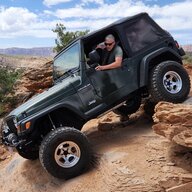
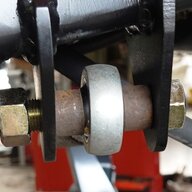
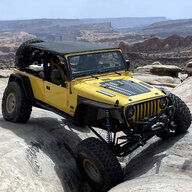
A lesson learned—keep it light and nimble!

Well when I put my midarm on because of the AiRock I needed a joint that would return to center so I got these at the time new Clayton joints that are on the frame end of my lower links. But IMO they're causing me issues since I've got JJ's at the other end... So I'm considering going to MC joints on mine too....

And Yes the Ballistic Fab joints are sort of a JJ knock off but you can grease them without having to disassemble them...

I think I'm going to pull the trigger on the MC replacements for the JJs on the front lower CAs. I talked to them and they don't offer a similar replacement for the smaller 2" joints on the uppers. I think the two front lowers are the only ones that need immediate attention.
 
I think I'm going to pull the trigger on the MC replacements for the JJs on the front lower CAs. I talked to them and they don't offer a similar replacement for the smaller 2" joints on the uppers. I think the two front lowers are the only ones that need immediate attention.

I was thinking something similar. One thing I've noticed during each re-grease is the lowers are always much worse than the uppers. In my case, I'd do all the lowers though.
 
I think I'm going to pull the trigger on the MC replacements for the JJs on the front lower CAs. I talked to them and they don't offer a similar replacement for the smaller 2" joints on the uppers. I think the two front lowers are the only ones that need immediate attention.

When you're ready to pull the trigger you can either come visit for a day or we'll meet up some where and I'll loan you my large JJ tool.

I was thinking something similar. One thing I've noticed during each re-grease is the lowers are always much worse than the uppers. In my case, I'd do all the lowers though.

And I agree that the lower joints seem to be worse than the uppers.
 
I finished up the upper JJ regrease. As is usually the case, the uppers were not as bad as the lowers. All the uppers cleaned up with no pits.

20260622_142807.webp


20260622_142819.webp


20260622_151122.webp
 
Since getting the TJ back from my son, it has become my daily driver. The headlights I gave him suck, so I installed a set of original JW Speaker LEDs. While I don't like the style, these are about as bullet proof as LEDs come. I've had them since 2015, across 3 different Jeeps, and they've seen in excess of 200,000 miles. They were originally Made In USA and the only downside is they're not heated, so they can ice up in winter. Also added yellow LEDs to the fog lights.
https://www.amazon.com/dp/B0D5474TZ8?tag=wranglerorg-20

FWIW, the driver side images show the JW Speaker light, while the passenger side is the existing "Round Eyes" halogen.

20260701_091315.webp


20260701_091321.webp


20260701_091342.webp


20260701_091349.webp


20260701_092559.webp
 
Since getting the TJ back from my son, it has become my daily driver. The headlights I gave him suck, so I installed a set of original JW Speaker LEDs. While I don't like the style, these are about as bullet proof as LEDs come. I've had them since 2015, across 3 different Jeeps, and they've seen in excess of 200,000 miles. They were originally Made In USA and the only downside is they're not heated, so they can ice up in winter. Also added yellow LEDs to the fog lights.
https://www.amazon.com/dp/B0D5474TZ8?tag=wranglerorg-20

FWIW, the driver side images show the JW Speaker light, while the passenger side is the existing "Round Eyes" halogen.

View attachment 697562

View attachment 697563

View attachment 697564

View attachment 697565

View attachment 697566
I've thought very seriously about rigging up some kind of a heating element for the washer reservoir or separate heated tube to pump washer fluid through like Land Rover and some other higher end vehicles do...

But I started doing this a couple winters ago...

Get some of this and either put it in a spray bottle or use a rag and spray or wipe it on the headlight before going out driving in the snow..

1783040106026.webp


https://www.amazon.com/Prestone-AS240-Windshield-Booster-Additive/dp/B0044FV9L6/?tag=wranglerorg-20
 
Okay folks, I've been wanting to do this for a while. Here's my current thought on a direction for the TJ. this is a lot, but I need to get it written down, to start rationalizing the build, parts list, and process:

Planning a 5-Inch Rear Stretch on a TJ — Looking for Critique​


I’m considering stretching my 2003 TJ while keeping the stock tub and basic stock-frame architecture. My goal is improved climbing stability and rear driveshaft length without turning it into a back-halved or heavily reconstructed build.

The current concept is:
  • GenRight Crawler EXT 19.5-gallon tank
  • Approximately 5 inches of rear stretch
  • No predetermined front stretch
  • Final wheelbase likely around 98.5–99 inches
  • 33-inch tires (I'm really wanting to push 33-inch tires and NOT go larger)
  • Conventional rear coils rather than coilovers
  • Rear sway bar retained
The front axle is an XJ high-pinion Dana 30 with 30-spline inners, 27-spline outers, Spicer 5-760X joints, a Yukon Spin Free kit, Eaton E-locker and tie-rod flip. The rear is a Dana stock Rubicon 44.

I originally considered moving the front axle forward 1–1.5 inches to reach 100 inches, but after looking more closely at the track-bar, drag-link, pitman-arm, spring and steering-box packaging, that does not appear to be a practical goal. I would now leave the front alone unless cycling the suspension shows that a small amount—perhaps 1/2 to 3/4 inch—can be gained without compromising steering geometry or full-bump clearance.

For the rear, I’m trying to determine the best overall approach:
  • Triangulated four-link
  • Retaining coils with relocated upper and lower spring mounts
  • Outboarding the rear shocks
  • Proper frame-notch or frame-arch modification
  • Modifying the existing corner armor and wheel opening
  • Differential-cover clearance to the EXT tank at full bump
  • Exhaust, brake-line, parking-brake cable and sway-bar packaging
My tentative sequence would be to install or mockup the GenRight tank, position the rear axle at the intended full-bump and ride-height locations, cycle everything, and then build the links, spring mounts, shocks and bump stops around the confirmed axle position.

Before buying parts or cutting the Jeep, I’d appreciate input on:
  1. Is a full 5-inch rear stretch worth pursuing, or is approximately 4 inches easier to package while retaining better frame and suspension geometry?
  2. Which rear suspension arrangement works best for a street-driven TJ on 33s?
  3. Are conventional coils still a good choice at 5 inches of stretch?
  4. What is the cleanest way to address the factory frame arch while preserving useful uptravel?
  5. Are there known interference issues with the GenRight EXT tank, upper links, differential covers or exhaust that should influence the design?
  6. What would you change in this plan before fabrication begins?

 
Okay folks, I've been wanting to do this for a while. Here's my current thought on a direction for the TJ. this is a lot, but I need to get it written down, to start rationalizing the build, parts list, and process:

Planning a 5-Inch Rear Stretch on a TJ — Looking for Critique​


I’m considering stretching my 2003 TJ while keeping the stock tub and basic stock-frame architecture. My goal is improved climbing stability and rear driveshaft length without turning it into a back-halved or heavily reconstructed build.

The current concept is:
  • GenRight Crawler EXT 19.5-gallon tank
  • Approximately 5 inches of rear stretch
  • No predetermined front stretch
  • Final wheelbase likely around 98.5–99 inches
  • 33-inch tires (I'm really wanting to push 33-inch tires and NOT go larger)
  • Conventional rear coils rather than coilovers
  • Rear sway bar retained
The front axle is an XJ high-pinion Dana 30 with 30-spline inners, 27-spline outers, Spicer 5-760X joints, a Yukon Spin Free kit, Eaton E-locker and tie-rod flip. The rear is a Dana stock Rubicon 44.

I originally considered moving the front axle forward 1–1.5 inches to reach 100 inches, but after looking more closely at the track-bar, drag-link, pitman-arm, spring and steering-box packaging, that does not appear to be a practical goal. I would now leave the front alone unless cycling the suspension shows that a small amount—perhaps 1/2 to 3/4 inch—can be gained without compromising steering geometry or full-bump clearance.

For the rear, I’m trying to determine the best overall approach:
  • Triangulated four-link
  • Retaining coils with relocated upper and lower spring mounts
  • Outboarding the rear shocks
  • Proper frame-notch or frame-arch modification
  • Modifying the existing corner armor and wheel opening
  • Differential-cover clearance to the EXT tank at full bump
  • Exhaust, brake-line, parking-brake cable and sway-bar packaging
My tentative sequence would be to install or mockup the GenRight tank, position the rear axle at the intended full-bump and ride-height locations, cycle everything, and then build the links, spring mounts, shocks and bump stops around the confirmed axle position.

Before buying parts or cutting the Jeep, I’d appreciate input on:
  1. Is a full 5-inch rear stretch worth pursuing, or is approximately 4 inches easier to package while retaining better frame and suspension geometry?
  2. Which rear suspension arrangement works best for a street-driven TJ on 33s?
  3. Are conventional coils still a good choice at 5 inches of stretch?
  4. What is the cleanest way to address the factory frame arch while preserving useful uptravel?
  5. Are there known interference issues with the GenRight EXT tank, upper links, differential covers or exhaust that should influence the design?
  6. What would you change in this plan before fabrication begins?

Having done this last winter, I have lots to say. I did coil overs which definitely added some challenges. But I also did the Savvy 4-link , stock axle housings and kept the Genright 19.5 gallon tank and filler neck in a stockish location. So:
1) more is better. Depends how hard you want work
2) Savvy 4-link is way better than stock, street and trail.
3) this requires a longer conversation. I have thoughts and I’m sure @mrblaine has better ones. DM me if you like and we can discuss by phone.
4) see no. 3
5) yes but doable. Exhaust out the rear will be custom and tight.
6) I considered modifying my corner armor I am very glad I sold my old armor and bought new blanks.
 
Having done this last winter, I have lots to say. I did coil overs which definitely added some challenges. But I also did the Savvy 4-link , stock axle housings and kept the Genright 19.5 gallon tank and filler neck in a stockish location. So:
1) more is better. Depends how hard you want work
2) Savvy 4-link is way better than stock, street and trail.
3) this requires a longer conversation. I have thoughts and I’m sure @mrblaine has better ones. DM me if you like and we can discuss by phone.
4) see no. 3
5) yes but doable. Exhaust out the rear will be custom and tight.
6) I considered modifying my corner armor I am very glad I sold my old armor and bought new blanks.

We won't talk until it involves 35's.
 
  • Like
Reactions: Woodrow
We won't talk until it involves 35's.

I considered suggesting that. But when I made the 33s to 35s leap, it generated more clearance issues than I anticipated. I obviously decided 35s was a better option. Never-the-less, a stretched 33s build is interesting to consider. I think it could be pretty capable and would be definitely easier to pull off. One downside is when you take on a project like this, it ends up being very tire size specific and I think it would be prohibitively difficult to change to 35s later.
 
I considered suggesting that. But when I made the 33s to 35s leap, it generated more clearance issues than I anticipated. I obviously decided 35s was a better option. Never-the-less, a stretched 33s build is interesting to consider. I think it could be pretty capable and would be definitely easier to pull off. One downside is when you take on a project like this, it ends up being very tire size specific and I think it would be prohibitively difficult to change to 35s later.

I didn't say you shouldn't discuss it with him, I just don't see the value in creating a less capable rig for the same amount of work and expense.
 
  • Like
Reactions: UhOh and Woodrow
I ran the math on this using three scenarios: i.e. a 32" tire, a 33" tire, and a 34.5" tire. Since moving up in tire size only nets 1/2 the tire size change, the numbers across all three scenarios weren't that big.

Formula used​

1784471801809.webp


Tire changes are assumed to raise the belly by half of the tire-diameter increase.


ScenarioTrue tireWheelbaseBelly clearanceBreakover angleChange from baseline
Current TJ32.0"93.4"15.00"35.6°Baseline
5" rear stretch33.0"98.4"15.50"35.0°−0.6°
5" rear stretch34.5"98.4"16.25"36.6°+0.9°, or +1° rounded

The exact change for the 34.5-inch tire scenario is +0.941°, which rounds to +0.9° to the nearest tenth or +1° to the nearest whole degree.
 
  • Like
Reactions: Wildman and Woodrow
That said, I know for sure that a 35-inch tire isn't what I'm looking for. This will be a daily driver, serving light wheeling duty. I know it's unconventional, and I'll be leaving capability on the table. However, that capability is marginal, especially when you consider that my TJ on 32s does almost everything I want it too. Where it lacks is on climbing, which the stretch will help with. I also know I'm giving up approach angle but that hasn't been a problem on 32s, given my wheeling scenarios.

FWIW, all of this is thinking out loud, so I can hear your perspectives, and gain from your knowledge. Again, to be clear, the stretch is to help with steeper climbs. I know it's not ideal like the LJ but it's a reasonable balance between the stock TJ and LJ wheelbase.

What else am I missing here?
 
Last edited:
Less capable with a stretch on 33's you mean, right? If so, why's that?

All of this is highly dependant on the terrain and usage....

Having been down a similar road where mine had all the raised skids, mid arm, and outboard while on 33s for many years, there was a very dramatic change in the jeep's capability when I finally put 35s on it.

The difference between 33s and 35s is just enough of a change where the bridging ability of the larger tire makes moving through the terrain much nicer and adds a significant amount of control. That extra inch of diff/axle clearance means a lot where such things matter, the same way raising the skids, body mounts and frame also matter.

I built mine backwards because the 33s were holding the Jeep back from what all the other fancy modifications working together were really capable of. Fundamentally, this is the old discussion of balance and making the individual aspects of the build compliment each other and work together as a system. Tire size is absolutely part of that.
 
  • Like
Reactions: Irun and Woodrow
That said, I know for sure that a 35-inch tire isn't what I'm looking for. This will be a daily driver, serving light wheeling duty. I know it's unconventional, and I'll be leaving capability on the table. However, that capability is marginal, especially when you consider that my TJ on 32s does almost everything I want it too. Where it lacks is on climbing, which the stretch will help with. I also know I'm giving up approach angle but that hasn't been a problem on 32s, given my wheeling scenarios.

FWIW, all of this is thinking out loud, so I can hear your perspectives, and gain from your knowledge. Again, to be clear, the stretch is to help with steeper climbs. I know it's not ideal like the LJ but it's a reasonable balance between the stock TJ and LJ wheelbase.

What else am I missing here?

In my case, a 6.5” stretch (93”-99.5”) while on 35s was a more dramatic change than the difference between 33s and 35s at 93”. The Jeep is much more stable going straight up or straight down as you’d expect. Though you talk about climbing improvement as a reason to stretch, descending was an even greater motivation for me. I’ve been uncomfortably light in the rear more than a few times coming down big drops. The other thing I was pleasantly surprised by after the stretch was stability in off camber situations. Also, I don’t sweat the breakover much. Anything less than 104” and you’re still better than LJ with same tires. And a nice tuck helps both with clearance and a smooth belly that will slide over stuff.