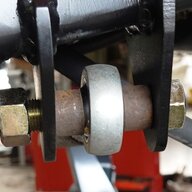
1997 "beater bomb"

Time for the braking guru to chime in, @mrblaine

No one knows more about TJ brakes than him.
I actually seen a few other Google searches where he chimed in.

One thing I've seen is that my rear caliper bleeder bolts face down ward VS facing up?

I've bleed them quite a bit. I am by no means a brake guy. I'm seeing corvette MCs from a 69, e350 ford , and Durango being used.

 
I actually seen a few other Google searches where he chimed in.

One thing I've seen is that my rear caliper bleeder bolts face down ward VS facing up?

You will never get a good bleed until those calipers are turned as in swap them side for side. First hand experience here:rolleyes:
 
  • Like
Reactions: mouth
I'll give it a try tonight. Thanks!
You're welcome.
I have been fighting the brake issue with Stinger since the start of my build. I used the Chevy Hydro boost unit and the truck's master cylinder. Found out the MC s bore was too large and did not deliver enough pressure. Blaine sent me a stock MC (in my ignorance I had sold the stock MC and vacuum unit) well with the hydro boost the stock unit delivered too much pressure but still had soft brakes. Now I have. Durango MC in and it's still not right. Blaine has been a huge help in assisting me in this never ending quest. The guy knows his stuff!
 
  • Like
Reactions: mouth
You're welcome.
I have been fighting the brake issue with Stinger since the start of my build. I used the Chevy Hydro boost unit and the truck's master cylinder. Found out the MC s bore was too large and did not deliver enough pressure. Blaine sent me a stock MC (in my ignorance I had sold the stock MC and vacuum unit) well with the hydro boost the stock unit delivered too much pressure but still had soft brakes. Now I have. Durango MC in and it's still not right. Blaine has been a huge help in assisting me in this never ending quest. The guy knows his stuff!
Yikes! You're in way deeper than me. I've read where k20 were too much for the rear axle. I've read so much the last 24 hrs. I'm leaning toward the Durango MC, maybe smaller rear calipers?
I did remove the rubber o-ring from the PV and tried it. No such luck there either.
 
Yikes! You're in way deeper than me. I've read where k20 were too much for the rear axle. I've read so much the last 24 hrs. I'm leaning toward the Durango MC, maybe smaller rear calipers?
I did remove the rubber o-ring from the PV and tried it. No such luck there either.


With the Durango MC I can just barely hold Stinger still in low gear, low range! No, I am not exaggerating. It takes pedal pressure! As such, the stock MC will probably be going back in and I may have a Durango for sale:)
 
Last edited:
I'm trying to do some research on what master cylinder to swap in, but it's nuts the amount of info. Feeling overwhelmed. Need to find someone who's done a full width swap and talk about what I actually need.
Brakes are simple. The math is simple and it has nothing to do with the width of the axle, only the brakes being used.

You need to know the year and model that your front brakes are so the caliper piston sizes can be looked up. After that, you need to list the components on your rig as far as master, booster, rear brakes, combo valve, and any other modifications to the brake system that are pertinent.
 
With the Durango MC I can just barely hold Stinger still in low gear, low range! No, I am not exaggerating. It takes pedal pressure! As such, the stock MC will probably be going back in and I may have a Durango for sale:)
That will all get better when you quit trying to solve your brake problems without a good foundation. Don't sell the Durango master, you may need it sooner than you think.
 
  • Like
Reactions: Stinger
Brakes are simple. The math is simple and it has nothing to do with the width of the axle, only the brakes being used.

You need to know the year and model that your front brakes are so the caliper piston sizes can be looked up. After that, you need to list the components on your rig as far as master, booster, rear brakes, combo valve, and any other modifications to the brake system that are pertinent.
OK thanks. Front brakes are 1977 ford f150. The booster, and MC are still factory as far as I know. Rears are from GM front calipers from mid 80s k20.

No real modifications, only using -3 stainless line from calipers to the hard lines.
 
Since I'm no longer running abs, should I remove that system and by pass it with new lines?
 
Last edited:
Since I'm no longer running abs, should I remove that system and by pass it with new lines?
All you do for the bypass is remove the plug at the back of the combo valve and convert it to a port with a screw in adapter from a non ABS valve and that connects to one front line, the other connects to the other front line.

The port for the rear brake discos from the ABS pump and hooks up to the rear line.

You have some brake issues with your caliper selection. As you noted, you have front brakes on the rear. If you plan to drive it in 2 wheel drive ever, it will be almost impossible to stop the rears from locking up first. The piston is larger in that caliper than even the monster front you have on there from the Ford.

Typical rule of thumb is the front caliper piston surface area has to be double the rear piston area.

Your front pistons are 73mm or 6.42 square inches, the rears are 80mm and need to be 55ish mm to balance out correctly and get the bias close to correct.

The stock booster and master can work with those if you get the bias correct and swap in a 98 Durango master. If you try to use the stock master and get the system all bled correctly, the pedal will be very spongy and very close to if not on the floor before it stops well.
 
  • Like
Reactions: mouth
That will all get better when you quit trying to solve your brake problems without a good foundation. Don't sell the Durango master, you may need it sooner than you think.
Did I mention that to someone like me that has no freaking clue, Bliane can be cryptic?
Sorry Mouth don't want to hijack your thread.
 
Sounds like I need to hunt for some smaller rear calipers to start things off.
And you are correct the pedal is soft and it doesn't stop til I have the brakes almost to the floor
 
Did I mention that to someone like me that has no freaking clue, Bliane can be cryptic?
Sorry Mouth don't want to hijack your thread.
Brakes are a system that has to have all the pieces in balance and working perfectly in order to do a simple task. The foundation is good components, quality rotors, high friction pads, and a caliper that has good distribution of braking force across the back of the pad.

Once you have that, then you need an excellent way to provide reliable high pressure into the caliper to build the braking force in the form of clamping pressure to make the pads work as good as possible. You have the reliable high pressure but no good foundation. When you get the good foundation, you will wonder what took you so long. You're wagging the dog with the tail but it is a very good tail, now you just need a good dog.
 
Sounds like I need to hunt for some smaller rear calipers to start things off.
And you are correct the pedal is soft and it doesn't stop til I have the brakes almost to the floor
Hydraulic principles are very simple. If you increase the bore size of the master into the same caliper, you wind up with a higher harder pedal but at the expense of loss of pressure into the caliper. If you increase the bore size of the pistons, you wind up with a lower softer pedal because the pressure is now higher into the caliper. The challenge is finding the correct balance between bore size and pedal travel and caliper size and clamping pressure.

If you have unlimited booster power which you don't, you can run any size master your legs can stand. If you have limited booster power which you do, you have to ease the bore size in the master up until you get a decent pedal without a large loss in clamping force from the lower pressure into the caliper.

We give up pressure to get pedal feel at the expense of clamping force when we run too large of a caliper due to the inverse nature of hydraulics.

Yes, you need smaller rear calipers. Dig around for a set of Metric GM caliper mounts and then use the dirt track calipers with smaller pistons.
 
  • Like
Reactions: Chris and mouth
Like I said!;););). I'd like to give you a ride in my helicopter sometime.:rolleyes:

I don't understand how adding a hydro booster onto a stock master cylinder can cause such a huge difference in pedal feel.
 
Like I said!;););). I'd like to give you a ride in my helicopter sometime.:rolleyes:

I worked the JK Short Lead Media Launch and spent two weeks on the Rubicon playing Jeep servant to the media. Mel runs a chopper service and ferries everything from Loon Lake to the Rubicon Springs camp. He also ferried us servants from Rubicon Springs over to the small airport and they bussed us to Squaw Valley Ski Resort to drive the JK's back to camp after the media drove them up Cadillac Hill. His helicopter is a Hughes 500 which looks sorta like the one in your avatar that he hot rodded with a larger turbine and a smaller diameter 5 blade rotor to fit through the trees easier. After several trips with him, I have a lifetime supply of helicopter rides. But, thanks for the offer.

I don't understand how adding a hydro booster onto a stock master cylinder can cause such a huge difference in pedal feel.

Why not? You took a variable output moderate power vacuum based system and converted to high power non variable force hydraulic and are now overpowering a crappy caliper. The only way to improve pedal feel is to sacrifice braking or make yourself work harder to kill the spongy pedal.
 
  • Like
Reactions: Chris
Well we flipped the calipers side to side and bled them again. Works amazing well compared to before.
 
  • Like
Reactions: Stinger