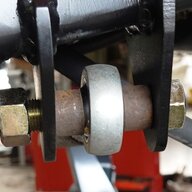
Factor 55 flat link vs standard winch hook

Blaine: while I have your attention for a moment...

Is there a functional or practical difference between the TRE safety thimble fairlead and the Savvy winch hoop with the thimble mount? To my eye, they look basically similar in function, with the difference simply being that one requires a winch hoop and pin, and the other does not.
No one liked the hoop or even wanted a hoop. I had to solve the problem a different way.
 
It sounds like a well designed aluminum hawse is the best solution for synthetic right now.

If a roller stops rolling, it becomes a poorly functioning hawse. Producing a steel/iron hawse suitable for synthetic ropes sounds labor intensive and cost prohibitive. Plastics are not a viable option yet. Aluminum works well as long as both the fairlead and the rope designs are paired to each other so as to not create self-inflicted problems.
Warn actually has a very nice one. Then they go and fuck it all up with a tube thimble that gouges the aluminum.
 
No one liked the hoop or even wanted a hoop. I had to solve the problem a different way.

That certainly answers the question. Up for another one? I hope so.

A few posts back, you said: "Any fairlead has to be able to withstand enough vertical loading to pick the front of the rig off the ground and maybe more depending on what is hung up." That started me thinking: the only thing holding the fairlead to the vehicle is the fairlead mount/winch deck. Is this the reason behind the angled sides on the Savvy winch deck that wrap back underneath the winch? It seems that without those in place, the only thing keeping the fairlead mount in its shape is the existing bend: there's no bracing, otherwise. That section looks suspiciously vital, to me.
 
That certainly answers the question. Up for another one? I hope so.

A few posts back, you said: "Any fairlead has to be able to withstand enough vertical loading to pick the front of the rig off the ground and maybe more depending on what is hung up." That started me thinking: the only thing holding the fairlead to the vehicle is the fairlead mount/winch deck. Is this the reason behind the angled sides on the Savvy winch deck that wrap back underneath the winch? It seems that without those in place, the only thing keeping the fairlead mount in its shape is the existing bend: there's no bracing, otherwise. That section looks suspiciously vital, to me.
Precisely why the angle gusset arrangement is built into the mount as well as the full winch width stiffener to increase the strength of the winch deck. Almost all winches we use depend on a precise arrangement of the holes to act as the rest of the winch assembly and hold it together. Most have tie bars or the integrated switch housing across the top, the winch deck completes the other side.

Very few bumper or fairlead mount builders understand what is going on in that area.
 
Very few bumper or fairlead mount builders understand what is going on in that area.

So, in your opinion, would this bumper be a good starting point, or a bad starting point? 3/16" steel, uses all of the stock mounting points, but it has no vertical support in the rear; can an added winch deck alone provide the necessary rigidity?

Pictured: Pencil included for scale.

IMG_20181027_160248-L.webp
 
  • Like
Reactions: bobthetj03
So, in your opinion, would this bumper be a good starting point, or a bad starting point? 3/16" steel, uses all of the stock mounting points, but it has no vertical support in the rear; can an added winch deck alone provide the necessary rigidity?

Pictured: Pencil included for scale.

View attachment 79208
Good start. You need the vertical lip of at least the same thickness and roughly 1.25" as close to 90 degrees up or down and a stiffened deck.
 
Does it matter if the vertical support on the rear of the bumper is welded in, or can it be adequately bolted in? If I'm bolting on a stiffened deck, it seems logical that bolts will also work for correcting the oversight at hand.

Oh, I'm derailing the thread. Sorry about that, everyone. I'll fix it: FACTOR 55 FUCKING SUCKS. All better!
 
Last edited:
Does it matter if the vertical support on the rear of the bumper is welded in, or can it be adequately bolted in? If I'm bolting on a stiffened deck, it seems logical that bolts will also work for correcting the oversight at hand.

Oh, I'm derailing the thread. Sorry about that, everyone. I'll fix it: FACTOR 55 FUCKING SUCKS. All better!
Doesn't matter as long as the number and quality of fasteners is sufficient to duplicate the strength of a welded lip and not your welds.
 
Oh, I'm derailing the thread. Sorry about that, everyone. I'll fix it: FACTOR 55 FUCKING SUCKS. All better!

You could put it here:
https://wranglertjforum.com/threads...hare_tid=13933&share_fid=1075363&share_type=t
But personally I think it's a close enough segway to the original subject. F55 makes fairleads as well so I'd say discussing fairlead mounts is valid subject matter. ;)

Speaks of rediculous things... Thoughts on the giant F55 fairleads? More hype or does the reduced radius help with rope longevity?


There must have been a time
when we could have said no.
 
Thoughts on the giant F55 fairleads? More hype or does the reduced radius help with rope longevity?

1. The thicker the fairlead, the further it has to be recessed to keep it out of the rocks.

2. Wider radius for longevity: once you pass the suggested minimum radius, I doubt the radius has any impact at all. I'll look that up later today.

3. A larger opening to let a 1/2" thimble to get pulled in is still pulling a thimble into the fairlead...

4. Wrapping the rope around the front of the fairlead and then back towards your suspension and using it for a suck-down winch - their suggestion - is a bad idea. The edges that the rope passes over are too sharp, and I'm not sure how that bevel is supposed to do anything. If you point the fairlead straight down, it works like any other suck-down fairlead from the main winch.

5. Can't comment on the finish; don't know enough about it.

6. Why are side pulls worse than extreme angles in any other direction?
 
1. The thicker the fairlead, the further it has to be recessed to keep it out of the rocks.

2. Wider radius for longevity: once you pass the suggested minimum radius, I doubt the radius has any impact at all. I'll look that up later today.

It certainly isn't going to be worse for rope as the radius increases.

6. Why are side pulls worse than extreme angles in any other direction?
Side pulls are something that even smart folks like Warn are confused about. The last 5 or so thimbles I have spliced on have required about 20 feet of line to be cut off. The drum is full nearly to the tie bars with them carefully wound. When a side pull is done, the rope stacks up on one side and can get into the tie bar/integrated bridge and the winch deck. Under load, the risk is very real to at a minimum damage or part the line, maximum, blow up the winch by physically expanding the tie bars/bridge to failure and splitting the winch apart. Even with the normal 2 layer gap below a full drum we have had to stop, tie off the rig being recovered, spool out, reconfigure the wraps evenly, and start again.

 
Side pulls are something that even smart folks like Warn are confused about. The last 5 or so thimbles I have spliced on have required about 20 feet of line to be cut off. The drum is full nearly to the tie bars with them carefully wound. When a side pull is done, the rope stacks up on one side and can get into the tie bar/integrated bridge and the winch deck. Under load, the risk is very real to at a minimum damage or part the line, maximum, blow up the winch by physically expanding the tie bars/bridge to failure and splitting the winch apart. Even with the normal 2 layer gap below a full drum we have had to stop, tie off the rig being recovered, spool out, reconfigure the wraps evenly, and start again.

Makes sense, but that's a problem that can't be solved with a fairlead...so I'm wondering how it's germaine to their fairlead ad. Simplest response: it isn't.
 
Makes sense, but that's a problem that can't be solved with a fairlead...so I'm wondering how it's germaine to their fairlead ad. Simplest response: it isn't.
I didn't read the ad so I am unaware of their claims. I will assume that like most of their crap that it is the same jaw jacking that the rest of it is.
 
I didn't read the ad so I am unaware of their claims. I will assume that like most of their crap that it is the same jaw jacking that the rest of it is.

I'll put it to you this way: I dislike these guys even more than MetalCloak...and you know how I feel about that company. I'll give F55 credit for good customer service for sending me a security key to undo one of their winch locks on a winch that I bought - free of charge, 2nd-day air, very nice on the phone - and for making the winch lock bolt itself (which is not a bad product) but that doesn't change how I feel about their recovery products. Misdirection is one thing, but fucking with recovery gear just to sell it is downright dangerous. Here's the ad:

Factor 55 introduces a new line of Aluminum Hawse Fairleads. The 1.0 and 1.5 fairleads are CNC machined from 1 and 1.5 inch thick USA 6000 series aluminum bar. The industry standard fairlead thickness is .75 inches thick.

The thicker aluminum bar results in a larger outer fillet radius for the synthetic rope to slide against. This results in less stress on the rope fibers during high angular pulls, increasing the life of your synthetic rope. The 1.0 and 1.5 fairleads are the industry’s first Hawse fairleads compatible with larger ½ inch diameter rope tube thimbles.

The rope slot height opening is taller to allow the larger ½” tube thimbles to pass through. There is also a machined outer corner chamfer to reduce rope stress for those than plan on using the winch as a front suspension “suck down” device. These fairleads come in a durable MIL-A-8625F TYPE III gun metal gray hard anodized finish with a laser engraved logo.

What is the best surface finish for Hawse aluminum fairleads? Without a doubt it is a Type III hard anodized coating. Not cosmetic Type II anodized finishes, not powder coated, and not raw or polished aluminum. Why? Because a hard coating can resist the abrasion damage from a dirty/gritty synthetic winch rope rubbing across it. Especially during extreme side pulls where rope fiber stresses are extremely high. A Mil-A-8625 Type III hard anodized finish leaves a .002” thick Al2O3 ceramic coating that is in the top 5 hardest materials known to mankind (See chart under Corundum/Sapphire). Not too far away from diamond hardness actually. Another valuable material property from hard anodized coatings are the low coefficients of friction. Low friction = lower rope heat. Only drawback? Hard anodizing is not offered in typical bright and fancy anodized colors. All Factor 55 fairleads only come in Mil-A-8625 hard gray finishes. Not fancy, but it is the proper finish to extend the life of your synthetic rope.

Overall Dimension: 12.35″ x 3.25″

Standard 10″ Bolt Mount Spacing

For synthetic winch rope only.
 
I'll put it to you this way: I dislike these guys even more than MetalCloak...and you know how I feel about that company. I'll give F55 credit for good customer service for sending me a security key to undo one of their winch locks on a winch that I bought - free of charge, 2nd-day air, very nice on the phone - and for making the winch lock bolt itself (which is not a bad product) but that doesn't change how I feel about their recovery products. Misdirection is one thing, but fucking with recovery gear just to sell it is downright dangerous. Here's the ad:

Factor 55 introduces a new line of Aluminum Hawse Fairleads. The 1.0 and 1.5 fairleads are CNC machined from 1 and 1.5 inch thick USA 6000 series aluminum bar. The industry standard fairlead thickness is .75 inches thick.

The thicker aluminum bar results in a larger outer fillet radius for the synthetic rope to slide against. This results in less stress on the rope fibers during high angular pulls, increasing the life of your synthetic rope. The 1.0 and 1.5 fairleads are the industry’s first Hawse fairleads compatible with larger ½ inch diameter rope tube thimbles.

The rope slot height opening is taller to allow the larger ½” tube thimbles to pass through. There is also a machined outer corner chamfer to reduce rope stress for those than plan on using the winch as a front suspension “suck down” device. These fairleads come in a durable MIL-A-8625F TYPE III gun metal gray hard anodized finish with a laser engraved logo.

What is the best surface finish for Hawse aluminum fairleads? Without a doubt it is a Type III hard anodized coating. Not cosmetic Type II anodized finishes, not powder coated, and not raw or polished aluminum. Why? Because a hard coating can resist the abrasion damage from a dirty/gritty synthetic winch rope rubbing across it. Especially during extreme side pulls where rope fiber stresses are extremely high. A Mil-A-8625 Type III hard anodized finish leaves a .002” thick Al2O3 ceramic coating that is in the top 5 hardest materials known to mankind (See chart under Corundum/Sapphire). Not too far away from diamond hardness actually. Another valuable material property from hard anodized coatings are the low coefficients of friction. Low friction = lower rope heat. Only drawback? Hard anodizing is not offered in typical bright and fancy anodized colors. All Factor 55 fairleads only come in Mil-A-8625 hard gray finishes. Not fancy, but it is the proper finish to extend the life of your synthetic rope.

Overall Dimension: 12.35″ x 3.25″

Standard 10″ Bolt Mount Spacing

For synthetic winch rope only.
I find it hypocritical that they discuss the qualities of anodizing while offering anodized colors that are guaranteed to do only one thing, fade and change color. They are correct in their assessment of that particular process, but it is nowhere near the hardness of diamond.
 
Since this is a thread about factor 55, what are your thoughts on the hitch link? I recently installed the savvy aluminum rear bumper with the 2" reciever, and I was considering purchasing the hitch link to have a point for rear recovery since that bumper doesn't have rings for a soft shackle. Would I be better off just using a standard hitch WITHOUT the ball? Or is the hitch link acceptable?
 
I find it hypocritical that they discuss the qualities of anodizing while offering anodized colors that are guaranteed to do only one thing, fade and change color. They are correct in their assessment of that particular process, but it is nowhere near the hardness of diamond.

Solid point.

Also, I just did a bit of research on the anodizing specification they mentioned, and that particular standard doesn't seem to make a difference between conventional anodizing and electrolytic oxidation; the former makes a softer version of aluminum oxide, and the later makes a layer with a hardness that can reach 2,000 on the Vickers scale. Problem is - as you said - diamond is 10,000 on that scale. Let's hope they use the latter process, but even if they do it's still kind of a misleading statement. I'm also unsure of whether or not a super-hard finish is really that useful in this application.
 
Since this is a thread about factor 55, what are your thoughts on the hitch link? I recently installed the savvy aluminum rear bumper with the 2" reciever, and I was considering purchasing the hitch link to have a point for rear recovery since that bumper doesn't have rings for a soft shackle. Would I be better off just using a standard hitch WITHOUT the ball? Or is the hitch link acceptable?

Mount a tow hook on the rear frame.
 
From Samson: "when a rope is deflected more than 10 degrees around a surface, the effective diameter of that surface should not be less than three times the diameter of the rope."

So, for a 3/8"-ish rope, the radius on the hawse fairlead should be 9/16" at a minimum.
 
Last edited: