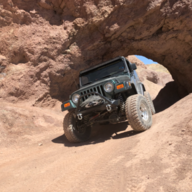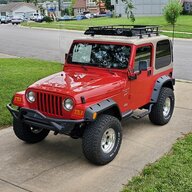
Ice chest vs. TJ

Have you put ice cream salt/rock salt in your ice chest before?
I fully understand the salt thing and I add rock salt to the ice when I'm making ice cream as it helps freeze the ice cream mix faster. But to just add salt to my ice in the ice chest? Nope, it's not going to help keep items cold in the chest longer in normal ice chest uses and I sure don't want my ice chest filled with salt water once all of the ice has melted. Which is why you don't see recommendations to add salt or rock salt to the ice in an ice chest used for keeping food/drinks for a multi-day need.

My planned use of block ice will work fine for the 3 days we'll be on the trail and I'll still have most of that block left when I'm done. I kept one block of ice for several years with multiple uses per year. It got slightly smaller each use of course but it was still big enough to put back into the freezer when I got home. I'll give most of the credit for that to the Coleman eXtreme cooler which is the best cooler I've owned in 50 years of camping... since I've never owned a Yeti etc. I'll see if that cooler works even better after adding the additional insulation (the Great Stuff I'll be adding today) I mentioned above. Insulation is king to keeping ice longer, the Great Stuff can only make it work better as a cooler. I expect a significant improvement. Maybe nearly as good as a Yeti or Cabelas. :)
 
I fully understand the salt thing and I add rock salt to the ice when I'm making ice cream as it helps freeze the ice cream mix faster. But to just add salt to my ice in the ice chest? Nope, it's not going to help keep items cold in the chest longer in normal ice chest uses and I sure don't want my ice chest filled with salt water once all of the ice has melted. Which is why you don't see recommendations to add salt or rock salt to the ice in an ice chest used for keeping food/drinks for a multi-day need.

My planned use of block ice will work fine for the 3 days we'll be on the trail and I'll still have most of that block left when I'm done. I kept one block of ice for several years with multiple uses per year. It got slightly smaller each use of course but it was still big enough to put back into the freezer when I got home. I'll give most of the credit for that to the Coleman eXtreme cooler which is the best cooler I've owned in 50 years of camping... since I've never owned a Yeti etc. I'll see if that cooler works even better after adding the additional insulation (the Great Stuff I'll be adding today) I mentioned above. Insulation is king to keeping ice longer, the Great Stuff can only make it work better as a cooler. I expect a significant improvement. Maybe nearly as good as a Yeti or Cabelas. :)
I understand that the block ice works great for your use, and that's great. We are out a lot longer on 10 day hunting trips. Just a little rock salt on the bottom of your ice chest is needed to keep things colder longer. I have 3 Yetis. 2 large ones and one small one. Yeti has a pamphlet inside the cooler recommending rock salt. I have use them for years and have added rock salt as recommended and know it works. For 3 day trips I don't need to use rock salt.
 
I understand that the block ice works great for your use, and that's great. We are out a lot longer on 10 day hunting trips. Just a little rock salt on the bottom of your ice chest is needed to keep things colder longer. I have 3 Yetis. 2 large ones and one small one. Yeti has a pamphlet inside the cooler recommending rock salt. I have use them for years and have added rock salt as recommended and know it works. For 3 day trips I don't need to use rock salt.

Does mixing salt with water produce an endothermic reaction?
 
I can't explain how or why it works, I just know it works for my needs. I don't want to argue over it with anyone either. If something else works better for you, then great, but you can't just come on and say it doesn't work if you haven't tried it.
 
  • Like
Reactions: Daryl and DrDmoney
Salt makes the water melt without inherently gaining any temperature. Thus it will make your beer colder because water transfers heat better than the air next to your ice. It won't make your cooler stay cold any longer though. It just doesn't work that way. If you need to cool off warm beer fast, salt your ice.

I spent quite a few hours looking for anything with greater thermal mass than water and there just about isn't anything readily available and safe to put in a cooler. Salt has less thermal mass than water so adding salt water to those plastic bottles for solid ice doesn't do you any good, nor would it do any good in keeping things cold longer. In the end I decided you're best off getting your ice as cold as possible in a chest freezer and not putting anything warm into your cooler. Anything like meat that isn't going to be used for a couple days is best packed frozen as well.
 
Salt makes the water melt without inherently gaining any temperature. Thus it will make your beer colder because water transfers heat better than the air next to your ice. It won't make your cooler stay cold any longer though. It just doesn't work that way. If you need to cool off warm beer fast, salt your ice.

I spent quite a few hours looking for anything with greater thermal mass than water and there just about isn't anything readily available and safe to put in a cooler. Salt has less thermal mass than water so adding salt water to those plastic bottles for solid ice doesn't do you any good, nor would it do any good in keeping things cold longer. In the end I decided you're best off getting your ice as cold as possible in a chest freezer and not putting anything warm into your cooler. Anything like meat that isn't going to be used for a couple days is best packed frozen as well.
Be careful. Adding too much salt to your cooler will freeze your beer solid.
 
The main effect of salt is freezing point depression.
https://en.m.wikipedia.org/wiki/Freezing-point_depressionThe effect of using salt in an ice maintained cooler is that the melting temperature of the ice will be lower.

Due to the effects of latent heat, ice melting will maintain the temperature at the freezing point until the ice is gone. Lower the freezing point, and you lower the maintained temperature. Adding salt to bottles of frozen water or bulk ice will cause them to melt at a lower temperature. They will maintain a colder temperature, but for a shorter period of time, because the colder the interior of the cooler is, the faster heat transfer will occur.

Adding salt does not increase the cooling capacity of ice, nor will it allow it to last longer. It will simply result in a lower maintained temperature until the ice is gone.

Now, with the melted saltwater, it will actually cool warm products faster than ice or ice and water alone. Ice with no water doesn’t have as much contact area as ice/water mix, and the rate of heat transfer will be slower. Add salt to the water, and the water/ice temperature will be lower, and you will maximize the rate of heat transfer over ice or ice/water alone.

Whether or not you add salt to the ice should be dependent on what you are storing. If you are storing refrigerated goods, use no salt. The temperature in the cooler will be maintained at the freezing point of pure(ish) water, so your products are unlikely to freeze. If you want to keep products frozen, use a significant amount of salt. The average temperature will be significantly lower, allowing frozen goods to stay frozen. To store products like ice cream, which melt well below 32 degrees, you will need a lot of salt.

The cost of adding salt for a lower temperature is that the lower temperature will accelerate heat transfer between the inside and the outside of the cooler. The largest loss of heat in a closed cooler is going to be through conduction (as opposed to convection or radiation). The rate of heat transfer through conduction is proportional to the difference in temperatures between the inside and the outside of the cooler. Thus, the same volume of salted ice will not be able to maintain the constant temperature as long as the unsalted ice.

That being said, the addition of salt to already frozen ice will not result in a constant temperature. As the ice melts, the salt will be diluted, and the freezing point will slowly raise as the ice continues to melt. The solution would be to freeze salt water to maintain a constant temperature lower than the standard freezing point.
 
...
4. Reflectix or similar foil-backed bubble insulation wrapped around the cooler helps increases the R value. (Some ACE hardware stores sell it by the linear foot.) Anything that keeps the sun off the cooler and heat at bay will work, including an ordinary blanket, jacket, windshield sun shade, etc.
...

Not to sidetrack from the salt debate... But I have used the foil-backed bubble insulation for a number of things. I have basically underlined under the carpet of my entire Jeep with the stuff. I cut small pieces for under all of the floorboards as well as larger piece that runs under the entire back of the Jeep. Its all under the carpet so you never even see it. But you will know its there. The heat that rises up from the floor boards is noticably reduced by having the foil-backed bubble insulation under the carpet. I'm sure my coolers keep things cold longer due to the insulation under the carpet. Especially under the exhaust side. Always pay attention to where your exhaust runs. You don't want to put cold things on top of the exhaust pipes.
 
Last edited:
  • Like
Reactions: DrDmoney
Not to sidetrack from the salt debate... But I have used the foil-backed bubble insulation for a number of things. I have basically underlined under the carpet of my entire Jeep with the stuff. I cut small pieces for under all of the floorboards as well as larger piece that runs under the entire back of the Jeep. Its all under the carpet so you never even see it. But you will know its there. The heat that rises up from the floor boards is noticably reduced by having the foil-backed bubble insulation under the carpet. I'm sure my coolers keep things cold longer due to the insulation under the carpet. Especially under the exhaust side. Always pay attention to where your exhaust runs. You don't want to put cold things on top of the exhaust pipes.
I also carry a couple old moving blankets to cover the ice chests with. Like you say, anything to help.
 
I bought a used Yeti 45 on Craigslist for $200 and strapped it down to the top of my Tuffy box. I make my own ice, both for the Jeep and for offshore fishing. A couple of Big Ice Trays will make a dozen 4” ice cubes and I can add a few more pounds of ice cubes from my home refrigerator. This mix will easily work for an extended weekend, especially if you employ some of the common sense ideas that have already been mentioned (like keeping it closed as much as possible).
9
View attachment 106571
I bought a used Yeti 45 on Craigslist for $200 and strapped it down to the top of my Tuffy box. I make my own ice, both for the Jeep and for offshore fishing. A couple of Big Ice Trays will make a dozen 4” ice cubes and I can add a few more pounds of ice cubes from my home refrigerator. This mix will easily work for an extended weekend, especially if you employ some of the common sense ideas that have already been mentioned (like keeping it closed as much as possible).

View attachment 106571

Cool wheel mounted table! Did you buy it or make it?
 
...

... I'll see if that cooler works even better after adding the additional insulation (the Great Stuff I'll be adding today) I mentioned above. Insulation is king to keeping ice longer, the Great Stuff can only make it work better as a cooler. I expect a significant improvement. Maybe nearly as good as a Yeti or Cabelas. :)
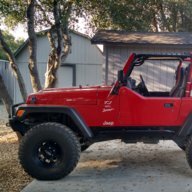
Did you get a chance to test the Great Stuff Coleman cooler on the Rubicon?
 
Did you get a chance to test the Great Stuff Coleman cooler on the Rubicon?
I did, and it really helped. It kept ice & everything cold inside until I got back home. Part of that credit goes to having a large block of ice in the center but I was happy. My second smaller ice chest? All the ice had melted by the second day.
 
  • Like
Reactions: jjvw