Introduction - EV time for TJs

4x4 EVC

TJ Enthusiast
Original poster
Supporting Vendor
Supporting Member
Joined
Dec 9, 2024
Messages
113
Location
Los Angeles
Hello All,

Wanted to introduce myself and what we do, briefly.

I'm Patrick, I own 4x4 EV Conversion (4x4evc.com). We convert Jeeps to all EV Jeeps.

Here's a picture of a CJ-7 we did:
20241024_095820 - cropped - for YouTube background - rev5 - 2048x1152.webp


We have a new website and a sister site we use to make sure we know all the changes for the entire TJ run - jeepchanges.com. Right now, we only track the TJs but will add the CJ and YJ as I have time.

From 1955 to 2006, we only do Jeep conversions.

I hope you guys enjoy the work we do but I'm 100% available to all that might want to ask quesitons for this new section of engine swaps for Jeeps.

Right now, we are pushing to get more TJ customers since that's the line we are working on now.

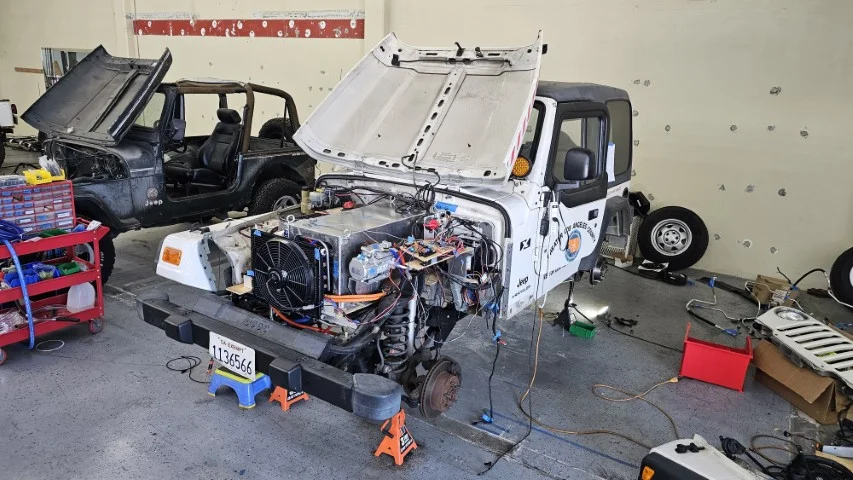
Here is a shot of work in progress for a 2003 RHD TJ:


I'll stop there, hope to hear from you guys.

- Patrick

20260329_151754 (Small).webp
 
Does this retain the transfer case or is it an AWD setup?

With the instant torque of electrics, I wasn't sure if a transfer case was even necessary.

Oh yes, full retention of the stock drivetrain (manual).

You only use 2nd and 3rd gears for daily driving but all the other gears and the TC is fully functional and hasn't been moved form it's orignal position.

Torque is the key here and you can make even more of it when in lower gears.

It's something to behold.

For automatic transmisions, we use a planatary gear reduction unit for the 'transmission' and retain the NP231 TC.

- Patrick
 
This seems to be a good way to get an EV without all the bullshit screens and electronics.

Knowing Jeeps and Jeep owners as well as I do, mostly because I've never not had a CJ or Wrangler or Grand W. in the entire time from my 15 birthday (1969 CJ-5A) to now at 62, I fully hear you about all the added crap that could be added.

Trust me, you will want some of it but the way we do it, you can add or NOT add anything you want. We build these EV conversion Jeeps with 100% end customer accessibility.

Also, all our conversions are on the backbone of CAN Bus networks. Calm down, don't let the scary acronym scare you. It's the network for all modern vehicles, ICE or EV.

That means, if you go to Speedhut, you'll find literally hundreds (288 when I checked just now!) of dials and gauges that plug right in.

If you're like the Dude and prefer brevity, we include a very basic gauge we source from EV West, here it is:

1787073846731.webp


You can read about it here if you like: https://evwest.com/mfd15-can-bus-display-for-tesla-and-hyper-9-systems-with-bms-info

My entire goal is to offer nothing more than a viable EV engine swap option and to take NOTHING away from the stock Jeep.

If you say it fast, it sounds easy....

- Patrick
 
If you're like the Dude and prefer brevity, we include a very basic gauge we source from EV West, here it is:

View attachment 705161
Now THAT is the way it should be done. I've always said that all an EV needs a battery, a good PWM controller, and an "E-meter" for battery status - similar to your gadget above. No phucking screens!

Why don't you just eliminate the transmission altogether? Serious question, 'cause I don't know...
 
  • Like
Reactions: Chris
Now THAT is the way it should be done. I've always said that all an EV needs a battery, a good PWM controller, and an "E-meter" for battery status - similar to your gadget above. No phucking screens!

Why don't you just eliminate the transmission altogether? Serious question, 'cause I don't know...

Good question, for sure.

There are about 4 ways to electrify an ICE vehicle that all EV builders use today - most include adding a Tesla motor to the front, back or both. The other is to do as you suggest and eliminate the trans and TC and come out of the Dana Motor (yes, did I mention that the EV motor we use is made by Dana...), to a yoke to a prop shaft to the diff.

I can do that but so can anyone.

In my mind, that's not a Jeep, it's an imposter trying to look like a Jeep. I feel like, 'if I wanted a Tesla, I'd buy one'. But, I want a Jeep that can do what only Jeeps can do. That means, you have to keep the drivetrain in tact and as stock as possible.

That means, you have to replace the ICE motor with an EV motor (the Dana Hyper9HV) that basically emulates the ICE motor functions of rotation of a central shaft that drives the trans (or reduction unit in an automatic stock setup) and a transfer case, then it's all stock from there.

There are other considerations, not the least of which is cost. A modern conversion can run into the $ hundreds of thousands dollars and take over a year to deliver.

And weight - all Tesla motors and Leif motors and whatever else is being used, all live and breath at 400V. That's a lot more weight than what we have now. We are 86lbs BELOW stock weight and very well balanced front to rear. Our builds are 144V nominal - use just 7 battery modules.

And, complexity. There is no way to build such a beast and make it something the average Jeeper can work on. ZERO chance of that, not because Jeepers aren't modern and shit, it's that almost all the components in such a build are sealed and NOT servicable, by design.

Suspension. All axle / motor swaps kill any chance at any real suspension articulation. It's just not in the design of those drive unit, understandable. And don't even think about an rock contact on a drive unit, not good.

So, cost, weight, design, suspension and actual functional use as a Jeep - those all add up to something I'm not personaly interested in driving or manufacturing.

Hell, I think the 4xe is a disaster of a design for many of those reasons. But, what the heck do I know, nobody asked me to run Jeep this week.

If that doesn't answer your questions, PLEASE, ask again or ask for any additional details, I LOVE smart questions!

- Patrick
 
Good question, for sure.

There are about 4 ways to electrify an ICE vehicle that all EV builders use today - most include adding a Tesla motor to the front, back or both. The other is to do as you suggest and eliminate the trans and TC and come out of the Dana Motor (yes, did I mention that the EV motor we use is made by Dana...), to a yoke to a prop shaft to the diff.

I can do that but so can anyone.

In my mind, that's not a Jeep, it's an imposter trying to look like a Jeep. I feel like, 'if I wanted a Tesla, I'd buy one'. But, I want a Jeep that can do what only Jeeps can do. That means, you have to keep the drivetrain in tact and as stock as possible.

That means, you have to replace the ICE motor with an EV motor (the Dana Hyper9HV) that basically emulates the ICE motor functions of rotation of a central shaft that drives the trans (or reduction unit in an automatic stock setup) and a transfer case, then it's all stock from there.

There are other considerations, not the least of which is cost. A modern conversion can run into the $ hundreds of thousands dollars and take over a year to deliver.

And weight - all Tesla motors and Leif motors and whatever else is being used, all live and breath at 400V. That's a lot more weight than what we have now. We are 86lbs BELOW stock weight and very well balanced front to rear. Our builds are 144V nominal - use just 7 battery modules.

And, complexity. There is no way to build such a beast and make it something the average Jeeper can work on. ZERO chance of that, not because Jeepers aren't modern and shit, it's that almost all the components in such a build are sealed and NOT servicable, by design.

Suspension. All axle / motor swaps kill any chance at any real suspension articulation. It's just not in the design of those drive unit, understandable. And don't even think about an rock contact on a drive unit, not good.

So, cost, weight, design, suspension and actual functional use as a Jeep - those all add up to something I'm not personaly interested in driving or manufacturing.

Hell, I think the 4xe is a disaster of a design for many of those reasons. But, what the heck do I know, nobody asked me to run Jeep this week.

If that doesn't answer your questions, PLEASE, ask again or ask for any additional details, I LOVE smart questions!

- Patrick

Probably more like a dumb question - but why can't you put the motor in the doghouse, and run a drive shaft to the T-case (for selectable 2/4WD) and eliminate the tranny altogether? What do you need the transmission for?
 
  • Like
Reactions: jjvw and 4x4 EVC
Probably more like a dumb question - but why can't you put the motor in the doghouse, and run a drive shaft to the T-case (for selectable 2/4WD) and eliminate the tranny altogether? What do you need the transmission for?

(seriously, PLEASE, there are NO dumb questions about this, NONE!)

Damn, you stumped me right out of the gate, now I feel stupid.

Where is the 'doghouse' ? Bellhousing and trans tunnel area??

I did a google search to see what you're talking about, I found a lot of Jeep ready dog houses, you know, for dogs...

The principal reason for a transmission of some kind, in my EV Jeeps and all EVs in the world, is the need to have enough rotational power to turn the motor under load one time, in essence, to get it to rotate. You do get all the torque the EV motor can put out at 1rpm but that's not much against load.

Even all Tesla motors have built in 'transmissions' (planetary gear reduction units) built into the drive unit (that's what Tesla calls the motor assembly). You want a certain level of motor rpm to be in your EV 'power band' (there is no power band in EVs but it's the easiest metaphor for this question).

Transmissions help with that PLUS, give you so many options when going off-road.

I don't use 1st gear unless some insane Echo Park neighborhood 45deg hill or I'm off-road and need as many rotations as possible to get unstuck. Likewise, we don't use 4th gear because the 1:1 ratio is just not enough umph to really do anything. That being said, my top out speed in 3rd gear before stop accelerating out of fear is around 80mph with NO effort on the motor at all.

The other main reason, of course, you have to connect to the TC otherwise, it's not a 4x4 but a 4x2 (is that a thing...?).

- Patrick
 
  • Like
Reactions: Zorba and Chris
(seriously, PLEASE, there are NO dumb questions about this, NONE!)

Damn, you stumped me right out of the gate, now I feel stupid.

Where is the 'doghouse' ? Bellhousing and trans tunnel area??

I did a google search to see what you're talking about, I found a lot of Jeep ready dog houses, you know, for dogs...

The principal reason for a transmission of some kind, in my EV Jeeps and all EVs in the world, is the need to have enough rotational power to turn the motor under load one time, in essence, to get it to rotate. You do get all the torque the EV motor can put out at 1rpm but that's not much against load.

Even all Tesla motors have built in 'transmissions' (planetary gear reduction units) built into the drive unit (that's what Tesla calls the motor assembly). You want a certain level of motor rpm to be in your EV 'power band' (there is no power band in EVs but it's the easiest metaphor for this question).

Transmissions help with that PLUS, give you so many options when going off-road.

I don't use 1st gear unless some insane Echo Park neighborhood 45deg hill or I'm off-road and need as many rotations as possible to get unstuck. Likewise, we don't use 4th gear because the 1:1 ratio is just not enough umph to really do anything. That being said, my top out speed in 3rd gear before stop accelerating out of fear is around 80mph with NO effort on the motor at all.

The other main reason, of course, you have to connect to the TC otherwise, it's not a 4x4 but a 4x2 (is that a thing...?).

- Patrick

Wasn't aware that EV motors needed gear reduction, but it makes sense. So why not just insert a planetary and save the weight and drag of the stock transmission?
 
Wasn't aware that EV motors needed gear reduction, but it makes sense. So why not just insert a planetary and save the weight and drag of the stock transmission?

Interesting follow up question - had to take a second to put together how to reply.

The easy answer is that if you accept what I decide as your final output rpm, than that restricts your driving to whatever I decide is best. IN the case of an EV like a Chevy Bolt or a IONIC5, (or any other OEM EV), the motor is tuned for the road they that matches the driver profile they are selling to.

The design and understanding with Jeeps is the driver decides to transit via highway or dirt path with ruts. The final rpm output is determined by the driver utilizing a variable transmission.

The longer and more complicated answer involves conceiving of a Jeep specific drive unit that incorporates an as yet not made 2-speed EV transmission directly connected to the transfer case, all in about the size of the stock skid plate.

Trust me, I've invested a lot of brain time to this down the road major upgrade. I'd have to get in bed with some of the big, heavy gear and hard part manufactures, and, well, I'm too tiny at the moment to even glance at.

Interesting where the mind takes you when you begin to shift away from the all-to-linier ICE setups of our youth.

- Patrick
 
my top out speed in 3rd gear before stop accelerating out of fear is around 80mph with NO effort on the motor at all.

Any concern for wear/longevity on the input gear resulting from long term everyday use of the rpm associated with 3rd gear at 80mph? Isn't that around 5500rpm?
 
  • Like
Reactions: Zorba
Any concern for wear/longevity on the input gear resulting from long term everyday use of the rpm associated with 3rd gear at 80mph? Isn't that around 5500rpm?

First and foremost - I DO NOT GO 80mph in my EV Jeeps or any other Jeep. The ONLY reason I know it can go that fast is it does it so silently and without the ICE feeling of sound and vibration to give you any indication of the effort, I looked down once and it was off the speedometer 85MPH mark and the GPS speedometer I put in to get a better reading of actual MPH read 82, 83, 84mph.

My new mental gauge is looking around on the highway and wondering why everyone else is going so slow.... Danger Will Robinson, DANGER!

Other than the occasional 70mph passing, I try to keep it under 65mph on the highway.

Now, on to your root question - wear and tear on the connective parts.

The Dana motor has an output shaft that connects to the input shaft of the various transmissions. We custom make that, here's some pictures of it:
1787164146808.webp


In our configuration, the coupler is hard fixed to the motor shaft BUT the splined side is lose to the transmission input shaft. This allows for the tiny amount of transmission center spline movement (normal) and was where we were worried about it causing any wear.

On our test Demo Jeep, we've torn the TAC (Torque Adapter Cover) down about 12 times. Now approaching 9k EV driven miles.

I assumed I'd see some of that grayish slurry at the bottom of it, hopefully showing only mild signs of contact with two interacting and rapidly rotating parts.

BUT, to my complete surprise, it never presented. Nothing. The small amount of weep from the transmission into the TAC, were the coupler lives and spins away, nothing, not even a hint of gray or any feeling of grit.

So, that's external of the transmission, now to the internal of the transmission...

At about 4k miles, I decided to take the transmission out and have it rebuilt. Not for any reason, it just seemed stupid not to have a baseline of rebuilt 'new'.

My interest was in the 2nd / 3rd synchro and specifically the brass thrust rings, the ones that cause the spinning shafts to slow to a point that synchro mesh is allowed to do it's magic. My logic was that these were and are the most wearable parts by design, They should reflect any additional wear or any excessive wear, especially in the thin thread-like inner part that's designed to use friction to slow the rotation down.

Again, 100% surprised that the stock transmission not only had no excessive wear, it had no decolorization, a symptom of heat when they wear OR are pushed hard to engage from gear to gear. Nothing.

I send all my rebuilds to Box and Gear - Yes, yes, I know, you're thinking Box and Gear is probably a dating bar, I mean, sure, I was hoping it was but, no, just gears and gear boxes. Sad,

But, Jessie, the owner's son and chief over there was likewise very happy with the rebuild and the lack of wear at any of the stock transmission wear points.

I worry and worry about parts I can't see, like these. But, so far, ZERO wear and tear on the stock parts or the adapter / coupler parts.

Color me surprised.

Here's a snap of the Motor Cradle Assembly (MCA) being pulled out during one of those early inspections.
1787164286826.webp


Lastly, here's my RPM to MPH chart for the T176 Transmission (not a TJ transmission):
1787166393735.webp


That's for 3rd gear. If I hit 5000rpm, I think the Jeep would simply explode at 95mph...

Even in 2nd gear, it's not an excessive load on the ICE running gears:
1787166621665.webp


Additionaly, I lock out the Dana motor from anything above 6000rpm, as a precaucation. This can be removed by the end customer but that's how we ship them.

That motor, by the way, has a max of 10,000rpm.

Hope this comes close to answering your question.

- Patrick

1787166182096.webp
 
So hook up a splined EV motor output like the Netgain Hyper9 to a 1310 or 1350 yoke to a short shaft, connected to a 2 or better 4 speed Atlas 4:1 transfer case.

-Mac

I like it, I can see it.

But, for now, I need to focus on just a viable motor swap options, not so much on what I know some of you guys will do to punish and test the limits.

The Hyper9HV is the Dana motor we are using. The Hyper9HV is the trade name for that motor and is sold by NetGain Motors. A great EV motor.

The reduction unit is from TorqueTrends. They make a HD version that we might experiment with down the road.

The hard part, is always, the connective / adapter parts from motor to Trans to TC. The combo options are many. I'm focusing, for now, on the stock parts to sit between and work with.

BUT, I know there's a guy in Europe that has a NP231 to Atlas face already built. Haven't put my hand on it yet but saw the pictures.

As much as I want to wonder down that path, each step off the straight line I'm walking eats time and resources ($$$). Things in short supply.

Keep thinking that way, push push push!

- Patrick
 
  • Like
Reactions: Zorba
First and foremost - I DO NOT GO 80mph in my EV Jeeps or any other Jeep. The ONLY reason I know it can go that fast is it does it so silently and without the ICE feeling of sound and vibration to give you any indication of the effort, I looked down once and it was off the speedometer 85MPH mark and the GPS speedometer I put in to get a better reading of actual MPH read 82, 83, 84mph.

My new mental gauge is looking around on the highway and wondering why everyone else is going so slow.... Danger Will Robinson, DANGER!

Other than the occasional 70mph passing, I try to keep it under 65mph on the highway.

Now, on to your root question - wear and tear on the connective parts.

The Dana motor has an output shaft that connects to the input shaft of the various transmissions. We custom make that, here's some pictures of it:
View attachment 705278

In our configuration, the coupler is hard fixed to the motor shaft BUT the splined side is lose to the transmission input shaft. This allows for the tiny amount of transmission center spline movement (normal) and was where we were worried about it causing any wear.

On our test Demo Jeep, we've torn the TAC (Torque Adapter Cover) down about 12 times. Now approaching 9k EV driven miles.

I assumed I'd see some of that grayish slurry at the bottom of it, hopefully showing only mild signs of contact with two interacting and rapidly rotating parts.

BUT, to my complete surprise, it never presented. Nothing. The small amount of weep from the transmission into the TAC, were the coupler lives and spins away, nothing, not even a hint of gray or any feeling of grit.

So, that's external of the transmission, now to the internal of the transmission...

At about 4k miles, I decided to take the transmission out and have it rebuilt. Not for any reason, it just seemed stupid not to have a baseline of rebuilt 'new'.

My interest was in the 2nd / 3rd synchro and specifically the brass thrust rings, the ones that cause the spinning shafts to slow to a point that synchro mesh is allowed to do it's magic. My logic was that these were and are the most wearable parts by design, They should reflect any additional wear or any excessive wear, especially in the thin thread-like inner part that's designed to use friction to slow the rotation down.

Again, 100% surprised that the stock transmission not only had no excessive wear, it had no decolorization, a symptom of heat when they wear OR are pushed hard to engage from gear to gear. Nothing.

I send all my rebuilds to Box and Gear - Yes, yes, I know, you're thinking Box and Gear is probably a dating bar, I mean, sure, I was hoping it was but, no, just gears and gear boxes. Sad,

But, Jessie, the owner's son and chief over there was likewise very happy with the rebuild and the lack of wear at any of the stock transmission wear points.

I worry and worry about parts I can't see, like these. But, so far, ZERO wear and tear on the stock parts or the adapter / coupler parts.

Color me surprised.

Here's a snap of the Motor Cradle Assembly (MCA) being pulled out during one of those early inspections.
View attachment 705279

Lastly, here's my RPM to MPH chart for the T176 Transmission (not a TJ transmission):
View attachment 705329

That's for 3rd gear. If I hit 5000rpm, I think the Jeep would simply explode at 95mph...

Even in 2nd gear, it's not an excessive load on the ICE running gears:
View attachment 705333

Additionaly, I lock out the Dana motor from anything above 6000rpm, as a precaucation. This can be removed by the end customer but that's how we ship them.

That motor, by the way, has a max of 10,000rpm.

Hope this comes close to answering your question.

- Patrick

View attachment 705328

Sort of. I'm not necessarily thinking of wear that would show up in the short term so much as that which would appear as a reduced life. Bearing life is measured in millions of revolutions, and your application spins the input bearing almost twice as many times for the same miles by using 3rd gear. That means the expected life of that bearing will be half of what it was originally designed for. It may have enough safety margin in the original design to not reveal itself as a weak link. Just something to be aware of.
 
Sort of. I'm not necessarily thinking of wear that would show up in the short term so much as that which would appear as a reduced life. Bearing life is measured in millions of revolutions, and your application spins the input bearing almost twice as many times for the same miles by using 3rd gear. That means the expected life of that bearing will be half of what it was originally designed for. It may have enough safety margin in the original design to not reveal itself as a weak link. Just something to be aware of.
Man, I love where your head is!

So, yes, exactly the type of normal but potentially quicker wear and tear at the Transmission input shaft front bearing - good question.

What we found was that the removal of the flywheel for the purpose of balancing the crank was the greatest determinate of that bearing to excessively wear or fail. What we found on the 3 times we replaced / inspected that bearing (it was leaking from age early in the process so we replaced the seal and bearing at the same time, 2nd time was for the transmission rebuild at around 4k EV miles and lastly just to inspect it on a removal) that it was as if brand new.

Once we figured out that most of the normal wear was caused by the normal lateral movement that is countered by the flywheel, and we removed that eccentricity, the bearing showed no wear at all.

Extending that out, if we are half wrong, it wouldn't show any wear for a very very long time.

But, time will tell. More data points will need to be gathered over time.

- Patrick
 
I had a thought today... If this was mentioned here or in the other thread, I've either already forgotten or I didn't see it, so I apologize if it has.

How does this EV motor get along with water? I'm completely ignorant about most things EV, so forgive me if this is a dumb question. But for example: can it be driven across a river/stream that an ICE powered vehicle would otherwise be able to cross? Can it handle deeper water? None? What exactly are the limits when it comes to water exposure?
 
  • Like
Reactions: macleanflood
I had a thought today... If this was mentioned here or in the other thread, I've either already forgotten or I didn't see it, so I apologize if it has.

How does this EV motor get along with water? I'm completely ignorant about most things EV, so forgive me if this is a dumb question. But for example: can it be driven across a river/stream that an ICE powered vehicle would otherwise be able to cross? Can it handle deeper water? None? What exactly are the limits when it comes to water exposure?

The Hyper9 HV (the trade name for the Dana motor TM4) is basically an open drip proof motor, meaning, it can actually have water flow through it and still run. Trust me, I've seen the videos BUT strongly discourage any home tests like that.

In all trail test, with any water crossings, NOT up above the motor, the motor didn't blink.

I would think it's about has reliable as any drive unit on any (most) other drive unit such as Teslas and such. The water issue is, at least for me, the battery boxes. We spend a lot of time working on making the Back Battery Box as water proof and sealed as we can. We include a leak detection sensor inside the Back Battery Box that lights up on the dash if tripped.

The thought being, if something breaks INSIDE the Back Battery box and the coolant leaks, we instruct our customers to park on slight up hill grade (a curb is enough) and open the stop plug in the back corner of the Back Battery box with the included hex key and see if any liquid comes out.

If it does, let it drain and call a tow truck.

If off road, we were thinking of having a pumped way to drain the Battery Boxes and limp off the trail to have it towed in to your garage for service. Yes, you can service the Battery Boxes yourself.

You can drive the EV Jeep without coolant for short, not punishing limp out situations, much like all limp out scenarios. The battery cells don't eat much heat but the inverter needs it's own coolant loop and is isolated from the other loop so no problem there.

Again, not a stupid question whatsoever, not even close.

This subject might lead to the myth that hurting your battery is a total loss of the vehicle, Not true and not that expensive. We use Tesla Model S modules. When I built the first ones, I paid about $1500 per module. Now, they are below $500/module (there are 7 modules per EV Jeep).

To remove the Back Battery Box takes a floor jack and about 30 min of time (HV connector disconnect, BMS circular plug disconnect, 3 cooling hoses, 3 bolts on the back cross member and 7 bolts on the back cross member (stock bolt locations).

Hope this helps.

- Patrick
 
The Hyper9 HV (the trade name for the Dana motor TM4) is basically an open drip proof motor, meaning, it can actually have water flow through it and still run. Trust me, I've seen the videos BUT strongly discourage any home tests like that.

In all trail test, with any water crossings, NOT up above the motor, the motor didn't blink.

I would think it's about has reliable as any drive unit on any (most) other drive unit such as Teslas and such. The water issue is, at least for me, the battery boxes. We spend a lot of time working on making the Back Battery Box as water proof and sealed as we can. We include a leak detection sensor inside the Back Battery Box that lights up on the dash if tripped.

The thought being, if something breaks INSIDE the Back Battery box and the coolant leaks, we instruct our customers to park on slight up hill grade (a curb is enough) and open the stop plug in the back corner of the Back Battery box with the included hex key and see if any liquid comes out.

If it does, let it drain and call a tow truck.

If off road, we were thinking of having a pumped way to drain the Battery Boxes and limp off the trail to have it towed in to your garage for service. Yes, you can service the Battery Boxes yourself.

You can drive the EV Jeep without coolant for short, not punishing limp out situations, much like all limp out scenarios. The battery cells don't eat much heat but the inverter needs it's own coolant loop and is isolated from the other loop so no problem there.

Again, not a stupid question whatsoever, not even close.

This subject might lead to the myth that hurting your battery is a total loss of the vehicle, Not true and not that expensive. We use Tesla Model S modules. When I built the first ones, I paid about $1500 per module. Now, they are below $500/module (there are 7 modules per EV Jeep).

To remove the Back Battery Box takes a floor jack and about 30 min of time (HV connector disconnect, BMS circular plug disconnect, 3 cooling hoses, 3 bolts on the back cross member and 7 bolts on the back cross member (stock bolt locations).

Hope this helps.

- Patrick

So if I'm understanding correctly, you basically just don't want the motor completely submerged under water, and avoid anything that could compromise the integrity of the battery box and it's ability to stay dry? Don't get me wrong.... I don't intend to strap on scuba gear and try to cross a lake by driving across the bottom with 8+ feet of water above my head submarine style.

Just wondering about how things would play out if you accidentally slid into deep water or drove into an area of water that is deeper than expected and end up with water halfway up the windshield.

Such things can obviously end horribly for an ICE equipped vehicle, but if you play your cards right and the stars align, draining the engine and refilling with fresh oil could be all that's needed for the engine. Just didn't know if that would be the kiss of death for the EV motor.

I appreciate you taking the time to answer all of the questions thrown your way. Not many would be willing. It's especially useful in this instance with something so new and unknown to so many and I'm learning quite a bit. 👍