Looking for ball joint opinions

This graphic is from the link you posted:
View attachment 670621

If you look at the design of the inner Cs, the bottom portion is considerably more stout than the top. The reason for this is that the bottom ball joint carries a lot more load than the top, and that load is transferred to the bottom of the C. That's typical for this type of suspension, and the reason why lower ball joints are usually much larger than uppers.

They're claiming that by adjusting the upper ball joint's pre-load, they are putting a higher portion of the load on the upper ball joint, and that is a true statement - pre-loading that upper ball joint puts more load on it and less load on the lower ball joint. However, it also puts more load on that weaker portion of the C. I don't have enough experience with the TJ, yet, to know if the upper portion of the C is a weak point in the system. However, I've seen reinforcement gussets added in that area, which makes me think it is a weak point in the system. Why would you want to put more load on the weak point (assuming it is)?

You got most of it. Some of the below will reinforce your words.

I will say that this being a MC product is not the tiniest bit surprising. Only a company with zero critical thought skills, no engineering ability, and a high dependence upon customer ignorance would come out with a product like this.
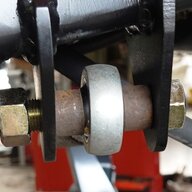
1- the upper pin in stock form floats up and down by about 1/4" or so to compensate for difference in tapers. That also means that the upper ball joint was never designed to nor intended to carry any vertical loads.

2 Why do you hate your steering knuckles so much or are so ignorant as an engineer that you would ever subject an overhung ear with a terrible stress riser at the base of it to vertical loads? The design of that upper ear and the smaller mass of the upper portion of the inner C tells you very explicitly that it was never designed for vertical loads nor do you want to subject your steering knuckles to those forces. They are only designed to handle lateral loads, period.
1770324921237.webp


The lower carries all the vertical loads. You can tell that by the fact that ball joint presses in from the bottom and hits a machined flat spot with a machined shoulder. The inner C below the centerline of the axle tube is beefy, gusseted and matches the lower part of the knuckle which has the balljoint hole in line with the highest strength reinforced portion of the knuckle. The fact that the upper presses in from the top also tells you that the upper was never supposed to carry vertical loads and as such, the inner C above the axle tube was not beefed up to do so. Yes, I'm aware that they have a mechanism to stop their upper from getting puked upward but that doesn't fix the overhung ear on the knuckle.
 
Piggybacking on this thread. I’m getting ready to replace my TJ’s ball joints, is there any other components that should be changed out during the process? Was thinking U-joints and hubs possibly?

I replaced all other suspension components last year and did the ZJ steering upgrade but other than that everything is original. It’s a 2004 with 96k miles for reference.
 
Piggybacking on this thread. I’m getting ready to replace my TJ’s ball joints, is there any other components that should be changed out during the process? Was thinking U-joints and hubs possibly?

I replaced all other suspension components last year and did the ZJ steering upgrade but other than that everything is original. It’s a 2004 with 96k miles for reference.

I did my u joints at the time and inner axle seals. When the hub bearings were off, it was easy to tell they were still good so I left them. Beware of changing out good high quality parts for bad. Sometimes you can make things worse- don't change out good Spicer parts for cheap Duralast while you are in there.
 
I did my u joints at the time and inner axle seals. When the hub bearings were off, it was easy to tell they were still good so I left them. Beware of changing out good high quality parts for bad. Sometimes you can make things worse- don't change out good Spicer parts for cheap Duralast while you are in there.

As much as I like wrenching on the Jeep I’m not looking to have something fail or repeat the job sooner than I need to. Going with the spicer ball joints and ujoints and timken hubs if they need to be done. Any recommendations on the axle seals? I may do brakes as well depending on how they look.
 
Piggybacking on this thread. I’m getting ready to replace my TJ’s ball joints, is there any other components that should be changed out during the process? Was thinking U-joints and hubs possibly?

I replaced all other suspension components last year and did the ZJ steering upgrade but other than that everything is original. It’s a 2004 with 96k miles for reference.

I recently replaced my ball joints and also replaced the sealed u-joints while in there. I hadn't noticed any noise or clunking in turns, but when I removed them several of the caps and needle bearings were completely dry and rusting. I doubt they would have lasted much longer.
 
As much as I like wrenching on the Jeep I’m not looking to have something fail or repeat the job sooner than I need to. Going with the spicer ball joints and ujoints and timken hubs if they need to be done. Any recommendations on the axle seals? I may do brakes as well depending on how they look.

If the seals don’t leak don’t replace them. They require removing the carrier to replace.