I’m fighting carsickness-wife drives like an Earnhardt- bent axle flange caused mine.



I'm assuming you are talking about something like this https://www.vibracoustic.com/en/product/nrg-disc-flexible-rubber-couplings/ Could be used, theoretically, but it wouldn't be something that could easily be done. You'd have a hard time finding any drive shaft shops that can build one this way (ourselves included) and you'd have to have a flange for your pinion for the rubber coupling to attach to. This flange, to my knowledge, does not exist for a dana 35 or 44 so you'd have to get a custom pinion flange made. These rubber couplings are becoming more common I think in some newer vehicles but they don't have the same robust reliability as a universal joint. Same goes for Rzeppa CV joints. That's what Jeep decided to put in all their Wranglers starting in 2007 which ironically has been the biggest boost in aftermarket u-joint style drive shafts. The new designs of joints that are meant to reduce vibrations, or maybe just give engineers something to do, work great in stock vehicles. It is when people start making changes to their jeep that the stock drivetrain components fail. Also, a universal joint can run smoothly at a degree or two, no problem. The oscillation is still there but at such a low level that it is unnoticeable and virtually non existent. It is as angle increases that the oscillation increases and people start to notice issues. There's some heady tech info that my dad (Tom Wood) wrote probably 20 years ago that explains the u-joint operation in greater detail here if you are interested https://4xshaft.com/blogs/general-tech-info-articles/driveshaft-angles.Interestingly, Dana also offers a flexible coupling for their driveshaft components that is rated to a 1 degree continuous and 2 degree maximum operating angle. They’re also designed to absorb torsional vibration. I wonder if this could be used to replace or supplement the lower single u-joint on a standard double cardan shaft…

Shawn WoodMaybe a question to pose to Shawn Woods?
This is the country where we take square bread, round meat, diced onions, sliced tomatoes and lettuce leaves, stack it together and cut it diagonally- then complain it falls apart.start making changes to their jeep
Sort of off topic, but this principle is actually the principle used to detect gravity waves. Basically, a device called an interferometer is used to measure incredibly tiny deviations in the length of a given space. Take a laser, break the beam into two dimensions. Merge the beam again, and tune the distance until the resultant beam is at maximum intensity. If one leg changes length relative to another, even on the order of a nanometer over a mile, you can visibly see the result as the resultant light gets dimmer and brighter as the space we occupy literally changes size. With this, we can literally see the gravity wave effects of black holes merging somewhere millions of light-years away, with surprising frequency.yep, we're on the same page 100% with that being the physical principle behind this...I've been using that principle to tune my guitar since 1998, though I don't think I actually understood it until I took physics in 2000-2001. I put some visuals to it about a year and a half ago, before I even had a rig that suffered from this.
https://wranglertjforum.com/threads...tions-after-re-gear-thread.32445/#post-691117
View attachment 310498
View attachment 310499
I just think some of us may be hearing the interference between two driveshafts, others may be hearing it between a driveshaft plus the resonant frequency of something else, or the resonant frequency of two components that are near the speed of the driveshaft, which itself isn't enough to perceive but may be enough to excite something else.

Why are they not called + joints or x joints?
That is some interesting information, thanks. Those articles were especially useful as I began learning about some of this stuff.I'm assuming you are talking about something like this https://www.vibracoustic.com/en/product/nrg-disc-flexible-rubber-couplings/ Could be used, theoretically, but it wouldn't be something that could easily be done. You'd have a hard time finding any drive shaft shops that can build one this way (ourselves included) and you'd have to have a flange for your pinion for the rubber coupling to attach to. This flange, to my knowledge, does not exist for a dana 35 or 44 so you'd have to get a custom pinion flange made. These rubber couplings are becoming more common I think in some newer vehicles but they don't have the same robust reliability as a universal joint. Same goes for Rzeppa CV joints. That's what Jeep decided to put in all their Wranglers starting in 2007 which ironically has been the biggest boost in aftermarket u-joint style drive shafts. The new designs of joints that are meant to reduce vibrations, or maybe just give engineers something to do, work great in stock vehicles. It is when people start making changes to their jeep that the stock drivetrain components fail. Also, a universal joint can run smoothly at a degree or two, no problem. The oscillation is still there but at such a low level that it is unnoticeable and virtually non existent. It is as angle increases that the oscillation increases and people start to notice issues. There's some heady tech info that my dad (Tom Wood) wrote probably 20 years ago that explains the u-joint operation in greater detail here if you are interested https://4xshaft.com/blogs/general-tech-info-articles/driveshaft-angles.
Yep. I'm not even saying that things like the flexible couplings are a bad design, just that there are certain things that work well for certain applications. I think of it like a video game where you can choose your characters strength, speed, agility, ect. but you only have so many points to spend. Same with drive shafts, if you are going to increase your strength levels to the moon you are going to have to make sacrifices in smoothness or flexibility or max speed. Same goes for increasing any of the other features, the other things will be sacrificed to some degree. One thing your burger/sandwich analogy makes me think of is what I call the "engineering paradox". This is where people sometimes get super hung up on a minor detail like the dust shield on their stock pinion yoke that's not on the aftermarket yoke. They will say "It just seems like if it wasn't important the engineers wouldn't have put it there, Jeep used it for a reason.". But ironically that same logic doesn't apply to suspension height, tire size, steering geometry, motor output, or any of the other changes a person made to get to the point where they need that new pinion yoke without the dust shield. There is no perfect design and changing one aspect of a complete system ripples outward and necessitates changes in other parts of that system. That ladies and gentleman is why I have a job, ultimately because people want bigger tires and drive shafts are somewhere downstream of that with all the other things required to make bigger tires work well.This is the country where we take square bread, round meat, diced onions, sliced tomatoes and lettuce leaves, stack it together and cut it diagonally- then complain it falls apart.
I really do marvel at the amount of changes to stock design the aftermarket creates. A good bit of this forum is how to alter these, and then how to fix the consequences.
I’m guilty as they come.
Why are they not called + joints or x joints? We need to work on that too. They aren’t at all u shaped. They could be Ewe joints if we put ‘em on sheep.
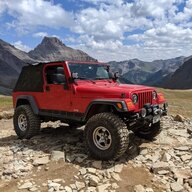
100%. They built over 300k non-Rubicon TJ's between 2003 and 2006. Even if the damper only cost $10, they would have spent $3 million on those. That doesn't happen unless they're pretty convinced that leaving it out would have cost much more than that in warranty work and customer complaints. And senior management would have to find the argument pretty convincing.Jeep decided to put a harmonic balancer on the end of the transfer case output for a reason. Any of us that had that option know it was a pain to remove when changing to a SYE. My guess is that Jeep engineers were trying to figure out a vibration, and the balancer was just enough to get it by testing. I could be way off base here.
Great post, you could could make a great living at this if you bumped your dad off-Yep. I'm not even saying that things like the flexible couplings are a bad design, just that there are certain things that work well for certain applications. I think of it like a video game where you can choose your characters strength, speed, agility, ect. but you only have so many points to spend. Same with drive shafts, if you are going to increase your strength levels to the moon you are going to have to make sacrifices in smoothness or flexibility or max speed. Same goes for increasing any of the other features, the other things will be sacrificed to some degree. One thing your burger/sandwich analogy makes me think of is what I call the "engineering paradox". This is where people sometimes get super hung up on a minor detail like the dust shield on their stock pinion yoke that's not on the aftermarket yoke. They will say "It just seems like if it wasn't important the engineers wouldn't have put it there, Jeep used it for a reason.". But ironically that same logic doesn't apply to suspension height, tire size, steering geometry, motor output, or any of the other changes a person made to get to the point where they need that new pinion yoke without the dust shield. There is no perfect design and changing one aspect of a complete system ripples outward and necessitates changes in other parts of that system. That ladies and gentleman is why I have a job, ultimately because people want bigger tires and drive shafts are somewhere downstream of that with all the other things required to make bigger tires work well.
U-joint being short for Universal Joint is confusing, u-joint makes you think it must be something similar to a u-turn. What's even more confusing is that we call them cardan joints when using the term double cardan which technically might be better named as a triple cardan because a double cardan shaft actually has 3 cardan joints in total. Even more confusing is that we also call them CVs. Wait, who's on first? I'm lost. English is just as hard as designing a vehicle.
BTW, my rant about modifying Jeeps messing up other things is not about the original question regarding the flexible couplings, which was a good question. Just talking more broadly about how when you start fixing problems which were created as a result of fixing other problems you can often end up chasing your own tail and there are some problems that are best left alone as they are not that big of a problem to begin with.
U-joint being short for Universal Joint is confusing, u-joint makes you think it must be something similar to a u-turn. What's even more confusing is that we call them cardan joints when using the term double cardan which technically might be better named as a triple cardan because a double cardan shaft actually has 3 cardan joints in total. Even more confusing is that we also call them CVs. Wait, who's on first? I'm lost. English is just as hard as designing a vehicle.
What an American thing to do, take a joint that moves in two directions and over-exaggerate its abilities by calling it "Universal". Certainly more marketable than "wobbly joint" or something like that.The universal joint has been around a long time (centuries), and there are many names used for them. The term universal joint is ubiquitous (at least in North America) because (if I remember my studies from over three decades ago) Henry Ford called them that, and he created the modern automotive industry. As with many things, the first to successfully mass-market a product generally gets naming rights by default.
I think this is just because we say what is easiest to say or we say what we've heard other people say. Or maybe double u-joint sounds too much like w-joint?Why the double Cardan joint is not called a double u-joint is not something I've heard explained, but if I had to guess, I'd guess that they probably call u-joints Cardan joints in Europe (after all, Cardan is named after the Italian who invented them), and the double-Cardan joint was likely invented by the European automotive industry (just a guess). It's called a double, and not a triple, because there are two Cardan joints (u-joints) connected by coupling yoke (or some other device, depending on the patent.)
 . We used to primarily refer to double cardans as CVs. With the rising prevalence of Rzeppa type CV joints in Jeeps we now use the term double cardan a lot more just as a matter of differentiation. Like I said, English (language) is hard. The important thing to me is always whether or not both parties agree on or understand the meaning of something. For example if someone asks about a "Double knuckle on their hog's head" I know that they are asking about putting two u-joints a their pinion/differential and not some sort of strange porcine deformity.
 If we really want to get technical a double cardan is not a true constant velocity (cv) joint but we still call them CVs because they do run at near enough of a constant velocity to get lumped in.Finally, let's talk about CV, or Constant Velocity, joints for a minute. All double Cardan joints are CV joints, but not all CV joints are double Cardan joints. The double Cardan is just one specific type of Cardan joint. One is named after a man (Cardano) and one is named after a concept (CV means the input and output shafts don't accelerate and decelerate with each rotation.)
You are absolutely right. When teaching our staff certain processes I like to make sure they understand the desired functional outcome. The better they understand why a thing needs to be done they better they understand how it should be done, context is key.I'm sure Shawn knows most of this stuff, but I bring it up because it's good information to know if you're building a Jeep. When I was in high school, I thought history was a useless exercise in memorization with no redeemable use because I didn't understand how historical context can lead to enlightenment. Many decades later, I've come to realize that learning some history of how things were named, used, designed, improved-upon, etc. can lead to a better understanding of how to design things. It's good to discuss these things because we can jump ahead in our design process by avoiding pitfalls already discovered and dealt with.
Knowing that a driveshaft and differential pinion shaft should be in line when you're using a double Cardan joint, but not when you're using two u-joints and parallel stub shafts is a good thing, but understanding why puts one on a much higher level of knowledge...
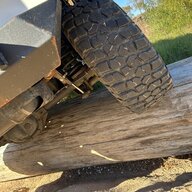
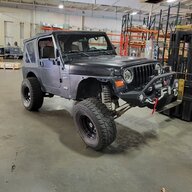
Who knows of any offroader from the factory with gear ratio lower than 4.1 ?

How about something more realistic that can go faster than 45mph, what about it's subsequent models over the years?Umm.. there is this vehicle called the Jeep you know, that helped with the war effort of sorts in the 40s. Came with 5.38s from the factory is the rumor.