TJ rear wiggle finally solved

RaymondT

TJ Enthusiast
Original poster
Supporting Member
Joined
Aug 13, 2016
Messages
718
Location
Sunshine Coast, BC
A few months back I replaced both front and rear track bars, tie rods, tie rod ends, steering gear, rear stabilizer bushings, links, rear lower control rod bushings, and all 4 shocks. Everything was original with lots of city miles on it. So I noticed a big improvement in handling and how it handles the bumps. But one thing that remained was this annoying rear end wiggle when cornering and hitting bumps at the same time. Highway driving was a constant nuisance to keep it tracking in the lane, especially when hitting head wind.

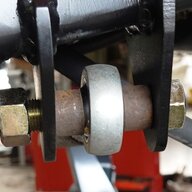
Turns out, it was mostly the rear upper control arms. I just pressed in new Moog "Problem Solver" bushings and reinstalled the control arms. Now it's so much nicer on the highway. Funny thing though, the bushing rubber wasn't all that bad. Sure, there was some surface cracks from old age but nothing serious. The biggest cause was the way the original Chrysler bushings were manufactured. The hole in the center of the Moog bushings was a perfect fit for the 10mm bolts. With the originals, the holes through the center were about 13mm in diameter and they had these protrusions to center the bolt. Most of them were pounded off allowing too much movement. The bolts were pristine with no sign of any wear.
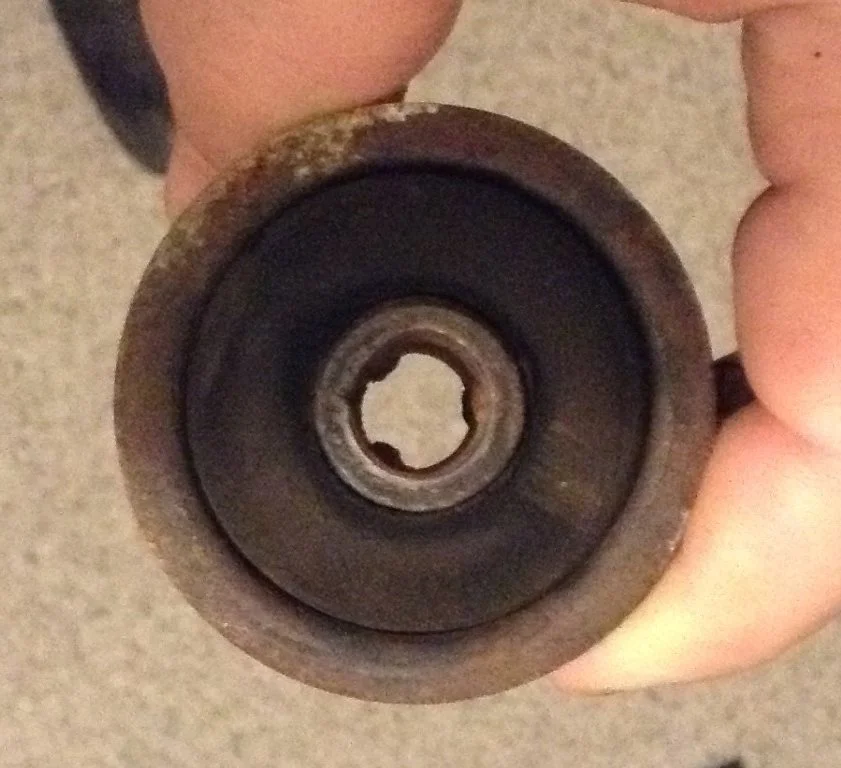
IMG_0734.webp
 
Thanks for sharing this fix. It doesn't surprise me that the control arms bushing was the source of this!
 
I have this same problem. 04 TJ was a big project last year. Replaced everything underneath. Currie CA's, new steering, springs, shocks, front track bar. Rear track bar was a forum score, used but seemed fine. Same symptoms though:

Jeep seems to "wiggle" a bit when the road pulls the tires. Steering wheel seems to "nudge" one way or the other, such that I kind of let my hand "float" while holding the wheel so I'm not fighting it much. In some bumpy turns, the wiggle is like an oscillation, or bounce off the outside of the corner. Hope that doesn't sound absurd.

One other thing to mention is that I installed Mr. Blaine's washers in the front lower CA mounts last year and recently I noticed a clank when backing up and tapping the brakes. Finally had my GF hop in while I looked and I could see the lower CA axle side bolt sliding back against the slot, as if the washers weren't holding the oval slots. I checked the torque and they were a little loose but even after setting them to 130ft-lbs, it's still happening. I need to pull the bolt and take a look at the washers, but just wondering if that little bit of movement could cause the steering wiggle?
 
Nice find. I know mine are shot, the outer metal collars are rusting through and allowing the bushing to swell.
 
Those Chrysler bushings are designed that way. My guess is to keep the bolt from seizing in the bushing.

It shouldn’t matter at all what size the hole is. A threaded fastener holds the parts together based entirely on clamping force. Example: some control arm holes are actually slotted for cam bolts. If the bolt is properly torqued, there should be ZERO movement even if the hole is 1/4” bigger than the bolt, because the clamping force keeps it solid.

I’m glad the new bushings fixed your problem. Maybe the bolts lost their torque and were not holding strong anymore or something else wrong but it’s not because of the size or design of the hole.
 
Those Chrysler bushings are designed that way. My guess is to keep the bolt from seizing in the bushing.

It shouldn’t matter at all what size the hole is. A threaded fastener holds the parts together based entirely on clamping force. Example: some control arm holes are actually slotted for cam bolts. If the bolt is properly torqued, there should be ZERO movement even if the hole is 1/4” bigger than the bolt, because the clamping force keeps it solid.

I’m glad the new bushings fixed your problem. Maybe the bolts lost their torque and were not holding strong anymore or something else wrong but it’s not because of the size or design of the hole.
While I agree completely, I'm in the middle of a situation that contradicts that theory. I have the slotted lower CA holes, and Mr. Blaine's lovely machined washers, and I've checked the torque over and over, and yet the washers have a few millimeters of gap fore and aft where the oval protrusion fits into the elliptical lower CA mount holes. A little grease gets in between the surfaces after greasing the joints, and the CA visibly moves back and forth under just a little momentum and a brake tap. I've tightened those bolts well beyond 130 ft-lbs and it's better but not eliminated. I'm going to likely get those washers welded to the CA's as a solution.
 
A bit of tack weld should fix that up for you. Just do your best to weld the washers in the same position.
While I know that the clamping force is supposed to hold everything from moving, I have seen an undersized bolt move around in the mounting hole several times, regardless of torque. Sometimes science and life don't agree with each other.
 
  • Like
Reactions: bucketspeed
Hmmm. Sounds like we all agree on the basic theory.

Hard to believe that a 14mm 12.9 bolt (lower control arm bolt specs I think?) that provides almost 19,000lb of clamping force won’t hold the connection solid, but a little tack weld does....unless something else is going on here that is not allowing the connection to work properly.

As to the original post, if the bushing had a design issue, I would expect widespread problems of loose and wiggly stock control arms but that is not the case as far as I am aware.

Cheers
 
  • Like
Reactions: bucketspeed
While I agree completely, I'm in the middle of a situation that contradicts that theory. I have the slotted lower CA holes, and Mr. Blaine's lovely machined washers, and I've checked the torque over and over, and yet the washers have a few millimeters of gap fore and aft where the oval protrusion fits into the elliptical lower CA mount holes. A little grease gets in between the surfaces after greasing the joints, and the CA visibly moves back and forth under just a little momentum and a brake tap. I've tightened those bolts well beyond 130 ft-lbs and it's better but not eliminated. I'm going to likely get those washers welded to the CA's as a solution.
You will have to weld them in your case. The slot is worn from a previous issue. If the bolt let the slot wear fore and aft, that also means the inside face is worn and the bracket is thinner than the oval that goes into the slot. So, the bolt only clamps the end of the bolt sleeve to the raised oval and not to the mount like it should. You can weld or you can pull the joints and start filing down the oval until it is exactly at flush to the inside of the mount or slightly below. You can't contradict a theory that is sound if you violate what makes it a sound theory.
 
  • Like
Reactions: bucketspeed
A bit of tack weld should fix that up for you. Just do your best to weld the washers in the same position.
While I know that the clamping force is supposed to hold everything from moving, I have seen an undersized bolt move around in the mounting hole several times, regardless of torque. Sometimes science and life don't agree with each other.
Science always works if the rules are followed. If something is not working then the rules were not followed. A bolt will always stabilize the joint if there is enough clamping force, sufficient faying surfaces, and the bolt has not been over-torqued to bring it to a state of plastic deformation instead of keeping it in elastic deformation.

FYI, all bolts are undersized for the holes they live it because that is how it works. The only ones that are not for our purposes are tapered.
 
Hmmm. Sounds like we all agree on the basic theory.

Hard to believe that a 14mm 12.9 bolt (lower control arm bolt specs I think?) that provides almost 19,000lb of clamping force won’t hold the connection solid, but a little tack weld does....unless something else is going on here that is not allowing the connection to work properly.

As to the original post, if the bushing had a design issue, I would expect widespread problems of loose and wiggly stock control arms but that is not the case as far as I am aware.

Cheers
Improper thickness leads to joint failure. Pretty basic. The original post is 100% bullshit based.
 
Steering wheel seems to "nudge" one way or the other, such that I kind of let my hand "float" while holding the wheel so I'm not fighting it much. In some bumpy turns, the wiggle is like an oscillation, or bounce off the outside of the corner.
That almost sounds like bumpsteer. Do you have a dropped pitman arm or a modified frame-side trackbar mount?
 
Negatron on the bump steer. When I bought it last year as a project for me and my son, we pulled the previous builder's lift work, which included a dropped PA, TC drop, plus a bunch of other things that we quickly learned about, primarily by reading countless hours of posts here! :) But to the point, when I pulled the lower CA bolt and checked out the washers, I saw the fore/aft wear of the oval slot, but I neglected to measure/inspect the thickness of the mount itself. It makes perfect sense that if I'm torqueing down the bolt and there's still movement, it's probably because the frame/mount material is just slightly too thin, and the CA joint is taking most of the clamping force instead of the frame, since the inner washer protrusion faces are likely resting on the CA. I'll take a look again and see about carefully shaving the washers as I don't have a welder handy. Thanks for all the input as usual!
 
  • Like
Reactions: Tob
Back to the original post...

I've seen those little nubs inside of control arm bushings... I wondered if they were there to allow room for Grease... Reduce the surface area where the bolt shaft touches the bushing... I remember drilling one out and using larger bolt one time but I can't remember what led me to do that.

It would be good to hear what Blaine says... I doubt there's anything under one of these he hasn't seen.
 
Back to the original post...

I've seen those little nubs inside of control arm bushings... I wondered if they were there to allow room for Grease... Reduce the surface area where the bolt shaft touches the bushing... I remember drilling one out and using larger bolt one time but I can't remember what led me to do that.

It would be good to hear what Blaine says... I doubt there's anything under one of these he hasn't seen.
The way the oem control arm bushing works- the rubber flexes and moves, not the bolt within the sleeve. The bolt should clamp the inner sleeve solid 100% with the mounting bracket - no movement!

Any movement of the bolt or sleeve means that the bushing is not able to work and do it’s job.

As an extreme example, you could completely weld the inner bushing sleeve (assuming hypothetically that the rubber doesn’t melt) to the frame bracket and axle bracket and it would work perfectly.
 
Asked and answered.
Maybe my mind is fried...incant see anything about the nubs inside the bushing
The way the oem control arm bushing works- the rubber flexes and moves, not the bolt within the sleeve. The bolt should clamp the inner sleeve solid 100% with the mounting bracket - no movement!

Any movement of the bolt or sleeve means that the bushing is not able to work and do it’s job.

As an extreme example, you could completely weld the inner bushing sleeve (assuming hypothetically that the rubber doesn’t melt) to the frame bracket and axle bracket and it would work perfectly.
Why are there little nubs inside the control arm bushing... versus having the bolt diameter and control arm bushing inside diameter machined normally.... For instance like a track bar bushing.