Kind of resurrecting an old thread - wanted to update what we have tried, warn about some mistakes, and get other ideas/opinions.
Old thread - https://wranglertjforum.com/threads/touchy-throttle-response.14314/
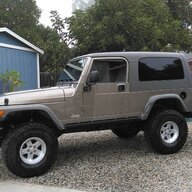
2004 Unlimited Auto trans - I had issues with throttle response. It seemed like there was slack/slop in the throttle linkage which made it difficult to smoothly apply power, especially when crawling etc. Per much advice on previous thread, I assumed it was just a function of getting used to it, training/muscle memory for the right foot. Put in 50+ hours on the trail, but it only got marginally better.
Mechanic suggested to replace the throttle linkage (even though existing looked fairly new and in good shape) which we did. No change. Mechanic (not a Jeep specialist) was a bit baffled by the amount of travel the throttle pedal has before starting to engage. He suggested we try shortening the cable a little bit and we tried it. Here were the results:
Good - MUCH better throttle response, much easier to maintain smooth power especially when bouncing around on the trails. Was so good we thought we had found the holy grail, right up until I figured out the Bad.
Bad - Shortening the throttle cable caused the throttle pedal to change its location (elevation?) relative to the brake pedal. In stock form the throttle pedal is lower (Closer to floor/firewall) than the Brake pedal - and I quickly figured out why. In the modified form the throttle pedal is much closer to the same elevation as the brake pedal. The result is it is now very easy to accidentally also hit the throttle when applying the brakes, especially when hard braking like on the trail crawling.....
Basically, in stock form the relationship of brake pedal to throttle pedal helped avoid (prevented?) hitting the throttle when you brake with just the left side (big toe side) of your foot.
Again I thought maybe the answer was practice and muscle memory training to make sure when braking I moved my foot completely onto the brake pedal. After hours It got better, but I would still hit both occasionally, especially when switching back & forth quickly while in the rocks - which can get a little scary...
The modified throttle response is so much better that I really wanted to find a solution. The obvious answer is to somehow adjust the pedal elevations back to stock form.
The easiest solution was to raise the elevation of the brake pedal, in relation to the throttle, to match the stock relationship. The simplest way to accomplish this was to add thickness to the rubber brake pedal pad. I played around with adding layers of rubber to the brake pedal. The final solution that seems to have worked was stacking a second stock pedal pad on top of the first. I used Black Automotive RTV Silicone Adhesive/Sealant to glue them together. It seems to be a very strong bond and the silicone is thick enough I was able to fill the side seams - basically looks like one piece with no gaps or seams that would catch a shoe etc. I can now apply full pressure to the brake pedal with just my big toe and the rest of my foot does not engage the throttle. I compared the difference in elevation and it appears to match the stock gap (as compared to several stock LJ's I measured).
So if you managed to wade through all of this - TLDR - what do y'all think?
Is there a better solution than shortening throttle cable to fixing the throttle response issue?
Is there a better way to restore stock pedal alignment?
Are there any safety concerns I should have with my solution?
Any better way to change elevation of the brake pedal or "thicken" the brake pedal pad?
I am sure some of you will read all this and give me big DUH - I probably should have anticipated the pedal issue. Just hope to generate some discussion on possible solutions, and also warn others of the importance of pedal arrangement.
All input greatly appreciated!
Old thread - https://wranglertjforum.com/threads/touchy-throttle-response.14314/
2004 Unlimited Auto trans - I had issues with throttle response. It seemed like there was slack/slop in the throttle linkage which made it difficult to smoothly apply power, especially when crawling etc. Per much advice on previous thread, I assumed it was just a function of getting used to it, training/muscle memory for the right foot. Put in 50+ hours on the trail, but it only got marginally better.
Mechanic suggested to replace the throttle linkage (even though existing looked fairly new and in good shape) which we did. No change. Mechanic (not a Jeep specialist) was a bit baffled by the amount of travel the throttle pedal has before starting to engage. He suggested we try shortening the cable a little bit and we tried it. Here were the results:
Good - MUCH better throttle response, much easier to maintain smooth power especially when bouncing around on the trails. Was so good we thought we had found the holy grail, right up until I figured out the Bad.
Bad - Shortening the throttle cable caused the throttle pedal to change its location (elevation?) relative to the brake pedal. In stock form the throttle pedal is lower (Closer to floor/firewall) than the Brake pedal - and I quickly figured out why. In the modified form the throttle pedal is much closer to the same elevation as the brake pedal. The result is it is now very easy to accidentally also hit the throttle when applying the brakes, especially when hard braking like on the trail crawling.....
Basically, in stock form the relationship of brake pedal to throttle pedal helped avoid (prevented?) hitting the throttle when you brake with just the left side (big toe side) of your foot.
Again I thought maybe the answer was practice and muscle memory training to make sure when braking I moved my foot completely onto the brake pedal. After hours It got better, but I would still hit both occasionally, especially when switching back & forth quickly while in the rocks - which can get a little scary...
The modified throttle response is so much better that I really wanted to find a solution. The obvious answer is to somehow adjust the pedal elevations back to stock form.
The easiest solution was to raise the elevation of the brake pedal, in relation to the throttle, to match the stock relationship. The simplest way to accomplish this was to add thickness to the rubber brake pedal pad. I played around with adding layers of rubber to the brake pedal. The final solution that seems to have worked was stacking a second stock pedal pad on top of the first. I used Black Automotive RTV Silicone Adhesive/Sealant to glue them together. It seems to be a very strong bond and the silicone is thick enough I was able to fill the side seams - basically looks like one piece with no gaps or seams that would catch a shoe etc. I can now apply full pressure to the brake pedal with just my big toe and the rest of my foot does not engage the throttle. I compared the difference in elevation and it appears to match the stock gap (as compared to several stock LJ's I measured).
So if you managed to wade through all of this - TLDR - what do y'all think?
Is there a better solution than shortening throttle cable to fixing the throttle response issue?
Is there a better way to restore stock pedal alignment?
Are there any safety concerns I should have with my solution?
Any better way to change elevation of the brake pedal or "thicken" the brake pedal pad?
I am sure some of you will read all this and give me big DUH - I probably should have anticipated the pedal issue. Just hope to generate some discussion on possible solutions, and also warn others of the importance of pedal arrangement.
All input greatly appreciated!