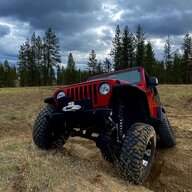
Giving up on pinion. I tried
2* low
1* low
0*
1* high
No fix….
2* low
1* low
0*
1* high
No fix….



No. This is a black box to me. I have one more rear arm to rebuild, so if I know how to simulate a load I can try that. I’ll look into it.Did you try to load the bushings with a large screwdriver or punch while you had the arms out? I don't know if you'll see the rubber tearing away from the ball with just your hairy eyeball. Think about the noise event...it happens under HEAVY load, not steady state. You're examining these things essentially under steady state...You have to load them to see if you have an issue.
Exactly...I would clamp the arm in a vise, and use a big, long screwdriver through the hole of the bushing. Push and pull that screwdriver and force the misalignment and exercise the rubber. You'll see very quickly if the center ball starts to move independently of the rubber.No. This is a black box to me. I have one more rear arm to rebuild, so if I know how to simulate a load I can try that. I’ll look into it.
As always, thanks Mike.
EDIT: ok, I see into the black box in this photo. Looks like a clevite bushing molded onto the steel ball. Weird design. If the rubber pulls free from the ball it would be bad.
View attachment 297983

Even without rotational pressure due to the lube, there would be misalignment under articulation, right?the more these dam things come up the more they make me ask questions.
the balls supposed to be bonded to the cushion material.
the ball/barrel is trapped in the mounting bracket and torque fixed (no rotation) this puts all the action into the cushion material. can we all agree so far?
but..........if the casing is dry and the joint over flexes it can tear, yes?
if the casing is lubed the cushion has no hold and the casing will rotate around it's surface, no? they supply lube so it seems 1 might consider it essential.
they are not pressure loaded so there is no squeeze or compression lock against the casing.
so how the are they really supposed work.
ya the things still trapped in there it can't turn sideways so it'll smash it's way to max flex between the traps (washers).Even without rotational pressure due to the lube, there would be misalignment under articulation, right?
the more these dam things come up the more they make me ask questions.
the balls supposed to be bonded to the cushion material.
the ball/barrel is trapped in the mounting bracket and torque fixed (no rotation) this puts all the action into the cushion material. can we all agree so far?
but..........if the casing is dry and the joint over flexes it can tear, yes?
if the casing is lubed the cushion has no hold and the casing will rotate around it's surface, no? they supply lube so it seems 1 might consider it essential.
they are not pressure loaded so there is no squeeze or compression lock against the casing.
so how the are they really supposed work.
The way I understand it...the bushing misalignment comes from the compliance of the rubber. It is supposed to be bonded to the ball and every time the rig flexes, you try to pull that rubber away from the ball. From a rotational aspect (think the axle dropping straight in droop) the bushing itself should rotate in the housing...if that dries out and friction increases, now, you'll start pulling the rubber into a twisting motion too. The steel center ball shouldn't move in relation to the mounting bracket if your bolt torque is right.Even without rotational pressure due to the lube, there would be misalignment under articulation, right?

Changed shafts and bearings. Passenger side had rust in the axle tube due to condensation buildup where the exhaust drops. Lots of rust particles in the gear oil and near the bearing. Bearing seemed fine, but I switched shafts anyway. Cleaned it all up and no change.
Checked the pinion for play. Nothing. Solid as a rock.
All I know to do now is remove the last CA, test, and rebuild it.
PassengerView attachment 298075
driver
View attachment 298076
View attachment 298077
Put the mechanics stethoscope on everything from the transmission back. Only spot under load that seems to have a possible click is the rear pinion. I don’t know how to fix that. May not even be that. Still in square one.
I’m going to clean out the garage. At least that way I actually accomplish something.
Bearing puller I could come up with. Of course I don’t have a press.If it's just pinion bearings it's not really hard to replace. Just time and the proper tools.
Having a bearing puller and a press to put the new bearings on is needed.
Again wishing my Jeep was done. I have all the tools and knowledge. We'd knock that out in a few hours.Bearing puller I could come up with. Of course I don’t have a press.
I’m gonna take it over to Idaho next week sometime and see if I can get it on the lift and have a guy look at it. I’m kind of tired of messing with this. I’ve been through everything. Crap!
ha i say that every other post............. if y'all weren't way out yonder.Again wishing my Jeep was done. I have all the tools and knowledge. We'd knock that out in a few hours.

Fuck, I've already sold the drivetrain out of my new LJ and I'm yet to put a wrench to it so I can deliver it. Hard to get motivated when parts are still months away.ha i say that every other post............. if y'all weren't way out yonder.
.





