
You are using an out of date browser. It may not display this or other websites correctly.
You should upgrade or use an alternative browser.
You should upgrade or use an alternative browser.

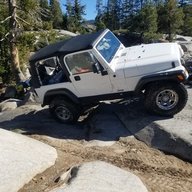
Usable Articulation
- Thread starter StG58
- Start date

Read my response. Assuming the shock travel allows it, the longer softer spring will apply down force longer than the stiffer spring. A Currie spring has more useable travel than a RE spring.
A spring's ride height is determined by both it's rate and length resisting against the weight of the vehicle. To increase (or decrease) lift, the length and/or rate needs to increase (or decrease).
2003 Rubicon
A spring's ride height is determined by both it's rate and length resisting against the weight of the vehicle. To increase (or decrease) lift, the length and/or rate needs to increase (or decrease).
2003 Rubicon

Again, you're assuming that longer necessarily implies softer. I'm saying that it doesn't need to.
https://www.ajdesigner.com/phpspringrate/spring_rate_equation_wire_diameter.php
https://www.ajdesigner.com/phpspringrate/spring_rate_equation_wire_diameter.php
Again, you're assuming that longer necessarily implies softer. I'm saying that it doesn't need to.
https://www.ajdesigner.com/phpspringrate/spring_rate_equation_wire_diameter.php
What is there to assume? You pick a longer spring with a higher spring rate and you get a taller jeep.
Longer only implies longer. Without knowing the rate, we can't know anything about what the actual ride height might be. (I think we agree with each other)Again, you're assuming that longer necessarily implies softer. I'm saying that it doesn't need to.
https://www.ajdesigner.com/phpspringrate/spring_rate_equation_wire_diameter.php
The common good advice is to choose the longest AND softest spring that will provide the ride height you are after. That will give you the most useable travel to build around.
2003 Rubicon
Yep, this is my second shock to rip appart.Making sure that your shocks are not your limit straps.
Limit straps are going in this year.
When doing my build it was based around a few sets of known factors. I knew what link kit I was using, what axles it was going on, and what springs I was using (Metalcloak 3.5").
To figure out shocks I put the axles in the jeep with the link kit. Then stuffed then up till something hit. In the front it was the truss to the oil pan, in the rear it's the upper control arm brackets to the floor. What hits in your jeep may be different. Then I took a measurement from the upper shock mount to where the rear would be (or where it is if you have shock mounts on your axle.) Then I put the springs in and drooped the axle till I could start to wiggle them in the cups. Then took the same measurements again. After that I went and picked the shocks that had a collapsed length at slightly shorter than measurement 1 and an extended length at or slightly longer than measurement 2. In my case I was able to cheat those a bit by moving the lower shock mounts around as I was swapping the axle at the time.
In my mind this gives you your maximum usable flex as you maintain spring pressure throughout the entire range of travel.
Now a monster flex coil over or a high center of gravity build are a totally different animal. There you have to consider if you are flexing past the point where the rig gets wants to tip even though you still have spring pressure on all 4 corners.
As to things to watch when adding down travel besides basic clearances.
- drive shaft slip length
- brake line length
- locker hose/wire length (for selectables)
- breather hose length
- steering linkage maximum misalignment
- track bar maximum misalignment (for stock style brackets)
- abs wires (if you have it)
I fixed the breather and locker hose issues by running them along the upper control arm and make a bit of a wide turn at the end to allow for movement. (FYI in the front if they are on the driver side, make sure they run on the outboard side of the arm... The cats get hot, man was I concerned when something exploded and all the moisture in my air system turned to steam coming out from the fender, it looked a lot like when the shock let go above.)
—
There must have been a time
when we could have said no.

Nice...
So, where are we at here so far?
Softer, longer springs are better than shorter stiffer springs. (watch for coil bind)
Using your shocks for limit straps is probably not a good idea.
Try to work out a balance between drop and stuff.
There's a LOT more to check for interference besides just tires into wheel wells.
Drive line and steering geometry need to be looked at.
What else do we have? Watch for handling changes / changes to under or oversteer as the sway bar geometry changes and the roll centers change?
So, where are we at here so far?
Softer, longer springs are better than shorter stiffer springs. (watch for coil bind)
Using your shocks for limit straps is probably not a good idea.
Try to work out a balance between drop and stuff.
There's a LOT more to check for interference besides just tires into wheel wells.
Drive line and steering geometry need to be looked at.
What else do we have? Watch for handling changes / changes to under or oversteer as the sway bar geometry changes and the roll centers change?
Do we need to talk about rear track bars? It seems that there was as much going on with those as there was with the fronts...Sums it up for the most part me thinks.
Do we need to talk about rear track bars? It seems that there was as much going on with those as there was with the fronts...
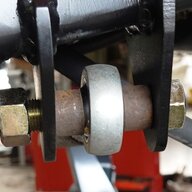
I think we can categorize that under "There's a LOT more to check for interference besides just tires into wheel wells", but yes the rear TB has a tendency of kissing the gas tank skid and possibly the tub, as does the rear TB relocation bracket, if so equipped.
Don't the aftermarket gas tank skids tend to offer up more clearance for the track bar? Seems like I've read/heard that for both Rokmen and Savvy gas tank skids. Added clearance for diffs and track bars...I think we can categorize that under "There's a LOT more to check for interference besides just tires into wheel wells", but yes the rear TB has a tendency of kissing the gas tank skid and possibly the tub, as does the rear TB relocation bracket, if so equipped.
Don't the aftermarket gas tank skids tend to offer up more clearance for the track bar? Seems like I've read/heard that for both Rokmen and Savvy gas tank skids. Added clearance for diffs and track bars...
I believe you are correct, although I cannot confirm this.
The fix for rear track bar clearance is to eliminate it and put in a triangulated 4 link 
But yes the savvy skid seems to give more diff clearance so I would presume that helps with the TB as well. I'm not positive though as that clearance may come more from the fact that it hangs down less as opposed to anything else.
—
There must have been a time
when we could have said no.
But yes the savvy skid seems to give more diff clearance so I would presume that helps with the TB as well. I'm not positive though as that clearance may come more from the fact that it hangs down less as opposed to anything else.
—
There must have been a time
when we could have said no.
I think @mrblaine posted something once about the Savvy skid being shaped in such a way or mounted to where the skid is more rearward in its position than other skids. If I'm recalling that accurately, then it would surely offer up more track bar clearance.The fix for rear track bar clearance is to eliminate it and put in a triangulated 4 link
But yes the savvy skid seems to give more diff clearance so I would presume that helps with the TB as well. I'm not positive though as that clearance may come more from the fact that it hangs down less as opposed to anything else.
—
There must have been a time
when we could have said no.
The fix for rear track bar clearance is to eliminate it and put in a triangulated 4 link
But yes the savvy skid seems to give more diff clearance so I would presume that helps with the TB as well. I'm not positive though as that clearance may come more from the fact that it hangs down less as opposed to anything else.
-
There isn't much you can do front to back on a GTS except make it tight to the tank as much as possible and that was done. Where it hangs down relative to the track bar's path can't be changed much due to the side of the fuel tank being right there so that face has to be pretty much vertical.
The Savvy GTS does has a slotted front hanger so you can jack the flange back and eliminate the track bar contacting it where it overhangs. The rear flange only has fitment slots or 1.5x the diameter of the bolt shanks because you can't push the skid back any further due to the tank hitting the cross member. I've seen 1.25" long slots in the rear flange which just tells you the designer doesn't know what they are doing.
There we go, solid answer on that one. Still the best gas tank skid on the market if you asked me. Particularly if you have a body lift so you can get the extra inch of clearance the competition won't give you. I guess if you need more clearance the only option is a fuel cell or the genright u shaped tank.
—
There must have been a time
when we could have said no.
—
There must have been a time
when we could have said no.
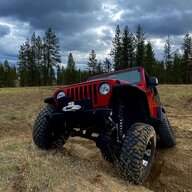
How are the Rocksports handling the small events compared to the Bilstein’s? I can’t stand the harshness of the Bilstein’s, as you know.I tried to find as much information as I could, but not many people are using them in the TJ community. I called MC several times hoping to get answers, but each one was “they are very similar to OME”. I was able to get a set for a really good price so I just decided to try them. My only goal of the swap was to try and take the edge off of the small event harshness of the Bilsteins, and if I was also able to gain some additional usable travel then that was a bonus. The rears have much more up than down which is something that I may need to experiment with, but for my use right now I’m not overly concerned.

Oh...I guess I kind of left that part out of my post.How are the Rocksports handling the small events compared to the Bilstein’s? I can’t stand the harshness of the Bilstein’s, as you know.

I drove 160 miles to my friend's shop, then did a short trail. We went back to the shop, swapped out the shocks and added the Antirock, then went back out and did the short trail again and the 160 mile drive home. I can say that the Rocksports are still firm, but that small event harshness has significantly diminished. It seemed to actually get a bit better toward the end of the drive home and was more noticeable after driving on the familiar roads near my house. Unfortunately, I had to drive it to another shop near me since the rear ARB decided to shit the bed, so I have not had any chance to drive it since Sunday night. However, I did also notice a difference in the small the events on that trip (which I'm also familiar with).
If I had to sum it up, I would say that the Rocksports took the edge off.
Give those shocks about 500 miles to break in and I'll bet you'll notice an improvement. My Rancho RS5000X shocks were that way. Wonder who's making those shocks for MC?
Similar threads

- Replies
- 15
- Views
- 6,614

- Replies
- 8
- Views
- 3,055

- Replies
- 9
- Views
- 1,441

- Replies
- 36
- Views
- 20,057


- Replies
- 4
- Views
- 1,442
R
