
Next dumb question, the yoke has a wear groove in it - just enough to catch a fingernail. I'm concerned that if I replace it, it will mess up my paint line on the nut "calibration".
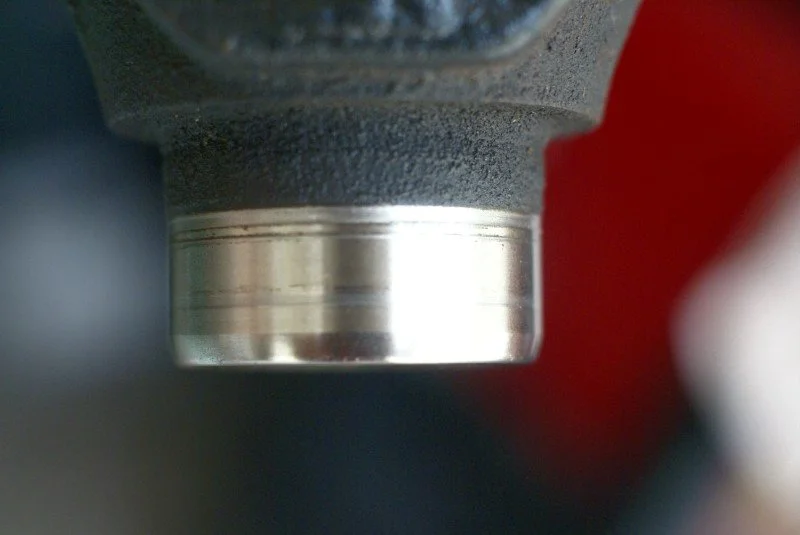


Next dumb question, the yoke has a wear groove in it - just enough to catch a fingernail. I'm concerned that if I replace it, it will mess up my paint line on the nut "calibration".
View attachment 682678
Sometimes, the recess for the seal is deeper than the thickness (the measurement up and down in your picture of the yoke above) of the seal. If so, you can replace the seal and install it at a different depth so that the lip rides in a different spot on the mating surface. I don't know if that's the case for you axle or not, though.
If not, and it's just barely detectable with your fingernail, you might be able to burnish it out enough with a strip of emery cloth. I've done that successfully many times on hydraulic cylinder rods on tractors and other implements over the years.
Burnishing is a term used to mean very little material is removed, so, yes, the spring in the seal will compensate (assuming it's a typical seal with a spring inside the lip - again, I'm speaking generally, not specific to your pinion seal).Ok - this is where my stupidity is REALLY going to show...
If I burnish it out, isn't that making the "hole" bigger? Or is the idea that the seal has plenty of give and "extra", it will compensate and not get worn/torn by the groove since same is now gone...
I'm no help with this one. Again - unfamiliar territory for me.In the meantime, I have the inner bearing pulled off the pinion. Other than the large oil slinger dingus, there are NO shims associated with that bearing. None. Zip. Zero. Nada. I find that rather odd, I guess there is a "perfect" one once in a while? Still have yet to pull the outer.
In the meantime, I have the inner bearing pulled off the pinion. Other than the large oil slinger dingus, there are NO shims associated with that bearing. None. Zip. Zero. Nada. I find that rather odd, I guess there is a "perfect" one once in a while? Still have yet to pull the outer.
The slinger IS your shim. From the factory they would determine depth and install a single shim of that thickness.
I'm pretty sure it does have a spring, but I'll verify. Thanx for your help.Burnishing is a term used to mean very little material is removed, so, yes, the spring in the seal will compensate (assuming it's a typical seal with a spring inside the lip - again, I'm speaking generally, not specific to your pinion seal).
Sometimes, the recess for the seal is deeper than the thickness (the measurement up and down in your picture of the yoke above) of the seal. If so, you can replace the seal and install it at a different depth so that the lip rides in a different spot on the mating surface. I don't know if that's the case for you axle or not, though.
If not, and it's just barely detectable with your fingernail, you might be able to burnish it out enough with a strip of emery cloth. I've done that successfully many times on hydraulic cylinder rods on tractors and other implements over the years.

Next dumb question, the yoke has a wear groove in it - just enough to catch a fingernail. I'm concerned that if I replace it, it will mess up my paint line on the nut "calibration".
View attachment 682678
Buy a new yoke.they aren't expensive.
New outer bearing on pinion:
View attachment 682804
That yoke looks fine, I would absolutely reuse it.
More confusion. One of the two pinion bearings I ordered is the wrong one. Sigh...
Did you not just order a master install kit?