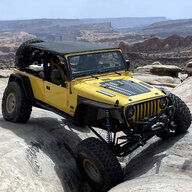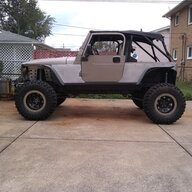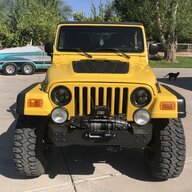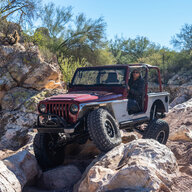
Dave Kishpaugh's (Jeep West) geometry correction brackets are now available

Status
Not open for further replies.
Easy enough... And interesting results. Since I hadn't thought about it before I input the data, I was expecting the results to be slightly different. And to some maybe that's the case, to me it's a bigger delta than expected. The shorter wheelbase creates a steeper 100% anti squat line making your anti squat value lower than the LJ.

First image, lifted and stock locations... Second image is lifted and geo improved locations.

View attachment 251580

View attachment 251582

Is the horizontal location of the mounts considered negligible? I don't see any input for longitudinal placement but moving one arm forward or backward in relation to the other (as the TJ's arms are) would move the instant center forward or backward by the same amount unless the arm was perfectly horizontal.
 
@Pressurized thanks for putting that up.
Is the horizontal location of the mounts considered negligible? I don't see any input for longitudinal placement but moving one arm forward or backward in relation to the other (as the TJ's arms are) would move the instant center forward or backward by the same amount unless the arm was perfectly horizontal.

Triaged calculator covers everything.
 
To me, except for the stock setup all of those anti-squat numbers are high (the first is crazy high), and as I understand it would absolutely result in hopping on a climb - but please correct me if I am wrong. I've always targeted anti-squat at a little under 100%. Since a likely incorrectly estimated CG can change the numbers, to me staying a bit under gives a little margin for error in that respect. That being said, I've always looked at the calculators as a guide - the proof of the pudding is in the eating.

Anyone happen to have numbers on the mid-arm?
 
To me, except for the stock setup all of those anti-squat numbers are high (the first is crazy high), and as I understand it would absolutely result in hopping on a climb - but please correct me if I am wrong. I've always targeted anti-squat at a little under 100%. Since a likely incorrectly estimated CG can change the numbers, to me staying a bit under gives a little margin for error in that respect. That being said, I've always looked at the calculators as a guide - the proof of the pudding is in the eating.

Anyone happen to have numbers on the mid-arm?
They do look high from what you would expect, and on another forum with a similar discussion I'm having, others have actually been right up against 200% anti squat with their calculations. Of course actual lift height changes these numbers, I'm up more than 4". It's the reason I was looking for a solution and found these brackets. It was never a comparison to the Savvy mid-arm for me. As that is still a possibility in the future for me. You can move the CG and it changes the numbers, but the spread doesn't change. So for me, if I got roughly 60% improvement in anti squat, it will still be 60% if I move the CG, even though the actual anti squat number is lower. I did experiment with that.

I think Garrett is going to input his numbers and the upper control arm frame side location will give us more indication (minus the variance in actual tire size) of his lift height to mine.

And yes, if I had complete control and it wouldn't harm other geometry goals, I would like to be just below 100% anti squat for traction purposes.
 
They do look high from what you would expect, and on another forum with a similar discussion I'm having, others have actually been right up against 200% anti squat with their calculations. Of course actual lift height changes these numbers, I'm up more than 4". It's the reason I was looking for a solution and found these brackets. It was never a comparison to the Savvy mid-arm for me. As that is still a possibility in the future for me. You can move the CG and it changes the numbers, but the spread doesn't change. So for me, if I got roughly 60% improvement in anti squat, it will still be 60% if I move the CG, even though the actual anti squat number is lower. I did experiment with that.

I think Garrett is going to input his numbers and the upper control arm frame side location will give us more indication (minus the variance in actual tire size) of his lift height to mine.

And yes, if I had complete control and it wouldn't harm other geometry goals, I would like to be just below 100% anti squat for traction purposes.
Hard to package perfection under a TJ. That’s why small gains for a little bit of money is so interesting.
 
This is what I got with total guess on weight distribution and COG. So the ACTUAL antisquat number is probably not accurate. This is just a demonstration of what would happen with redrilling.
B115118E-DFCA-4D63-81AB-D119E3477D79.webp

Here is with drilling the upper axle bracket 5/8” lower
9B7D16F1-28BB-413B-8117-8A1413AEDDFC.webp

Here is with drilling a third hole another 5/8” lower
121E5EBA-604F-435E-8DA0-188E46613DCE.webp
 
  • Like
Reactions: pc1p
I also think one of the biggest improvements we can do is tuned shocks. If we are willing to spend $1-2000 on shocks and mounts, why not a bit more for some more help?
 
  • Like
Reactions: Rick Flair
How many outboards have you done? The caliper flip does nothing but make an outboard easier and package better. One outboard is enough to figure this out. Yet Dave has gone out of his way to not do this for reasons I cannot understand. Combined with everything else I pointed out, it is clear that there is an agenda.
Whatever Josh
 
This is what I got with total guess on weight distribution and COG. So the ACTUAL antisquat number is probably not accurate. This is just a demonstration of what would happen with redrilling.View attachment 251600
Here is with drilling the upper axle bracket 5/8” lower
View attachment 251601
Here is with drilling a third hole another 5/8” lower
View attachment 251602

So the anti-squat number could be improved without brackets, but the brackets are required to do that without sacrificing link separation.

This thread is my very earliest exploration into understanding this stuff so I don't even really know the impact of inadequate link separation, I've just picked up that it's bad, mmmkay? I also saw someone post that required link separation is based on tire size but it's lost in all the BS several pages ago.
 
So the anti-squat number could be improved without brackets, but the brackets are required to do that without sacrificing link separation.

This thread is my very earliest exploration into understanding this stuff so I don't even really know the impact of inadequate link separation, I've just picked up that it's bad, mmmkay? I also saw someone post that required link separation is based on tire size but it's lost in all the BS several pages ago.
Link separation resists the torque applied by power and braking. The further the links are apart the more torque it can resist (or the lower axial load applied to each arm), since available torque applied is a function of the tire size, that is why tire size comes into play.

If separation is too short, higher load applied to the arms and thus the brackets and you will tend to break.
 
Here is my Jeep with control arms in stock mounts. So the geo correction AS number is (theoretically) 40% lower than stock mounts since we can’t trust the absolute numbers. Just the relative shift.
881581F1-BC09-4EB8-87FC-CD5CBE2D61D4.webp
 
Status
Not open for further replies.