The heat exchanger is this one:
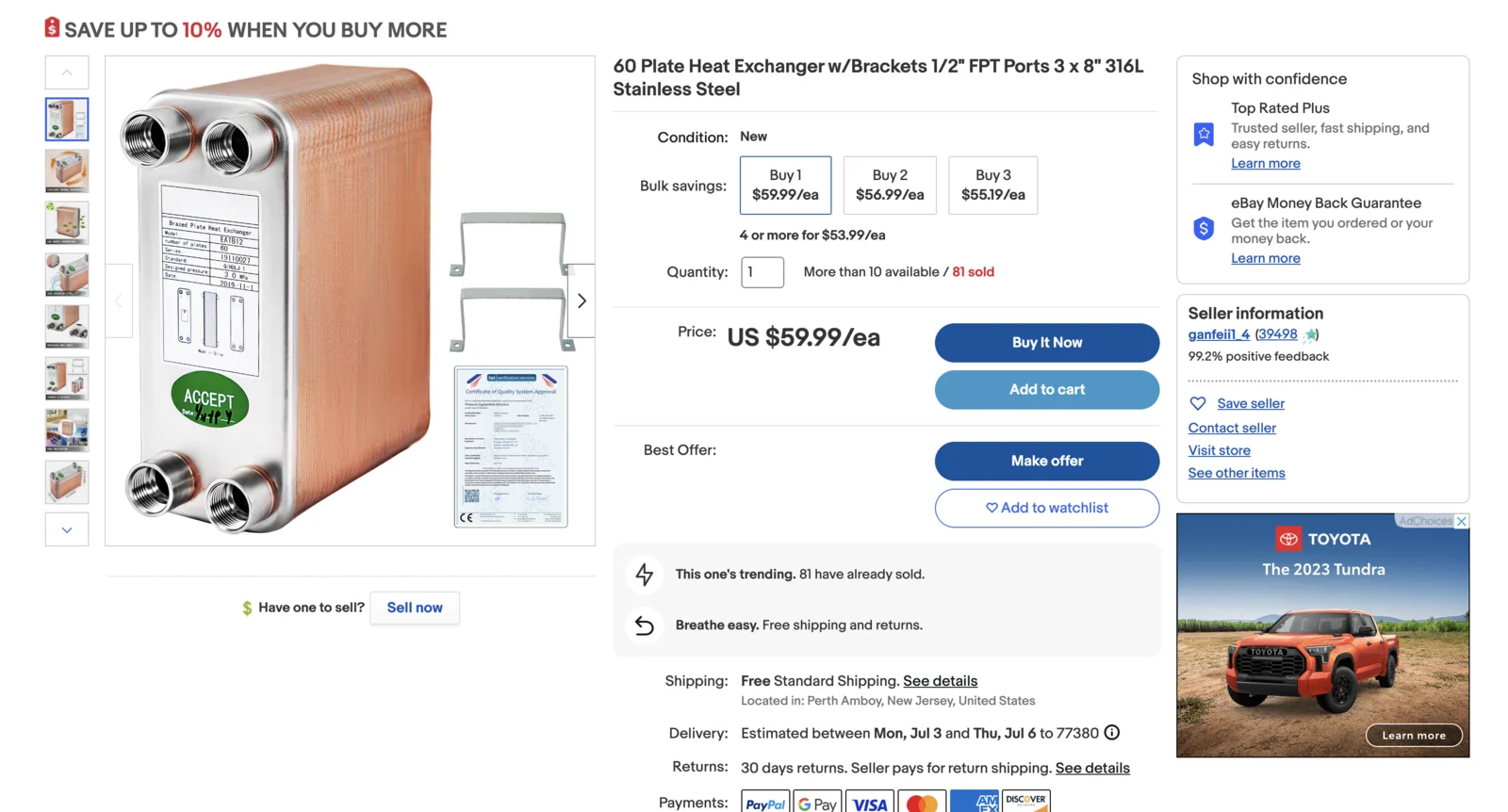
https://www.ebay.com/itm/1241249481...d=link&campid=5337789113&toolid=20001&mkevt=1
https://www.ebay.com/itm/1241249481...d=link&campid=5337789113&toolid=20001&mkevt=1



Don't be a grammar nazi. The heat exchange don't have enough surface area or any airflow it actually impact the temperature. By itself it acts as a capacitor in the thermal equation.
The heat exchanger is this one:
View attachment 436444
https://www.ebay.com/itm/1241249481...d=link&campid=5337789113&toolid=20001&mkevt=1
love it. Did you do some calculations to arrive at 60 plates or just go with the biggest thing that would fit? I've wanted to do some analysis of my own but I have no idea what the cooling system flow rate and pump head is supposed to be.
Yes, I made calculations. The specific model that I bought from Ebay does not provide the BTU rating for it. Based on other products with similar technology, I calculated that it will be in the ballpark of 300 KBTU/HR. Let's be humble and say 200 KBTU/HR. This is like a complete overkill whatsoever to any heater core possible. I think that heater core dissipates maybe 30KBTU/HR if any. If you want just to have it for heater core purposes, then 10 plates will easily make it.
My goal was not to how to deal with leaking heater cores once and forever, but rather how to have a secondary cooling system to which I can add additional auxiliary radiators to help cooling down the engine. Especially in the summer heat, with AC, at slow speed. Plan is have an additional radiators (basically heater cores with fans), that are connected to the secondary loop. The goal is make sure that engine runs at 215F and not higher. I don't want to swap to electric fans for the main radiator, as it does not make sense reliability wise (maybe adds power, but huge stress on the radiator etc).

Awesome. Just for my own curiosity, what is your job and in what field?
I'm nerding out over this particularly because much of my work over the last year has involved retrofitting a plate heat exchanger into primary-only (refrigerant) systems and moving all the loads into a secondary loop, in order to reduce refrigerant charge by 90%. Essentially converting it to a chiller.
I'm intrigued by this, but I'm apparently too stupid to understand how you have it plumbed based on the description you've given so far.
...Or maybe that heat exchanger pic helps me understand. One side of the exchanger is just the regular flow through the engine. The other side of the exchanger is the secondary loop that goes to the heater core? And then the pump controls if that secondary loop is going to flow or not?

 )
)



Little late to the party here, but I replaced my factory core with a Performance Radiator core a year ago. Last Saturday it catastrophically failed and dumped most of the coolant in the floor and left me stranded. Thankfully, I was close to home and got the jeep back to my shop with my RV. Pics are in my build thread if you want to see what happened to the Performance Radiator core. I ordered a Four Seasons replacement from Rock Auto, but it wasn't going to be here by the weekend, so I ordered another one from O'Reilly's. According to the parts guy, Four Seasons was bought out by Murray, with the same part number, so that is what I put in. The Four Seasons one will be here Monday, so I'll compare it to the Murray I put in yesterday. It is not a fun job. In total, took me about 7 hours. Wishing I would have just left the factory core in there when I replaced the evaporator a year ago, but with 175K miles on the Mopar unit, I thought I was being proactive, so I bought the Performance Radiator option along with the evaporator.

If you don't have plans for the Performance unit I'm up for paying for shipping to me using your shipper of choice so I can add it to this thread.

Or at the least take lots of pics of it after you pull it out (if you are trying for any warranty and they want it back). That is super disappointing to hear.