Gear Ratio for 35's on 1999 TJ 4.0?

Where would you like to see the rpms at 75mph on flattish ground?

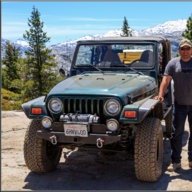
I'm at 2,750 rpm at 77 mph, as verified by GPS. That's right in the peak torque range of the 4.0L engine. I think 70 mph was right around 2,500 rpm and I routinely drive my Jeep 70-75 mph on relatively flat highways (getting out of the SF Bay area and heading to the mountains).
 
I'm at 2,750 rpm at 77 mph, as verified by GPS. That's right in the peak torque range of the 4.0L engine. I think 70 mph was right around 2,500 rpm and I routinely drive my Jeep 70-75 mph on relatively flat highways (getting out of the SF Bay area and heading to the mountains).

AX-15/33.875"/4.56 = 77mph @ 2751rpm
Correct? ;)
 
  • Like
Reactions: afmoto
I disagree as well.

You and @Jerry Bransford are obviously entitled to your opinions but don't miscontrue your opinions as facts. When you speak in absolute numbers it kind of reeks a bit of arrogance because the best answer in motorsports is typically "it depends" (just like lawyers). I've been around motorsports racing for over three decades and only novices speak in absolute numbers. Every goober in the paddock knows how to show up at a track and re-gear a superbike for redline in top gear, at the end of the fastest straight on that particular track. Is that the best gearing? Well, "it depends". If you're at Daytona and you gear the bike for the banking, that will definitely be the right answer because you're finished if you can't stay in the draft of the other bikes in top gear. On the other hand, at tracks like Sears Point in N. California, many factory superbike teams only use four of the six gears in the gearbox (which would make gearing for redline in 6th gear completely ridiculous) because the layout of the track would require too much shifting in bad spots. If they used all six gears, their lap times would actually be slower than setting up the bike for only four gears.

This is your sandbox and you control it but I'll maintain my opinion that speaking in absolute numbers is not ideal. The gearing that I like for my Jeep at sea level on the California highways will likely not be the same as a guy who lives at high altitude in the mountains of Colorado, and drives mostly on steep, 2-lane roads.

*edit: in fact, if absolute numbers are the way to go, why does Jeep make both 2.7:1 and 4:1 transfer cases? Is one right and the other wrong? Let's not even bring up Atlas transfer cases, which offer SIX different ratios in their transfer case. Is one right and the other five are wrong? Or is the answer more like "it depends" on where and how you will use the vehicle?
 
Last edited:
. . . I'll maintain my opinion that speaking in absolute numbers is not ideal. The gearing that I like for my Jeep at sea level on the California highways will likely not be the same as a guy who lives at high altitude in the mountains of Colorado, and drives mostly on steep, 2-lane roads.

*edit: in fact, if absolute numbers are the way to go, why does Jeep make both 2.7:1 and 4:1 transfer cases? Is one right and the other wrong. . . ? Or is the answer more like "it depends" on where and how you will use the vehicle?

Stop making sense. ;)

As for transfer case ratios, I have found the 4:1 ratio of the Rubicon 241OR to be less than ideal for situations requiring higher wheel speed such as beach running on sand, etc. I have also found a 4:1 low range to be less than ideal for milder trails and forest service roads. (Do you think that maybe the original Jeep engineers actually got it right for most jeepers when they spec'd the transfer case ratios for the early CJ's?) My particular solution was to have both 2.72:1 and 4:1 low ranges by adding a Rubi-Crawler underdrive to my 42RLE automatic transmission. As an added bonus, I can now operate in both 2WD and 4WD "mid range" (2.72:1), 4:1 low range 4WD, and I also have the option of a 10.88:1 4WD super low range. Others may have different ideas as to what works best for them. So far my decision has worked well for me, most recently on a long weekend exploring California's "lost coast" where 4:1 low range resulted in rpms being too high for comfortable cruising, high range was too high keeping me in 1st and 2nd gears, and 2.72:1 2WD was "just right" keeping my rpm's in a comfortable range with the ability to leave the transmission in "D" with overdrive off and just cruise.

I think we all tend to suffer from what one member here terms "confirmation bias," i.e., we all tend to defend our own decision making to some degree when it comes to equipment choices. However, some people are quite adamant that their choices are the only correct ones, only rank novices would dare disagree, and by extension their shit doesn't stink either. In my experience, @Chris is not a member of the latter group.
 
Last edited:
Personally, I'd take the 4:1 transfer case over the 2.7 any day. I'd also go with 4.88 gears in place of my 4.56 gears even with a 33" tire.

"Personally" is the key word in your reply. You'll also notice that the 4th reply in this thread is from a guy with 35's who has 4.88's and would've chosen 4.56's if he could do it again (and he lives in the same area as the OP).

In fact, just take a peek at the gearing for all the Jeeps on this forum who will be doing the Rubicon next month:

https://wranglertjforum.com/threads/rubicon-trail-run.19903/post-408170
Notice that nobody is running 3.73 because that's clearly outside the reasonable range for 35's but there are plenty of guys running 4.56, 4.88, 5.13 and even 5.38. Is any one of them 'wrong'? Probably not, even if one or two of them might select different gears if they had to do it again.
 
...Notice that nobody is running 3.73 because that's clearly outside the reasonable range for 35's but there are plenty of guys running 4.56, 4.88, 5.13 and even 5.38. Is any one of them 'wrong'? Probably not, even if one or two of them might select different gears if they had to do it again.
4.56, 4.88, 5.13, and 5.38 gears are all perfect choices for 35" tires depending on the transmission type and engine size. The problem is that few know which of those is best for various transmission and engine type combinations.
 
  • Like
Reactions: derekmac
Mr. Bills said:
I think we all tend to suffer from what one member here terms "confirmation bias," i.e., we all tend to defend our own decision making to some degree when it comes to equipment choices. However, some people are quite adamant that their choices are the only correct ones, only rank novices would dare disagree, and by extension their shit doesn't stink either. In my experience, @Chris is not a member of the latter group.

I think that's a very astute observation. A lot of us do a ton of research and by the time we pull the trigger on a mod, we tend to be quite confident that we're making a solid decision. The intrinsic problem is that we are making that decision based on our specific circumstances, which may not be shared by everyone else. Frankly, I'm almost surprised that there are so many other people who have selected 4.56 gearing with a 5-speed and 35's because I was making a conscious decision to go with slightly taller gearing, just because I know I drive fast and would have to cover many miles to get out to the mountains. 4.56 is probably not the ideal gearing for most people, I sort of think 4.88 is the safest bet because it's a compromise between the tallest and shortest gearing available. If someday I decide that my Jeep will become a strictly off-road toy that will get hauled around on a trailer, I'll probably rip out most everything, upgrade both axles, stick the shortest gearing I can get in them, and replace the transfer case with an Atlas with 5.0:1 ratio. The Jeep would be better on the Rubicon and I would definitely try Fordyce then, but obviously it would suck to try and drive it 500+ miles on the highway in that configuration. Same Jeep, different circumstances, different compromises. So which one is "best"? Well, it depends... ;)
 
Frankly, I'm almost surprised that there are so many other people who have selected 4.56 gearing with a 5-speed and 35's because I was making a conscious decision to go with slightly taller gearing, just because I know I drive fast and would have to cover many miles to get out to the mountains.
This is why I like my 4.56's. Driving around 100 highway miles at 75/80 mph to get to the trails would be painful with 5.13's. The way I have it set up works for my driving style and trail use (don't play on many rocks, too much shaking around for my tastes). My gearing was already chosen by the PO for what it's worth.

If I could do anything differently, I'd change the 231 out for a 241 so I could have the gearing advantage only in 4 low. I've yet to encounter a situation where I needed more revs in 2wd.