Tips For Welding To An Axle

That'll Buff

New rattle = louder music
Original poster
Supporting Member
Joined
Jul 30, 2025
Messages
244
Location
Texas
As stated in my last thread, my rear track bar hits the gas tank skid and the only real way to fix it is to put on the RJ bracket and track bar. @Woodrow pulled through and got his old set to me, which I'm quite thankful for. What I didn't realize when hearing about it is that unlike the MC bracket I have (and I assume most others), it needs to be welded to the axle. This isn't a major issue since I have access to welders at work and at a friends place not too far away, so I have options. What I don't know is if there should be any precautions when doing this, more specifically when it comes to something small like this. I know when doing a truss you have to remove the internals, preheat, jump around, blanket cool, etc to be as careful as possible to not warp the axle, but that is a lot of welding over the whole distance of the housing which inputs a lot of heat. The bracket seems maybe 3" wide, which would probably only be around 30 seconds of arc time, so am I right to assume that I should be fine to bolt it up and weld with no real consequences? Also if anyone has any recommended settings from their own experience that would be helpful. Unfortunately I know nothing about the machines I would be using, but I doubt there is anything incredibly unusual about the set ups so general settings should be good enough for me to get through this. I have a little bit of experience welding so it's not gonna be my first time touching MIG, but I only really know enough to hold scraps together so any help is nice.

A couple of additional questions about the install too. I've heard that the fuel lines above the bracket need to be moved/adjusted or else you can crush them. What is the recommended procedure to do this? Just bend them out of the way, disconnect and reroute, a different way I'm not thinking of? The website also recommends 2.5" of bump stop over stock. Going to assume that this has enough research and testing behind it that I should just take it at face value, but if anyone can say differently I'm all ears. I'm in no major rush to get this done, especially if it requires parts beyond what I have already, so best to ask all my questions now and be well prepared for the future when I get around to it.
 
  • Like
Reactions: Woodrow
Only thing on an axle you need to be concerned with welding are the cast steel centers and outters.

You don't need to weld much. I didn't take any precautions. Cleaned up the area, removed the paint with a wire wheel and burned it in...if I recall it's a ~1" weld at the bottom in an easily accessible spot.

-Mac
 
As stated in my last thread, my rear track bar hits the gas tank skid and the only real way to fix it is to put on the RJ bracket and track bar. @Woodrow pulled through and got his old set to me, which I'm quite thankful for. What I didn't realize when hearing about it is that unlike the MC bracket I have (and I assume most others), it needs to be welded to the axle. This isn't a major issue since I have access to welders at work and at a friends place not too far away, so I have options. What I don't know is if there should be any precautions when doing this, more specifically when it comes to something small like this. I know when doing a truss you have to remove the internals, preheat, jump around, blanket cool, etc to be as careful as possible to not warp the axle, but that is a lot of welding over the whole distance of the housing which inputs a lot of heat. The bracket seems maybe 3" wide, which would probably only be around 30 seconds of arc time, so am I right to assume that I should be fine to bolt it up and weld with no real consequences? Also if anyone has any recommended settings from their own experience that would be helpful. Unfortunately I know nothing about the machines I would be using, but I doubt there is anything incredibly unusual about the set ups so general settings should be good enough for me to get through this. I have a little bit of experience welding so it's not gonna be my first time touching MIG, but I only really know enough to hold scraps together so any help is nice.

A couple of additional questions about the install too. I've heard that the fuel lines above the bracket need to be moved/adjusted or else you can crush them. What is the recommended procedure to do this? Just bend them out of the way, disconnect and reroute, a different way I'm not thinking of? The website also recommends 2.5" of bump stop over stock. Going to assume that this has enough research and testing behind it that I should just take it at face value, but if anyone can say differently I'm all ears. I'm in no major rush to get this done, especially if it requires parts beyond what I have already, so best to ask all my questions now and be well prepared for the future when I get around to it.

You've spent more time typing that than the prep and welding take. Clean metal, weld away.
 
Only thing on an axle you need to be concerned with welding are the cast steel centers and outters.

-Mac
Not that it matters since there is no cast steel on any TJ axle, front or rear, but if there was, cast steel welds exactly the same as wrought, rolled, hammered, or forged steel. What is difficult is cast iron. Unless it is one of the more friendly high strength nodular versions, chances of success are very low.
 
As stated in my last thread, my rear track bar hits the gas tank skid and the only real way to fix it is to put on the RJ bracket and track bar. @Woodrow pulled through and got his old set to me, which I'm quite thankful for. What I didn't realize when hearing about it is that unlike the MC bracket I have (and I assume most others), it needs to be welded to the axle. This isn't a major issue since I have access to welders at work and at a friends place not too far away, so I have options. What I don't know is if there should be any precautions when doing this, more specifically when it comes to something small like this. I know when doing a truss you have to remove the internals, preheat, jump around, blanket cool, etc to be as careful as possible to not warp the axle, but that is a lot of welding over the whole distance of the housing which inputs a lot of heat. The bracket seems maybe 3" wide, which would probably only be around 30 seconds of arc time, so am I right to assume that I should be fine to bolt it up and weld with no real consequences? Also if anyone has any recommended settings from their own experience that would be helpful. Unfortunately I know nothing about the machines I would be using, but I doubt there is anything incredibly unusual about the set ups so general settings should be good enough for me to get through this. I have a little bit of experience welding so it's not gonna be my first time touching MIG, but I only really know enough to hold scraps together so any help is nice.
As Mac and Blaine said, bolt it on and burn it in.
A couple of additional questions about the install too. I've heard that the fuel lines above the bracket need to be moved/adjusted or else you can crush them. What is the recommended procedure to do this? Just bend them out of the way, disconnect and reroute, a different way I'm not thinking of?
I just bent them out of the way. Also see below.
The website also recommends 2.5" of bump stop over stock. Going to assume that this has enough research and testing behind it that I should just take it at face value, but if anyone can say differently I'm all ears. I'm in no major rush to get this done, especially if it requires parts beyond what I have already, so best to ask all my questions now and be well prepared for the future when I get around to it.
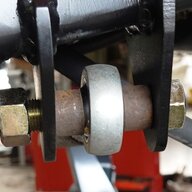
Bump stops are why cycling your axle is so important. You need to pull the springs and move the axle (full stuff, droop and flex both directions) to determine what your clearance issues are and therefore how much bump stop is required or what needs to be cut or moved out of the way. Also be aware that bump stops that aren’t metal (including urethane) compress.
 
A former heavy equip mechanic working on a one of the contractors old Terex TS32 used the crank pulley bolt for the ground lead and welded on a motor mount or something of that sort. That basically ruined the engine when it also semi welded the crank bearings to the crank. Moral of the story, dont use a lug, yoke or D/S when welding on a diff housing.