Question about flat towing after new gear install

Jesse_224

Member
Original poster
Joined
Apr 9, 2020
Messages
33
Location
Oklahoma
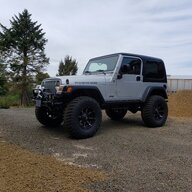
I have a question about flat towing my Jeep after having new gears installed. I recently had a shop change out the rear end in my Jeep. I bought my Jeep with Dana 30/35 axles , 4.10 gearing, and open diffs. I found a replacement LJ Dana 44 rear end that I purchased. I had the shop install the Dana 44, re-gear to 4.88, and install Eaton E-lockers in the front and rear.
By the way, my Jeep is a 4.0 with an NV3550 manual trans.
I hadn’t really thought about the new gear break in procedure. It really hadn’t even crossed my mind. So, I get to the shop to pick my Jeep up with every intention of driving my Jeep the 100 miles home. The shop owner asks how far I have to travel to get home and I tell him 100 miles, he says that I need to break the gears in by driving about 10 miles at lower speeds then to let the Jeep sit for an hour to cool off, then do that four more times. I know that is pretty standard break in procedure. He then tells me that since my Jeep is already set up with a tow bar, and I had driven a truck to pick the Jeep up, I could just flat tow it home. I could tell flat towing it was not his favorite idea, but since it would take me more than 7 hours to get home with “proper” break in, he said it would be ok. I insisted that if he thought it could damage anything that I would just drive it home doing the proper break in due to the giant pile of cash I had just spent on parts and labor. He informed me that flat towing it would be fine, so I did.

So, the question is…
Do you think I did any damage? Today I am doing a proper break in, even if it’s in vain. Everything seems just fine.

 
Definitely maybe you are ok…
When I did the break in on mine, I was the OCD guy and used my temp gun every time I drove it. The rear heated up much more noticeably than the front, since the front is essentially along for the ride and has no load aside from spinning the driveshaft.
Your drive home mimics what the front is doing during normal break in, except for the 100mi duration.
Did you happen to give the diffs a touch and see if they got hot during the ride? Did they puke any fluid?

I’d say the odds are in your favor.
 
Definitely maybe you are ok…
When I did the break in on mine, I was the OCD guy and used my temp gun every time I drove it. The rear heated up much more noticeably than the front, since the front is essentially along for the ride and has no load aside from spinning the driveshaft.
Your drive home mimics what the front is doing during normal break in, except for the 100mi duration.
Did you happen to give the diffs a touch and see if they got hot during the ride? Did they puke any fluid?

I’d say the odds are in your favor.

I did not touch them, but they didn’t puke any fluid.
 
I don't know but the gears were turning the whole time you were towing it. How did they cool off while towing? I'm thinking they didn't get to cool off and you may have screwed up you new gears. Just sayyin!
 
Soooo... doesn't this mean that since the wheels were driving the diff instead of the diff driving the wheels that any wear-in occurred on the back side of the gear teeth? Am I not thinking right on this?
 
I don't know but the gears were turning the whole time you were towing it. How did they cool off while towing? I'm thinking they didn't get to cool off and you may have screwed up you new gears. Just sayyin!

Hopefully not. They didn’t get to cool off, but hopefully not having a load kept them from getting too awful hot. I know the answer is “maybe”, and only time will tell.
It just seems like gear break in is a lot like engine break in. Manufacturers say one thing, but plenty of people do a hard break in without adverse effects.
 
Soooo... doesn't this mean that since the wheels were driving the diff instead of the diff driving the wheels that any wear-in occurred on the back side of the gear teeth? Am I not thinking right on this?
I see your point, and you may be right, I’m not sure. I doubt very much work hardening would happen in either case due to low resistance between the pinion and ring gear. I’m more worried about overheating causing a change in the hardness/brittleness of the ring and pinion.
 
When you buy a new vehicle off the lot why is there no such break in period? Yes there is no towing or hard breaking for 500 miles, but that brand new diff doesn’t get the concern that a regear gets. Why?
 
When you buy a new vehicle off the lot why is there no such break in period? Yes there is no towing or hard breaking for 500 miles, but that brand new diff doesn’t get the concern that a regear gets. Why?

I have that same question. The closest thing to an answer I found was that the 500 miles or so of taking it easy on a new vehicle breaks in the gears.
 
I think you're probably fine since there was basically no load on the gears. You'll know soon enough anyway, these things don't wait and spontaneously fail, if there's a problem it'll howl at you.

Where you at in Oklahoma?
 
Here's a good explanation I found on the why you should break them in slowly. Heat and work hardening.


Why do gears need to break-in anyway?
Before we into the "hows' of gear break-in, we do need to touch on the whys. No matter what gear set you use from the lowest-tier manufacturer to the highest-grade ring-and-pinion sets on the market, all of them require at least some form of break-in procedure before you can drive normally and especially before you hammer down on the throttle. The main reason has to do with how gears and gear steel reacts under the heat and load of everyday driving versus during the manufacturing process. While gears are machined, lapped, and hardened during manufacturing, they're not put under the same loads as the constant heat cycling and vehicle load that driving on the street puts them under, much less banging around off-road or towing heavy. This heat cycling causes the gears to expand and shrink by a several thousandths of an inch and until they're fully hardened during a gradual break-in. Driving too aggressively too soon means that instead of hardening, the gear steel will actually soften and expand due to the high levels of heat to the point where any backlash set during install gets thrown off and causes excessive noise, if not eventual gear failure.


With a proper break-in, the gears undergo a more gradual heating and cooling cycle that the gear manufacturer's call "work hardening" that makes the gear steel even harder than it came from the factory and ensures that the gear steel doesn't expand excessively even under heavy loads or high speeds. The work hardening of gears can only occur if overall heat doesn't peak too high and if the gears get enough time to cool between drive cycles in enough gear oil to keep them properly lubricated. If done correctly (and paired with a good install that hits recommended backlash specs), then your new set of gears should give you fairly quiet operation and years of excellent performance and reliability.
 
  • Like
Reactions: kincaid.0678
When you buy a new vehicle off the lot why is there no such break in period? Yes there is no towing or hard breaking for 500 miles, but that brand new diff doesn’t get the concern that a regear gets. Why?

From my understanding OE gearsets are finished lapped and shot peened. Aftermarket gearsets are not necessitating a slow and deliberate break-in period. The aftermarket does offer a "super finishing" process, at a cost, that eliminates the need for break-in.
 
  • Like
Reactions: TJ Jim
gear break in is way over hyped. If the shop drove it ~10 miles and let it cool, its good to go.
 
gear break in is way over hyped. If the shop drove it ~10 miles and let it cool, its good to go.

I hope you are right. I test drove it before leaving the shop. That would get an easy driving 10 minutes with a cool down.
 
You will still need to break in the gears after flat towing. Flat towing will break in the coast side of the gears, that never see much wear. The drive side of the gears won't be touched. So you should be just fine. I would change diff fluid once you got home though before driving and breaking in the drive side of the gears.
 
You will still need to break in the gears after flat towing. Flat towing will break in the coast side of the gears, that never see much wear. The drive side of the gears won't be touched. So you should be just fine. I would change diff fluid once you got home though before driving and breaking in the drive side of the gears.

I appreciate the info, unfortunately it is to late to change the diff oil before break in. I’ve drove it in 10-15 mile increments at about 35mph with a long cool down for about another 100 miles now. Everything seems to be going well so far (fingers crossed). I guess I could go ahead and change it now just to be safe.
 
To follow up a little on my post, today I made it to my 500 mile service. Everything with the gears has seemed just fine so far. I drained the gear oil and pulled the diff covers. The ring and what I could see of the pinion looked to be in pretty perfect shape. I had a very very small amount of metal shavings in the gear oil. Everything looked good to me.
That is until I read the markings on my ring gear. “105020 Dana 44-456GX D21” it appears to me that although I payed to have 4.88’s installed, 4.56’s actually got installed. Take a look at the pics and someone tell me if I’m wrong…

5923F15F-1462-4B0D-819E-BBAF24802826.jpeg


8EF1593A-17B6-4259-974F-9564401ADFE5.jpeg
 
The receipt just has the amount payed. The Invoice actually shows that 4.88 gears were to be installed in both my Dana 30 and 44.