


As some of y'all know from my build thread (and lack of progress therein), lately I've been working on a massive rainwater collection system because the well at the sab homestead is running out of water and we are miles from any public water pipeline. Too many straws sucking water out of our aquifer! It's a multi-year project due to cost and the time involved. Last weekend I finished building a large structural stand for a 1,500 gallon tank that will hold untreated, first-flush water (the first water to come off the dirty roof after an extended period of no rain). It's modular, and pictures of the parts don't make sense, so I won't post a picture of it until I pour the footers and place it in it's permanent home.
My collection system is actually two separate systems. We have four buildings here, and all have steel roofs so that drinking water can be collected off them (asphalt shingles leach bad stuff into the water). Getting steel roofs on all four buildings was part of the larger rainwater collection system project (and a bit expensive.) Two of the buildings were here when we bought the place, and they had asphalt shingles on them. The other two, we built with steel roofs. There are two roofs in each system, and the projected square footages of both systems are very similar.
The reason for two systems is simple - gravity and elevation. The gutters on two of the buildings are higher than the others, and if I connected them, water from the higher buildings would back up into the gutters on the lower buildings, and the system would lose water overflowing out of the lower gutters instead of collecting it. So, I have another tank to collect the water from the higher buildings, and I'll use a float-controlled 240VAC transfer pump to pump from there to the main tank. Fortunately, we have electric power available because we'd need a very large solar or wind off-grid setup to run everything on the homestead.
Yesterday, I decided to solve a mystery. System A has always acted the way I would expect it to, but System B has had some peculiarities that have had me suspecting a leak somewhere in the underground piping system. The underground pipes hold about 350 gallons of water between storms (they are 4" and 6" pipes, and there is about 800 feet of pipe.) However, I've been pumping those out to fill the garden tank and use that water between storms, and I'm only getting about 70 gallons out. That's one of the peculiarities that's easy to explain. There are several others that aren't as easy to explain.
Finding problems with underground systems is always challenging because it's not fun to dig and dig until you find the problem. I've used the "look for a wet spot," but that's never been successful, so I've put off solving this mystery. Yesterday was the day I decided to dig into it (what a masterful pun!)
I knew that I needed to use the ol' noggin' to figure out the most likely location to dig first. My thinker still works pretty good, but the joints on my excavator are plumb wore out. So, here was my logic used to pick that first spot and avoid a lot of diggin' (hopefully.) There's a vertical cleanout stack that comes up to the surface at the downstream end, next to the tank. One of the other unexplained peculiarities was that this cleanout, which should be under pressure when water's in the collection pipes, only had water partially up it. From that water level, I could tell what elevation the leaking spot is at. Unfortunately, with just a 3% grade on the pipe (3' of fall per 100' of pipe), and the inability to very accurately measure the ground elevations, I could only eyeball and narrow it down to about 50' of pipe.
With that section of pipe in mind, I next realized that the most likely location for a leak is at a joint, and there just happened to be a 45° elbow within that 50' section of pipe. Elbows tend to be the most likely spots for a leak, too, because you have high twisting stress due to the direction change of the pipe. Think of using a cheater pipe on your ratchet. The cheater pipe is like the long section of pipe after the turn. If the expansive clay soils move that section of pipe, it twists the joint more so than it would a straight section of pipe.
So, with shovel in hand, I began the excavation. Ten minutes later, I found this (cleaned up for the photo - it was dirty!):
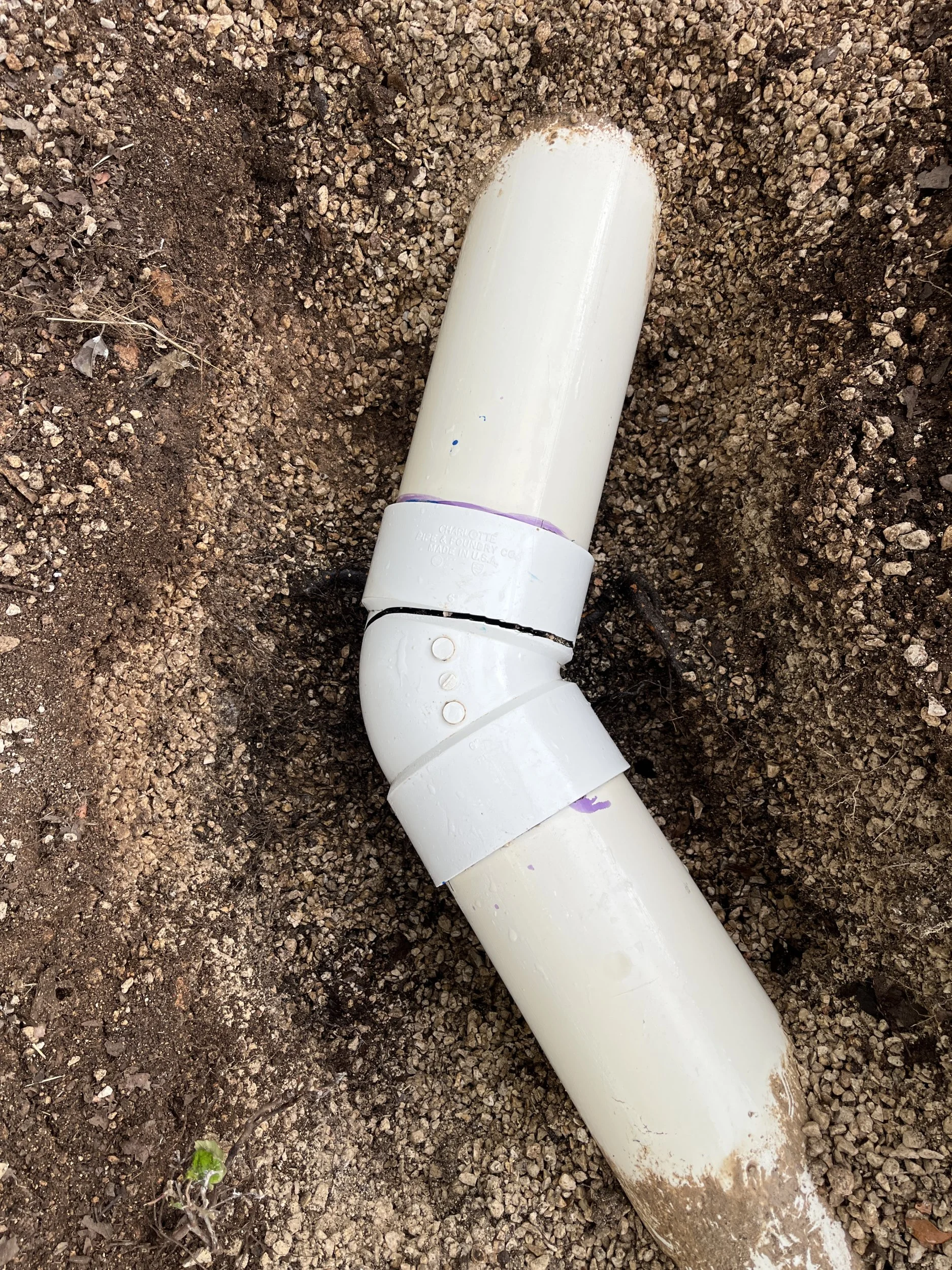
Looking closely, the right side of the crack has jagged edges, while the left side doesn't. I think a small crack developed on the right side (the inside angle) and slowly moved to the left a bit at a time, leaving the jagged sections. Eventually, the remaining material wasn't strong enough, and the rest of the fitting cracked all at once. This failure mode is very similar to seeing beach marks in a cross-section of a failed steel part. If that theory is correct, the forces in play were working to spread that 135° inside angle wider (towards 180°).
I think I know what happened to cause that. When I laid that pipe, the trenches on both sides that I cut were not perfectly straight, and it took some force to get the pipes in the trenches because they touched the trench walls on both ends. Not an ideal installation, but I'm working in solid rock, so widening the trenches was a whole weekend's worth of work with a jackhammer. I think it cracked soon after installation. By now, mother nature's forces have likely permanently curved the pipes, so if I replace it, there's likely no longer stress present to break a new fitting. Evidence of that being the case is the fact that, now that the fitting is completely broken in two pieces, there's not a lot of displacement. For the most part, the end of the pipes at the break are still aligned well.
I couldn't get the parts to repair this (it's a 6" Sch 40 PVC pipe - not common) locally, especially on a weekend, so I cleaned myself presentable and took Mrs. sab into town for dinner last night, and while there, I stopped at the store to get some silicone self-sealing tape made for underground use. When I got back home, I changed back into my workin' duds and wrapped that tape around the crack and re-bedded the pipe. I've ordered a new fitting and a repair coupling, which I think are on a one-month backorder (fingers crossed I'm wrong). When that stuff comes, I'll dig it up and fix it properly.
Last night, we got 1.5" of rain, which was why I decided to fix it after dinner. That was in the forecast, and why I wanted to effect a temporary repair.
One final comment. Trees amaze me. There's a live oak tree about 15' from this spot, and the only location in the trench containing roots was at that break. In the four years since all the roots in that trench were eliminated by the rock saw, a root as big around as my thumb has grown right at that leak! I suspect that it would have eventually destroyed this pipe, so I'm glad I found the leak and cut the root out.
My collection system is actually two separate systems. We have four buildings here, and all have steel roofs so that drinking water can be collected off them (asphalt shingles leach bad stuff into the water). Getting steel roofs on all four buildings was part of the larger rainwater collection system project (and a bit expensive.) Two of the buildings were here when we bought the place, and they had asphalt shingles on them. The other two, we built with steel roofs. There are two roofs in each system, and the projected square footages of both systems are very similar.
The reason for two systems is simple - gravity and elevation. The gutters on two of the buildings are higher than the others, and if I connected them, water from the higher buildings would back up into the gutters on the lower buildings, and the system would lose water overflowing out of the lower gutters instead of collecting it. So, I have another tank to collect the water from the higher buildings, and I'll use a float-controlled 240VAC transfer pump to pump from there to the main tank. Fortunately, we have electric power available because we'd need a very large solar or wind off-grid setup to run everything on the homestead.
Yesterday, I decided to solve a mystery. System A has always acted the way I would expect it to, but System B has had some peculiarities that have had me suspecting a leak somewhere in the underground piping system. The underground pipes hold about 350 gallons of water between storms (they are 4" and 6" pipes, and there is about 800 feet of pipe.) However, I've been pumping those out to fill the garden tank and use that water between storms, and I'm only getting about 70 gallons out. That's one of the peculiarities that's easy to explain. There are several others that aren't as easy to explain.
Finding problems with underground systems is always challenging because it's not fun to dig and dig until you find the problem. I've used the "look for a wet spot," but that's never been successful, so I've put off solving this mystery. Yesterday was the day I decided to dig into it (what a masterful pun!)
I knew that I needed to use the ol' noggin' to figure out the most likely location to dig first. My thinker still works pretty good, but the joints on my excavator are plumb wore out. So, here was my logic used to pick that first spot and avoid a lot of diggin' (hopefully.) There's a vertical cleanout stack that comes up to the surface at the downstream end, next to the tank. One of the other unexplained peculiarities was that this cleanout, which should be under pressure when water's in the collection pipes, only had water partially up it. From that water level, I could tell what elevation the leaking spot is at. Unfortunately, with just a 3% grade on the pipe (3' of fall per 100' of pipe), and the inability to very accurately measure the ground elevations, I could only eyeball and narrow it down to about 50' of pipe.
With that section of pipe in mind, I next realized that the most likely location for a leak is at a joint, and there just happened to be a 45° elbow within that 50' section of pipe. Elbows tend to be the most likely spots for a leak, too, because you have high twisting stress due to the direction change of the pipe. Think of using a cheater pipe on your ratchet. The cheater pipe is like the long section of pipe after the turn. If the expansive clay soils move that section of pipe, it twists the joint more so than it would a straight section of pipe.
So, with shovel in hand, I began the excavation. Ten minutes later, I found this (cleaned up for the photo - it was dirty!):
Looking closely, the right side of the crack has jagged edges, while the left side doesn't. I think a small crack developed on the right side (the inside angle) and slowly moved to the left a bit at a time, leaving the jagged sections. Eventually, the remaining material wasn't strong enough, and the rest of the fitting cracked all at once. This failure mode is very similar to seeing beach marks in a cross-section of a failed steel part. If that theory is correct, the forces in play were working to spread that 135° inside angle wider (towards 180°).
I think I know what happened to cause that. When I laid that pipe, the trenches on both sides that I cut were not perfectly straight, and it took some force to get the pipes in the trenches because they touched the trench walls on both ends. Not an ideal installation, but I'm working in solid rock, so widening the trenches was a whole weekend's worth of work with a jackhammer. I think it cracked soon after installation. By now, mother nature's forces have likely permanently curved the pipes, so if I replace it, there's likely no longer stress present to break a new fitting. Evidence of that being the case is the fact that, now that the fitting is completely broken in two pieces, there's not a lot of displacement. For the most part, the end of the pipes at the break are still aligned well.
I couldn't get the parts to repair this (it's a 6" Sch 40 PVC pipe - not common) locally, especially on a weekend, so I cleaned myself presentable and took Mrs. sab into town for dinner last night, and while there, I stopped at the store to get some silicone self-sealing tape made for underground use. When I got back home, I changed back into my workin' duds and wrapped that tape around the crack and re-bedded the pipe. I've ordered a new fitting and a repair coupling, which I think are on a one-month backorder (fingers crossed I'm wrong). When that stuff comes, I'll dig it up and fix it properly.
Last night, we got 1.5" of rain, which was why I decided to fix it after dinner. That was in the forecast, and why I wanted to effect a temporary repair.
One final comment. Trees amaze me. There's a live oak tree about 15' from this spot, and the only location in the trench containing roots was at that break. In the four years since all the roots in that trench were eliminated by the rock saw, a root as big around as my thumb has grown right at that leak! I suspect that it would have eventually destroyed this pipe, so I'm glad I found the leak and cut the root out.















 . PA DEP standard for homes with on-lot septic is 400 GPD for a 3 bedroom house.


