
What other projects are you working on?

As some of y'all know from my build thread (and lack of progress therein), lately I've been working on a massive rainwater collection system because the well at the sab homestead is running out of water and we are miles from any public water pipeline. Too many straws sucking water out of our aquifer! It's a multi-year project due to cost and the time involved. Last weekend I finished building a large structural stand for a 1,500 gallon tank that will hold untreated, first-flush water (the first water to come off the dirty roof after an extended period of no rain). It's modular, and pictures of the parts don't make sense, so I won't post a picture of it until I pour the footers and place it in it's permanent home.

My collection system is actually two separate systems. We have four buildings here, and all have steel roofs so that drinking water can be collected off them (asphalt shingles leach bad stuff into the water). Getting steel roofs on all four buildings was part of the larger rainwater collection system project (and a bit expensive.) Two of the buildings were here when we bought the place, and they had asphalt shingles on them. The other two, we built with steel roofs. There are two roofs in each system, and the projected square footages of both systems are very similar.

The reason for two systems is simple - gravity and elevation. The gutters on two of the buildings are higher than the others, and if I connected them, water from the higher buildings would back up into the gutters on the lower buildings, and the system would lose water overflowing out of the lower gutters instead of collecting it. So, I have another tank to collect the water from the higher buildings, and I'll use a float-controlled 240VAC transfer pump to pump from there to the main tank. Fortunately, we have electric power available because we'd need a very large solar or wind off-grid setup to run everything on the homestead.

Yesterday, I decided to solve a mystery. System A has always acted the way I would expect it to, but System B has had some peculiarities that have had me suspecting a leak somewhere in the underground piping system. The underground pipes hold about 350 gallons of water between storms (they are 4" and 6" pipes, and there is about 800 feet of pipe.) However, I've been pumping those out to fill the garden tank and use that water between storms, and I'm only getting about 70 gallons out. That's one of the peculiarities that's easy to explain. There are several others that aren't as easy to explain.

Finding problems with underground systems is always challenging because it's not fun to dig and dig until you find the problem. I've used the "look for a wet spot," but that's never been successful, so I've put off solving this mystery. Yesterday was the day I decided to dig into it (what a masterful pun!)

I knew that I needed to use the ol' noggin' to figure out the most likely location to dig first. My thinker still works pretty good, but the joints on my excavator are plumb wore out. So, here was my logic used to pick that first spot and avoid a lot of diggin' (hopefully.) There's a vertical cleanout stack that comes up to the surface at the downstream end, next to the tank. One of the other unexplained peculiarities was that this cleanout, which should be under pressure when water's in the collection pipes, only had water partially up it. From that water level, I could tell what elevation the leaking spot is at. Unfortunately, with just a 3% grade on the pipe (3' of fall per 100' of pipe), and the inability to very accurately measure the ground elevations, I could only eyeball and narrow it down to about 50' of pipe.

With that section of pipe in mind, I next realized that the most likely location for a leak is at a joint, and there just happened to be a 45° elbow within that 50' section of pipe. Elbows tend to be the most likely spots for a leak, too, because you have high twisting stress due to the direction change of the pipe. Think of using a cheater pipe on your ratchet. The cheater pipe is like the long section of pipe after the turn. If the expansive clay soils move that section of pipe, it twists the joint more so than it would a straight section of pipe.

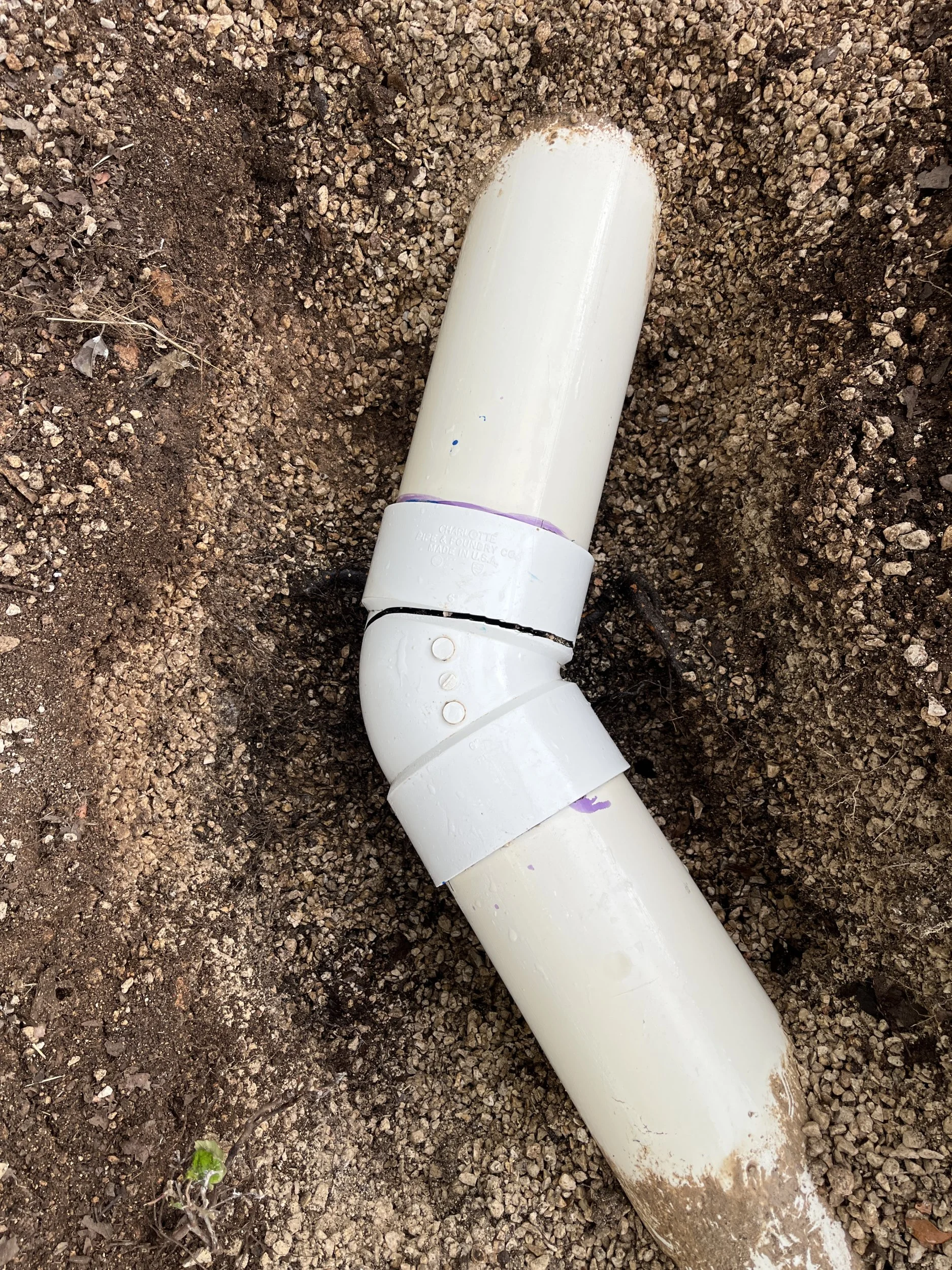
So, with shovel in hand, I began the excavation. Ten minutes later, I found this (cleaned up for the photo - it was dirty!):
IMG_8671.webp


Looking closely, the right side of the crack has jagged edges, while the left side doesn't. I think a small crack developed on the right side (the inside angle) and slowly moved to the left a bit at a time, leaving the jagged sections. Eventually, the remaining material wasn't strong enough, and the rest of the fitting cracked all at once. This failure mode is very similar to seeing beach marks in a cross-section of a failed steel part. If that theory is correct, the forces in play were working to spread that 135° inside angle wider (towards 180°).

I think I know what happened to cause that. When I laid that pipe, the trenches on both sides that I cut were not perfectly straight, and it took some force to get the pipes in the trenches because they touched the trench walls on both ends. Not an ideal installation, but I'm working in solid rock, so widening the trenches was a whole weekend's worth of work with a jackhammer. I think it cracked soon after installation. By now, mother nature's forces have likely permanently curved the pipes, so if I replace it, there's likely no longer stress present to break a new fitting. Evidence of that being the case is the fact that, now that the fitting is completely broken in two pieces, there's not a lot of displacement. For the most part, the end of the pipes at the break are still aligned well.

I couldn't get the parts to repair this (it's a 6" Sch 40 PVC pipe - not common) locally, especially on a weekend, so I cleaned myself presentable and took Mrs. sab into town for dinner last night, and while there, I stopped at the store to get some silicone self-sealing tape made for underground use. When I got back home, I changed back into my workin' duds and wrapped that tape around the crack and re-bedded the pipe. I've ordered a new fitting and a repair coupling, which I think are on a one-month backorder (fingers crossed I'm wrong). When that stuff comes, I'll dig it up and fix it properly.

Last night, we got 1.5" of rain, which was why I decided to fix it after dinner. That was in the forecast, and why I wanted to effect a temporary repair.

One final comment. Trees amaze me. There's a live oak tree about 15' from this spot, and the only location in the trench containing roots was at that break. In the four years since all the roots in that trench were eliminated by the rock saw, a root as big around as my thumb has grown right at that leak! I suspect that it would have eventually destroyed this pipe, so I'm glad I found the leak and cut the root out.
 
As some of y'all know from my build thread (and lack of progress therein), lately I've been working on a massive rainwater collection system because the well at the sab homestead is running out of water and we are miles from any public water pipeline. Too many straws sucking water out of our aquifer! It's a multi-year project due to cost and the time involved. Last weekend I finished building a large structural stand for a 1,500 gallon tank that will hold untreated, first-flush water (the first water to come off the dirty roof after an extended period of no rain). It's modular, and pictures of the parts don't make sense, so I won't post a picture of it until I pour the footers and place it in it's permanent home.

My collection system is actually two separate systems. We have four buildings here, and all have steel roofs so that drinking water can be collected off them (asphalt shingles leach bad stuff into the water). Getting steel roofs on all four buildings was part of the larger rainwater collection system project (and a bit expensive.) Two of the buildings were here when we bought the place, and they had asphalt shingles on them. The other two, we built with steel roofs. There are two roofs in each system, and the projected square footages of both systems are very similar.

The reason for two systems is simple - gravity and elevation. The gutters on two of the buildings are higher than the others, and if I connected them, water from the higher buildings would back up into the gutters on the lower buildings, and the system would lose water overflowing out of the lower gutters instead of collecting it. So, I have another tank to collect the water from the higher buildings, and I'll use a float-controlled 240VAC transfer pump to pump from there to the main tank. Fortunately, we have electric power available because we'd need a very large solar or wind off-grid setup to run everything on the homestead.

Yesterday, I decided to solve a mystery. System A has always acted the way I would expect it to, but System B has had some peculiarities that have had me suspecting a leak somewhere in the underground piping system. The underground pipes hold about 350 gallons of water between storms (they are 4" and 6" pipes, and there is about 800 feet of pipe.) However, I've been pumping those out to fill the garden tank and use that water between storms, and I'm only getting about 70 gallons out. That's one of the peculiarities that's easy to explain. There are several others that aren't as easy to explain.

Finding problems with underground systems is always challenging because it's not fun to dig and dig until you find the problem. I've used the "look for a wet spot," but that's never been successful, so I've put off solving this mystery. Yesterday was the day I decided to dig into it (what a masterful pun!)

I knew that I needed to use the ol' noggin' to figure out the most likely location to dig first. My thinker still works pretty good, but the joints on my excavator are plumb wore out. So, here was my logic used to pick that first spot and avoid a lot of diggin' (hopefully.) There's a vertical cleanout stack that comes up to the surface at the downstream end, next to the tank. One of the other unexplained peculiarities was that this cleanout, which should be under pressure when water's in the collection pipes, only had water partially up it. From that water level, I could tell what elevation the leaking spot is at. Unfortunately, with just a 3% grade on the pipe (3' of fall per 100' of pipe), and the inability to very accurately measure the ground elevations, I could only eyeball and narrow it down to about 50' of pipe.

With that section of pipe in mind, I next realized that the most likely location for a leak is at a joint, and there just happened to be a 45° elbow within that 50' section of pipe. Elbows tend to be the most likely spots for a leak, too, because you have high twisting stress due to the direction change of the pipe. Think of using a cheater pipe on your ratchet. The cheater pipe is like the long section of pipe after the turn. If the expansive clay soils move that section of pipe, it twists the joint more so than it would a straight section of pipe.

So, with shovel in hand, I began the excavation. Ten minutes later, I found this (cleaned up for the photo - it was dirty!):
View attachment 682463

Looking closely, the right side of the crack has jagged edges, while the left side doesn't. I think a small crack developed on the right side (the inside angle) and slowly moved to the left a bit at a time, leaving the jagged sections. Eventually, the remaining material wasn't strong enough, and the rest of the fitting cracked all at once. This failure mode is very similar to seeing beach marks in a cross-section of a failed steel part. If that theory is correct, the forces in play were working to spread that 135° inside angle wider (towards 180°).

I think I know what happened to cause that. When I laid that pipe, the trenches on both sides that I cut were not perfectly straight, and it took some force to get the pipes in the trenches because they touched the trench walls on both ends. Not an ideal installation, but I'm working in solid rock, so widening the trenches was a whole weekend's worth of work with a jackhammer. I think it cracked soon after installation. By now, mother nature's forces have likely permanently curved the pipes, so if I replace it, there's likely no longer stress present to break a new fitting. Evidence of that being the case is the fact that, now that the fitting is completely broken in two pieces, there's not a lot of displacement. For the most part, the end of the pipes at the break are still aligned well.

I couldn't get the parts to repair this (it's a 6" Sch 40 PVC pipe - not common) locally, especially on a weekend, so I cleaned myself presentable and took Mrs. sab into town for dinner last night, and while there, I stopped at the store to get some silicone self-sealing tape made for underground use. When I got back home, I changed back into my workin' duds and wrapped that tape around the crack and re-bedded the pipe. I've ordered a new fitting and a repair coupling, which I think are on a one-month backorder (fingers crossed I'm wrong). When that stuff comes, I'll dig it up and fix it properly.

Last night, we got 1.5" of rain, which was why I decided to fix it after dinner. That was in the forecast, and why I wanted to effect a temporary repair.

One final comment. Trees amaze me. There's a live oak tree about 15' from this spot, and the only location in the trench containing roots was at that break. In the four years since all the roots in that trench were eliminated by the rock saw, a root as big around as my thumb has grown right at that leak! I suspect that it would have eventually destroyed this pipe, so I'm glad I found the leak and cut the root out.

I love the system sab . Great Job man ! Water is a struggle here at times too .
 
  • Like
Reactions: sab
As some of y'all know from my build thread (and lack of progress therein), lately I've been working on a massive rainwater collection system because the well at the sab homestead is running out of water and we are miles from any public water pipeline. Too many straws sucking water out of our aquifer! It's a multi-year project due to cost and the time involved. Last weekend I finished building a large structural stand for a 1,500 gallon tank that will hold untreated, first-flush water (the first water to come off the dirty roof after an extended period of no rain). It's modular, and pictures of the parts don't make sense, so I won't post a picture of it until I pour the footers and place it in it's permanent home.

My collection system is actually two separate systems. We have four buildings here, and all have steel roofs so that drinking water can be collected off them (asphalt shingles leach bad stuff into the water). Getting steel roofs on all four buildings was part of the larger rainwater collection system project (and a bit expensive.) Two of the buildings were here when we bought the place, and they had asphalt shingles on them. The other two, we built with steel roofs. There are two roofs in each system, and the projected square footages of both systems are very similar.

The reason for two systems is simple - gravity and elevation. The gutters on two of the buildings are higher than the others, and if I connected them, water from the higher buildings would back up into the gutters on the lower buildings, and the system would lose water overflowing out of the lower gutters instead of collecting it. So, I have another tank to collect the water from the higher buildings, and I'll use a float-controlled 240VAC transfer pump to pump from there to the main tank. Fortunately, we have electric power available because we'd need a very large solar or wind off-grid setup to run everything on the homestead.

Yesterday, I decided to solve a mystery. System A has always acted the way I would expect it to, but System B has had some peculiarities that have had me suspecting a leak somewhere in the underground piping system. The underground pipes hold about 350 gallons of water between storms (they are 4" and 6" pipes, and there is about 800 feet of pipe.) However, I've been pumping those out to fill the garden tank and use that water between storms, and I'm only getting about 70 gallons out. That's one of the peculiarities that's easy to explain. There are several others that aren't as easy to explain.

Finding problems with underground systems is always challenging because it's not fun to dig and dig until you find the problem. I've used the "look for a wet spot," but that's never been successful, so I've put off solving this mystery. Yesterday was the day I decided to dig into it (what a masterful pun!)

I knew that I needed to use the ol' noggin' to figure out the most likely location to dig first. My thinker still works pretty good, but the joints on my excavator are plumb wore out. So, here was my logic used to pick that first spot and avoid a lot of diggin' (hopefully.) There's a vertical cleanout stack that comes up to the surface at the downstream end, next to the tank. One of the other unexplained peculiarities was that this cleanout, which should be under pressure when water's in the collection pipes, only had water partially up it. From that water level, I could tell what elevation the leaking spot is at. Unfortunately, with just a 3% grade on the pipe (3' of fall per 100' of pipe), and the inability to very accurately measure the ground elevations, I could only eyeball and narrow it down to about 50' of pipe.

With that section of pipe in mind, I next realized that the most likely location for a leak is at a joint, and there just happened to be a 45° elbow within that 50' section of pipe. Elbows tend to be the most likely spots for a leak, too, because you have high twisting stress due to the direction change of the pipe. Think of using a cheater pipe on your ratchet. The cheater pipe is like the long section of pipe after the turn. If the expansive clay soils move that section of pipe, it twists the joint more so than it would a straight section of pipe.

So, with shovel in hand, I began the excavation. Ten minutes later, I found this (cleaned up for the photo - it was dirty!):
View attachment 682463

Looking closely, the right side of the crack has jagged edges, while the left side doesn't. I think a small crack developed on the right side (the inside angle) and slowly moved to the left a bit at a time, leaving the jagged sections. Eventually, the remaining material wasn't strong enough, and the rest of the fitting cracked all at once. This failure mode is very similar to seeing beach marks in a cross-section of a failed steel part. If that theory is correct, the forces in play were working to spread that 135° inside angle wider (towards 180°).

I think I know what happened to cause that. When I laid that pipe, the trenches on both sides that I cut were not perfectly straight, and it took some force to get the pipes in the trenches because they touched the trench walls on both ends. Not an ideal installation, but I'm working in solid rock, so widening the trenches was a whole weekend's worth of work with a jackhammer. I think it cracked soon after installation. By now, mother nature's forces have likely permanently curved the pipes, so if I replace it, there's likely no longer stress present to break a new fitting. Evidence of that being the case is the fact that, now that the fitting is completely broken in two pieces, there's not a lot of displacement. For the most part, the end of the pipes at the break are still aligned well.

I couldn't get the parts to repair this (it's a 6" Sch 40 PVC pipe - not common) locally, especially on a weekend, so I cleaned myself presentable and took Mrs. sab into town for dinner last night, and while there, I stopped at the store to get some silicone self-sealing tape made for underground use. When I got back home, I changed back into my workin' duds and wrapped that tape around the crack and re-bedded the pipe. I've ordered a new fitting and a repair coupling, which I think are on a one-month backorder (fingers crossed I'm wrong). When that stuff comes, I'll dig it up and fix it properly.

Last night, we got 1.5" of rain, which was why I decided to fix it after dinner. That was in the forecast, and why I wanted to effect a temporary repair.

One final comment. Trees amaze me. There's a live oak tree about 15' from this spot, and the only location in the trench containing roots was at that break. In the four years since all the roots in that trench were eliminated by the rock saw, a root as big around as my thumb has grown right at that leak! I suspect that it would have eventually destroyed this pipe, so I'm glad I found the leak and cut the root out.

You know, it’s damn cold here in the winter, and snow is a pain in the but to deal with every day like this year, but water is not not of those things I’ll ever have to worry about…. Well, running out anyway. The water table is so high at my house that I need a sump pump to manage the run off. If that goes out, I’ll have a flooded basement.

I love to see the creativity you guys out west use in collecting and conserving water.
 
My goal was to retire to a mountain state because I'm happiest in the backcountry, and that's where the public backcountry land is. For many reasons, water rights being one of them, we decided to stay put here. Texas groundwater law is based on "right of capture," just like mineral (oil) rights, and surface water is owned by the property owner until it hits a watercourse, where it becomes state property. The groundwater rule is nice for a property owner ("right of capture" means you can use as much water as you can suck from the ground on you property), but it's why our wells are running out of water. I live near about 20 stone quarries who use a lot of groundwater in their operations, and they are sucking the ground dry. Fortunately, I'm free to use as much rainwater as I can capture...

We'll have almost 40,000 gallons of water storage when this system is complete, and that will last us over a year to get through the long droughts we have here. We use only 50-60 gallons per day here by being extremely water-conscious.
 
We use only 50-60 gallons per day here by being extremely water-conscious.

Makes me wonder how much water we use with our well and not being extremely, but somewhat water conscious.
I live on a granite hill and my well is deep but sitting in moving water. This has taught us to be conscious but not too conscious.
 
  • Like
Reactions: sab
Makes me wonder how much water we use with our well and not being extremely, but somewhat water conscious.
I live on a granite hill and my well is deep but sitting in moving water. This has taught us to be conscious but not too conscious.

How deep? I'm just curious as the last well we drilled in Commiefornia was 1,000 ft. Typical was 250-300, but thanx to strawberry farmers dumping fertilizer down their wells, that aquifer was ruined. I hate strawberry farms to this day...
 
  • Wow
Reactions: MtPockets
How deep? I'm just curious as the last well we drilled in Commiefornia was 1,000 ft. Typical was 250-300, but thanx to strawberry farmers dumping fertilizer down their wells, that aquifer was ruined. I hate strawberry farms to this day...

I’m just under 200’
 
  • Like
Reactions: Zorba
I’m just under 200’

Is that a typical depth for your area?

I can remember being able to faintly hear running water in the 250' well we used when I was a child. One neighbor drilled a well that ended up being dry - BUT - it was still somehow connected to the water table. Normally, all summer long a very subtle current of air would set down the shaft - you could put a grain of sand near the opening and it would get sucked down after a few moments. The story was different in the winter - several days after a good rain, a fairly powerful wind would blow up and OUT of the shaft - enough to make noise! They think the shaft broke into a cavern that was connected to the water table, or an underground river of some kind.

Here in Florida, the water table sits at the deep, and I mean DEEP, level of a whopping 7 feet! As my wife says, this entire state is a soggy sponge floating in pond scum. Yet water here is VERY expensive.
 
Makes me wonder how much water we use with our well and not being extremely, but somewhat water conscious.
I will say that it takes a lot of work and lifestyle changes to get to 25-30 gallons per person per day. Things like:
  • Putting a water meter on your pump outlet so that you can tell how much water you're using, including per event (how much water does a load of laundry take?)
  • Measure water use for each activity, rank it by the amount used (highest to lowest) and then start at the top of the list and work down, figuring out how to modify each activity to use less water. You rank the list because it's easier to save a gallon from a 20 gallon event than from a 1 gallon event. Concentrate on the biggest impacts, first.
  • Wearing a pair of jeans to the office for a full week between washing. Sounds gross, but they don't get dirty in an office environment. Jeans when in the shop - not so much. We use more water from the clothes I wear on the weekend than from the clothes I wear during the week.
  • Turning the tap off whenever you're not using water. This includes while showering. I cut my per-shower usage from about 30 gallons to 12 gallons by doing this. I have a friend that even keeps a 5 gallon bucket in his shower, and he fills that while waiting for hot water, then uses it to water his garden. I haven't gotten that extreme, yet, but I could see that in our future once we HAVE to rely on the rainwater system.
  • Don't shower everyday. If you don't sweat, you can likely skip a daily shower and just "take a hooker's bath." That's hard to do in Texas though. I sweat more in a year living here than I did the entire time growing up in Wisconsin. I usually have to ask Mrs. sab, "do I stink?" if we head to town for dinner, and I haven't showered. She's brutally honest, thank goodness. :p
  • Only flush the toilet once per day or after a BM - following the mantra "if it's yellow, let it mellow, if it's brown, flush it down," which I first heard from family friends with cousins living in California in the 70s.
  • Pressure wash things whenever possible. It uses under half the water of washing with a nozzle on a hose.
Edited to add this because I accidentally hit "Post Reply" prematurely:

The regular activity that uses the most water, by far, is washing a load of clothes for us. When working in the shop, my clothes get filthy, so it's a conventional machine (as opposed to a high-efficiency machine) for us. We were able to reduce our use from 40 gallons per load to 21 gallons per load by buying a new conventional machine and using the right capacity setting, but that's almost twice as much water as a shower, the next-highest usage activity.

Bottom line: It doesn't happen automatically, or even automagically. It takes effort. We started conserving over a decade ago. It doesn't help our well situation at all because our use pales in comparison to a single quarry using a million gallons a day. However, it's trained us for the eventual day when the quarries empty the aquifer. We had 200' of water in our well in 2008. Today, we have about 20'...
 
Last edited:
I have a friend that even keeps a 5 gallon bucket in his shower, and he fills that while waiting for hot water, then uses it to water his garden.

A variant of that that I use is to use it to flush the toilet. The toilet is right next to the shower, so I take the lid off the tank after doing my business, flush it then re-fill the tank from the hand held shower head. Right about the time the tank is full, the water is hot.
 
  • Like
Reactions: lBasket and sab
my well is...sitting in moving water

I can remember being able to faintly hear running water in the 250' well we used when I was a child. One neighbor drilled a well that ended up being dry - BUT - it was still somehow connected to the water table. Normally, all summer long a very subtle current of air would set down the shaft - you could put a grain of sand near the opening and it would get sucked down after a few moments. The story was different in the winter - several days after a good rain, a fairly powerful wind would blow up and OUT of the shaft - enough to make noise! They think the shaft broke into a cavern that was connected to the water table, or an underground river of some kind.

Both of those describe a karst aquifer. A karst aquifer means the water is contained in voids that are macroscopic, typically in limestone because it's soft and easily eroded by flowing water to create the voids. The largest voids are caves. To the east of us lies the Edwards aquifer, which is a karst aquifer. It recharges in hours or days because rainwater goes into voids at the surface and quickly fills the voids, and it empties quickly, too.

On the other hand, our well is not in a karst aquifer, it's in a porous aquifer. The voids in a porous aquifer are the tiny, sometimes microscopic, pores between grains of sand, pieces of gravel, or chunks of rock. Water moves very slowly through it. It usually takes years for rainwater to make it into porous aquifers. In fact, in our aquifer, the Trinity, the water we're using has been in the ground for about 20,000 years (it has been "aged" by looking at the isotopes in the water)! That's why the aquifer is draining. We're pulling water out much faster than it can recharge from the surface.

I know all this because 14 years ago, one day we turned the tap on and no water came out. Being a feller that loves to dig into things technically, I did just that. And in the process, I ended up becoming pretty knowledgeable on the subject of groundwater and water regulations in the state of TX.

Each aquifer system is unique, so you can't really make generalizations. For instance, on the other side of the county in which we live, the very same aquifer has plenty of water in it. Those folks have several hundred feet of water left, mainly because the thickness of the layer that holds the water is several orders of magnitude thicker over that way.
 
A variant of that that I use is to use it to flush the toilet. The toilet is right next to the shower, so I take the lid off the tank after doing my business, flush it then re-fill the tank from the hand held shower head. Right about the time the tank is full, the water is hot.
Yes, you can do that, but to have that work, you have to shut the toilet's water valve off and on to keep the float from automatically filling it. We don't shower enough to leave the valve off permanently, and my back and knees can't handle that much bending over. It will be easier to carry it to the garden when that day comes...

Edited to add: After re-reading your post, I'm guessing you refill the toilet tank with the bucket prior to it filling automatically (beating the fill hose to it's task.) I suppose I could leave the bucket in the shower until the next toilet flush and then fill the toilet. That's a much shorter walk than to the garden, but I'll bet I'm not on the ball enough to remember to do that when I flush the toilet. I'm much more likely to flush the toilet, and then see the bucket as I walk by the shower. :ROFLMAO:

Honestly, though, it's just a matter of breaking habits...
 
Last edited:
  • Like
Reactions: lBasket
we used to use about 3000-3500 gallons a month for our family of 4 when we lived in town and had a water meter. I haven't paid attention since we moved to having a well but I suspect it hasn't changed much. I know there's room to improve because my wife thinks she needs to leave the washer on "super load" regardless of how much clothes are in it, and the kids still like to play in the shower so they spend way longer than necessary. But for now, there hasn't been any concern for running dry in our area. My well is deeper than most of my neighbors at 330' so if I hear of someone running dry I'll come back to this thread for ideas!

I have some friends that use rainwater as their primary source. They only have 14k gallons of storage but they live on Prince of Wales island in Alaska, which is known for being one of the rainiest places in the northern hemisphere.
 
we used to use about 3000-3500 gallons a month for our family of 4 when we lived in town and had a water meter.
That's 25-30 gallons per person per day. Are you sure about that number? It's similar to mine, and unless you're concentrating on water conservation hard, like we have, I don't know how you'd use that low amount of water. Water bills are often in hundreds or thousands of gallons, not in gallons. Maybe there's a decimal off?

I have some friends that use rainwater as their primary source. They only have 14k gallons of storage but they live on Prince of Wales island in Alaska, which is known for being one of the rainiest places in the northern hemisphere.
Yes, there are three big variables in the equations to determine tank size: the rainfall characteristics (intensity and frequency), projected area of the collection roof(s), and daily household use. You need all three to determine a tank size.
 
That's 25-30 gallons per person per day. Are you sure about that number?

I was going to question the same thing. We use about 8k/mo of a budget of around 13k (until summer when we have grass and garden watering going - which will be severely cut back this year due to drought).
 
  • Like
Reactions: sab
Yes, you can do that, but to have that work, you have to shut the toilet's water valve off and on to keep the float from automatically filling it. We don't shower enough to leave the valve off permanently, and my back and knees can't handle that much bending over. It will be easier to carry it to the garden when that day comes...

Edited to add: After re-reading your post, I'm guessing you refill the toilet tank with the bucket prior to it filling automatically (beating the fill hose to it's task.) I suppose I could leave the bucket in the shower until the next toilet flush and then fill the toilet. That's a much shorter walk than to the garden, but I'll bet I'm not on the ball enough to remember to do that when I flush the toilet. I'm much more likely to flush the toilet, and then see the bucket as I walk by the shower. :ROFLMAO:

Honestly, though, it's just a matter of breaking habits...

No bucket needed - I just extend the handheld to the toilet tank as the toilet is right next to the shower.
 
  • Like
Reactions: sab
That's 25-30 gallons per person per day. Are you sure about that number? It's similar to mine, and unless you're concentrating on water conservation hard, like we have, I don't know how you'd use that low amount of water. Water bills are often in hundreds or thousands of gallons, not in gallons. Maybe there's a decimal off?


Yes, there are three big variables in the equations to determine tank size: the rainfall characteristics (intensity and frequency), projected area of the collection roof(s), and daily household use. You need all three to determine a tank size.

I think usage is based on convenience and cost.

I have city water and sewer. When my 2 children lived at home, in high school, we were using 200 GPD. I wrote it off as a lot of laundry and long showers. Back then, the cost for water and sewer was less than $1000 per year. Now that it's just my wife and I, our usage is less than 100 GPD, but the cost is about the same :mad:. PA DEP standard for homes with on-lot septic is 400 GPD for a 3 bedroom house.

When we go RV'ing at a state park with only water/electric hook ups, we can go 3 days before we fill the 30 gallon grey water tank. That includes taking showers in the communal bathhouse.
 
  • Like
Reactions: sab and John Cooper