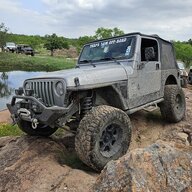
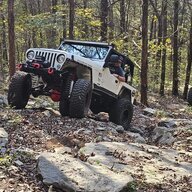
An ode to my Moab wheels

Outdoor Auto channel did a really good breakdown on the structural difference between I think BFG TAKO3 in load range C and E. The E wasn't any stiffer, it just had a slightly different structural layup. If I remember correctly there was barely a difference in the weight. It was a really good example of old rules not applying with new tire tech.

I am with @mrblaine on quality tires generally making for a better ride and top tier tires in general having advanced massively in the last 20 years.

Hmm, interesting. I know the 15" C-rated weighs the same as the 17" D-rated but I assumed that was because there's more tire on the 15". However, looking now I see the 17-E and 17-D in the "same" size (slightly different outer diameter) are very close (the E is actually lighter!).

But okay, maybe I'm not with the times. I'm happy to be wrong on that as it means the least amount of extra money and I get to keep my moabs :)
 
  • Like
Reactions: TheBoogieman
If you want a real world example of E rated tires "squish", I've got a good comparison. First picture is me running my normal psi, 11-14ish (I have innacuarate deflators) and the second one shows that back tire even lower. Not sure what because I thought it was fine and didn't check, but I also broke the bead at some point that trip and packed it with mud without realizing till the next day. Definitely single digits though.

20260228_101137.webp


20260425_143200.webp
 
If you want a real world example of E rated tires "squish", I've got a good comparison. First picture is me running my normal psi, 11-14ish (I have innacuarate deflators) and the second one shows that back tire even lower. Not sure what because I thought it was fine and didn't check, but I also broke the bead at some point that trip and packed it with mud without realizing till the next day. Definitely single digits though.

Thanks, this is the sort of thing I was looking for. Your first picture definitely looks like less squish than I roll with normally, but the second looks more like it so that makes me feel better. Looks like those are either 17" rims or smaller-than-35" tires?
 
  • Like
Reactions: That'll Buff
Hmm, interesting. I know the 15" C-rated weighs the same as the 17" D-rated but I assumed that was because there's more tire on the 15". However, looking now I see the 17-E and 17-D in the "same" size (slightly different outer diameter) are very close (the E is actually lighter!).

But okay, maybe I'm not with the times. I'm happy to be wrong on that as it means the least amount of extra money and I get to keep my moabs :)

Along those lines.

A month ago I increased my tire pressure on my current 285/75R16 KO3s from 30 to 35 while doing some long distance driving. There was a small difference in road harshness, but much less than you might imagine. Fuel economy improved but alot of other variables were also moving at that time. When they were fitted, the shop fill them to 42psi I think. Somewhere in the 40s was too much.

I ran my various tires at 28psi for 20 years. Today, on a new compound I'm doing something different.
 
  • Like
Reactions: danredtj
Thanks, this is the sort of thing I was looking for. Your first picture definitely looks like less squish than I roll with normally, but the second looks more like it so that makes me feel better. Looks like those are either 17" rims or smaller-than-35" tires?

Both, (extremely old and worn) 33's on 17's in those pics. They aren't going to act like bead locked stickies and eat the rocks, but they'll work.
 
Along those lines.

A month ago I increased my tire pressure on my current 285/75R16 KO3s from 30 to 35 while doing some long distance driving. There was a small difference in road harshness, but much less than you might imagine. Fuel economy improved but alot of other variables were also moving at that time. When they were fitted, the shop fill them to 42psi I think. Somewhere in the 40s was too much.

I ran my various tires at 28psi for 20 years. Today, on a new compound I'm doing something different.

I run 315/75R16 E-rated tires at around 42-45 PSI on road. A bit crisp on potholes, but the lower rolling resistance plus the significantly reduced steering slop makes it much more enjoyable to drive.

90+ mph at 45 PSI is way less sketchy than at 30 PSI.
 
  • Wow
Reactions: TheBoogieman
Perhaps he was joking.

There is no way I would drive any CJ, YJ, or TJ at that speed - even with stock tires.

Sometimes you gotta pass some elderly GenXer in a Buick LeSabre...

But yeah holding 90 you only get like 10 mpg. Fuel consumption is proportional to the square of speed at freeway speeds, so while at 100, you're getting just under 8 mpg and approaching the ~190 HP limit of the engine. Drop to 70 and you'll get 16 mpg and only need 60-ish HP to do it.

At 100 mph, you're burning through a full tank of gas in 1/3 the time you would just going 70 mph.

Driving fast gets expensive.
 
  • Haha
Reactions: John Cooper