Which welding wire for outboarding shocks?

astjp2

TJ Guru
Original poster
Supporting Member
Joined
Aug 22, 2018
Messages
6,842
Location
Utah and Alaska
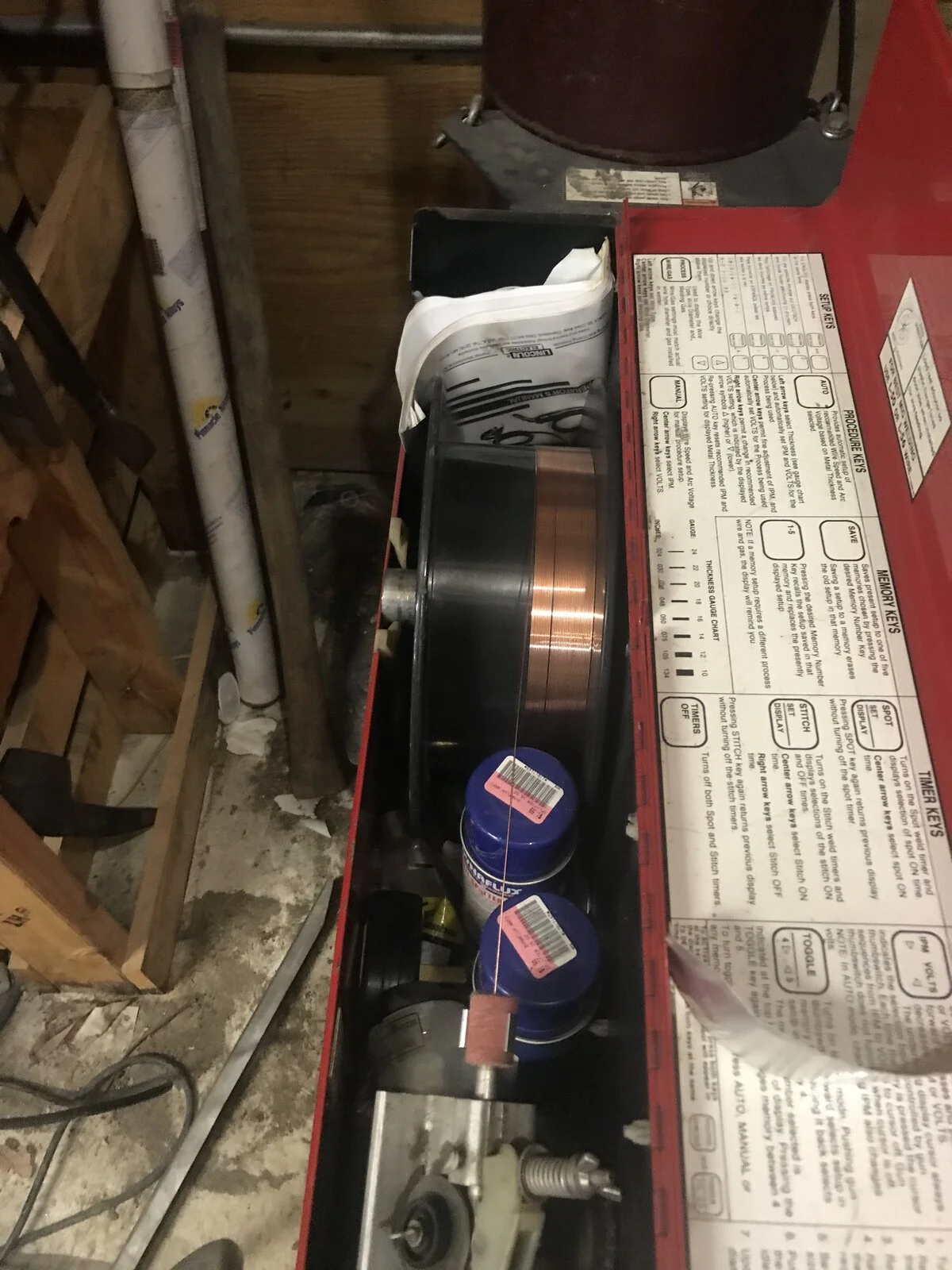
So I finally ran out of wire on my mig, it’s a Lincoln 250 amp and I have been running 75/25 gas and .035 wire and I was wondering if I should get inner shield wire so I can have both the gas and flux core wire. I plan on welding on my frame when I outboard my shocks. Any advice would be helpful. Tim
D6D7400F-45A2-4C7D-9068-E5AE31408F30.webp


6A85C8F9-32D0-4A19-8683-4C7FF6E3A743.webp
 
So I finally ran out of wire on my mig, it’s a Lincoln 250 amp and I have been running 75/25 gas and .035 wire and I was wondering if I should get inner shield wire so I can have both the gas and flux core wire. I plan on welding on my frame when I outboard my shocks. Any advice would be helpful. Tim
View attachment 224681

View attachment 224683
There are no advantages to using the flux core unless you want to spend time cleaning every weld.
 
My little hobart only has flux core at the moment. With patience and practice it will make a very clean weld with minimal spatter. Anything vertical, upside down, or slightly dirty metal makes a terrible mess. I really need to get a bottle one day and a spool of solid wire. If at all possible, I would always stick to gas and solid wire. The only times I ever wished I had flux core was outside on windy day. So I put the forklift inside the shop and welded...Point being, solid is better...pretty much always.
 
Stick with solid core and Stargon. Also make sure 035 is the wire size you need. If you are welding more thin metal you want to step down a size. You can always increase the feed rate for the few times you weld thicker material. That handy chart on the lid is your friend.
 
Stick with solid core and Stargon. Also make sure 035 is the wire size you need. If you are welding more thin metal you want to step down a size. You can always increase the feed rate for the few times you weld thicker material. That handy chart on the lid is your friend.
I suck at welding coped tube joints so I run some .030 so I don't have to weld quite so fast. Just enough of a band-aid to not look worse than normal.
 
  • Like
Reactions: pc1p
Solid wire with gas shielding. The inner shield makes the weld a bit more brittle, especially at the edges of the weld as it draws more carbon from the parent steel. Also someone posted up a 98/2 Argon mixture of gas, while it will really make the welding easier and a better looking weld, it could get expensive for hobby user. The .030" wire is a good suggestion as well, it's good to 1/4" thickness steel.
 
  • Like
Reactions: SPECWAR
Don’t know why they state parent metal thicknesses in relationship to usable wire size. I’ve welded 2-3” plate with .035 copper clad, or penny wire as we once referred to it, and 98/2 mix with multiple passes. (To X-ray and ultra sound quality)
Yes, 98/2 is higher cost, but much easier to spray arc multiple passes with.
Just my $.02 worth.
 
Don’t know why they state parent metal thicknesses in relationship to usable wire size. I’ve welded 2-3” plate with .035 copper clad, or penny wire as we once referred to it, and 98/2 mix with multiple passes. (To X-ray and ultra sound quality)
Yes, 98/2 is higher cost, but much easier to spray arc multiple passes with.
Just my $.02 worth.
Because if they don't do it that way, there is no basis for most to have any idea where to start. How would you do it? Oh hey guys, just turn it on, crank it up and then figure out why you're burning through all your crap since you have no idea where to even begin with for the settings.

To your point though, I have a buddy who Tig welds everything. He built a base for his monster Wilton vise out of a piece of 3" round solid welded to a 1" thick x 36" diameter steel plate so it wouldn't scoot around on the floor. He Tig welded about 50-60 passes so that it has about a 3" tall x 3" wide weld stack that was radiused from the plate up onto the solid. Now it rocks because that much weld bowed the 1" plate up all the way around.

He has little wedges he sticks in around the edge to solid it up some so it don't rock. Point being, just because you can, doesn't mean you should.
 
  • Like
Reactions: WSS
Yes, 98/2 is higher cost, but much easier to spray arc multiple passes with.
Just so you know, there may be about 5 folks on this whole forum that understand what spray arc is, why you use it, and have a machine big enough to do it. You are however one of my favorite types who give advice. You've been doing something so long at a level no one needs for what we do that you are out of touch with what actually works.
 
  • Haha
Reactions: pc1p
The "2" in 98/2 is usually oxygen. That said, it is best used to stabilize spray arc. Shortarc transfer is best with a 75/25 (argon and c02). Spraying is mostly a flat position mode.

The OP asked about what type, not sure if anyone mentioned the type of wire?? The best all around wire spec for that machine (nice machine BTW) and fixing Jeeps is Lincoln L56 wire. It has a spec of E70S-6. All position medium freezing, low carbon and low silica composition.

My shop is plumbed with gas that we mix ourselves, We hook a 230l liquid argon dewar and a T (330cu feet??) HP oxy bottle to a Thermco mixer. We generally run 2.5% oxy unless it is some crappy porosity and sand filled chinese material. We run a true spray at 430a and 32v It is beautiful to watch. We have a trailing argon plate to protect the molten puddle from air attack. Material has to be flat or very close, much of an angle and the weld flows like water.

IMG_5880.webp
 
Globular Transfer😁.
I’m an old school 7018 low hydrogen guy at heart, but had to learn to embrace mig/tig when all the fabricators were making the switch years ago.
Ya, thats old school. My welds look "globular". My stick welds usually have a signature stub or two stuck in the weld.

Speaking of old school, this was in my Granfathers shop, then my dads shop and I have had it in my shop for 20yrs. Really pure DC output, touch the stick and it starts to burn. 220v single phase too. It burned up on start up a few years ago. I had intended to restore it and get a new transformer but I decided to give it to a friend who has a 60's garage in AZ. He is retired and will take the time to restore it properly.

IMG_6579.webp
 
OP, do you know if lincoln has a app your type of machine? Miller has one that may be useful for you machine if they do not. It is much like a ballistic calculator, enter a few parameters and then set to what it recommends. Makes my look like I can weld. It is usually within a tenth of a volt and 10 or so on WTS.