241 vs Atlas ll

I see this pretty regularly with guys we run with on 231s. They can get by, but the lower crawl would really put them over the top. I am sure when they get something lower they will be exceptional since they've learned so much control with the 231.

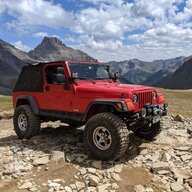
From my avatar, on those rocks I had to slip the clutch to much in my mind. It wanted to surge forward, while I was trying to not let it surge.
 
  • Like
Reactions: rasband
It isn't contrary, you still need to know how hot your trans is so you know if you need a cooler or how well the one you have is working. Nothing contrary whatsoever unless you're looking for a way to be lazy.
maybe i assumed to much reading post 54, i took that as you haven't had any problematic temp issues.

i do run a cooler in the grill, but since the skids down, and an oil change and trans fluid change are in order. it wouldn't be to hard to drop the trans pan and put in a bung to accommodate a sensor. i'd kinda rather know, than not.

anything special to know about it's location other than in the pan?
 
Last edited:
Have you been in a situation on a steep climb up a rock face where you need to come to a full stop, hang out for a moment to reassess without the slightest bit of roll back or else you lose the entire line? Imagine performing this manueuver precisely, seamlessly, and delicately with one foot.
 
Last edited:
Curious tho... how is the install of a 241 vs atlas II different?
I think it's primarily around the size, the atlas being a bit larger, along with the speedo output (they give you options) and a few other small customizations. That affects the crossmember/skid, tub, and driveshafts (probably).
 
I'd like to drive a similarly equipped rig side by side (auto/manual) as I have never wheeled an auto. I understand the many reasons why they may be better, even if that doesn't align with preferences, but nothing really tells like seat time. I don't currently want a lot more than I get with the 6spd and 241, but as they say - comparison is the thief of joy.
Won't really work that well. Again, if you run the auto, you have to drive and control the rig. You do not let it putt along like you're plowing a field with a tractor until you have to slam the clutch in or die.

The learning curve is much steeper with the manual but it levels off pretty quickly. The learning curve with an auto is very shallow but it goes on for a very long time and keeps climbing until you master it. Most manual owners operate under the very misguided assumption that you stick it in gear and step on the throttle. Nothing is further from the truth.
 
Let's avoid an auto vs manual debate.

Curious tho... how is the install of a 241 vs atlas II different?

I'm also interested in this.

Starting from an SS SYE'd 231 with a Savvy cable shifter, I *think* all I would need to swap in a 241 is the rear driveshaft length corrected and changed to a flanged t-case output, some modifications to the case end of the cable shifter, a 4wd indicator switch, and putting a 1310 yoke on the front output.

I gather an Atlas is much more involved because it's not at all based on a 231 or 241 so nothing matches up, and then there's the shifters.
 
does the 241 have a future? i can't find anyone that sells 241J's, either they don't bother or don't have any.
does it have a future if you can only get parts and depend on salvage to acquire 1?
 
Last edited:
  • Like
Reactions: Irun
Won't really work that well. Again, if you run the auto, you have to drive and control the rig. You do not let it putt along like you're plowing a field with a tractor until you have to slam the clutch in or die.

The learning curve is much steeper with the manual but it levels off pretty quickly. The learning curve with an auto is very shallow but it goes on for a very long time and keeps climbing until you master it. ...
There is a trick move with an auto that you described a while back that involved "hopping" the driver front tire over an obstacle. Hold the brake, give some throttle to load up the entire rig so the engine torque lifts the left front corner of the chassis, let off the brake and the left front tire gets light enough to jump up and over when you start moving forward again.
 
Last edited:
  • Like
Reactions: The shuggs
I disagree and know manual gives you intimate control.
Not now, not ever. You are not capable of letting the clutch out and slipping it enough to keep the tires at the absolute limit of adhesion, stopping mid line, balancing the rig, and then move ever so delicately to see what it is going to do without losing the line. I've watched 100's of manual drivers and not one of them has ever been able to do it in JV.
 
Have you been in a situation on a steep climb up a rock face where you need to come to a full stop, hang out for a moment to reassess without the slightest bit of roll back or else you lose the entire line? Imagine performing this manueuver precisely, seamlessly, and delicately with one foot.
Yeah I had a situation like that this last monday. Driver tire started lifting a bit much while climbing and had to stop at the top there and reverse just a tiny hair and come more driver. Auto trans and hydro assist made it extremely manageable. Not sure how fun it would have been in a manual.
7D4BB9DE-A5AA-404B-B4B3-CEB8FCC47B19.webp
 
Yeah I had a situation like that this last monday. Driver tire started lifting a bit much while climbing and had to stop at the top there and reverse just a tiny hair and come more driver. Auto trans and hydro assist made it extremely manageable. Not sure how fun it would have been in a manual.
View attachment 324347
Queue @Zorba camera tirade in 3...2...1......

:)

(Just kidding, Buddy!)

That's a cool little ledge, Stark.
 
Yeah I had a situation like that this last monday. Driver tire started lifting a bit much while climbing and had to stop at the top there and reverse just a tiny hair and come more driver. Auto trans and hydro assist made it extremely manageable. Not sure how fun it would have been in a manual.
View attachment 324347

Not fun at all.... I pucker the tightest in those moments.
Up hill facing... steep.. off camber.. low traction.. in a manual. Gives me the heebie geebies.

BUT... there are ways to manage and drive your way out of those scenarios.
 
Last edited:
There is a trick move with an auto that you described a while back that involved "hopping" the driver front tire over an obstacle. Hold the brake, give some throttle to load up the entire rig so the engine torque lifts the left front corner of the chassis, let off the brake and the left front tire gets light enough to jump up and over when you start moving forward again.
Usually on this obstacle.
1650504762858.webp


The rock across in front of the rig has a good size hole in it so you can't drive straight up it. The height of the fender to that rock gives an idea of the depth. It is also a hard left turn to get into it if you look at the rigs behind.

It is just wide enough to get the rig into which means to get up it, you wind up with the right front sidewall in full left turn against the face of the rock to get the left tire up high enough to clear the bumper. That means all it does is try to lift the left front really high since the right front won't climb with the sidewall against the ledge rock.

We've all lifted the left front, let off the gas and it comes back down pretty easily. What I would do to make the right front climb the ledge is ease it up really high and jump off the throttle which lets the front drop but before it got all the way back down, I'd ease into the throttle very quickly with it on the way down and use the momentum of the rig moving down to counteract the rising and force it to go up that way. Took me a couple of tries sometimes to time it just right but when it finally worked it was a thing of beauty.
 
I can bail out with the clutch a lot more quickly than I can bump an auto shifter into neutral.
With an auto and a light front end you just reduce throttle and it rolls back. You don't have to operate a different pedal, the skinny one does it. Automatics slip allot at idle. With a manual you have something like 90% of your max torque at idle still being applied when you let off so you have to do something extra. With an auto the torque goes to a fraction of that so the Jeep rolls back. My comment is not at all intended as one is better or worse, simply your description doesn't match my experience driving one.
 
You do not let it putt along like you're plowing a field with a tractor until you have to slam the clutch in or die.
This is hits home coming from a manual toyota with more transfercases than horsepower to a tj with a 241. I do enjoy driving manuals though.

I think the 241 works for most of the wheeling I do.
 
  • Like
Reactions: mrblaine