All things welding

I have an old chicago electric 240v flux/mig. I have only played around with the flux. Is it possible to flux a body panel on a truck with flux without warpping? Maybe if I took it slow, skipped around and let cool?
 
I have an old chicago electric 240v flux/mig. I have only played around with the flux. Is it possible to flux a body panel on a truck with flux without warpping? Maybe if I took it slow, skipped around and let cool?

It's possible but will be very time consuming. I'd also be concerned about scraping all the slag off the welds.
 
  • Like
Reactions: sab and Hopper
@sab @AirborneTexasRanger , I have a JL axle that’s being worked on, but yes I will be welding a track bar bracket to the inner C
I know nothing about the inner C on a JL axle. Do you know if it's cast steel, nodular iron (aka, ductile iron), or cast iron? To cast any ferrous metal, additional carbon (higher than the normal 1% or less in mild steel) and silicon are added. The additional carbon is added to get it to flow in the mold, and silicon is added to promote ductility (it reacts with the carbon so that graphite forms during cooling rather than cementite, which is very brittle).

All cast ferrous alloys benefit from generous preheating and slow cooling, which keeps the graphite molecules, which are a weakly-bonded part of the crystalline structure of the metal, from forming cracks due to temperature changes occurring too quickly, either during welding or while cooling. The selection of a proper filler rod is critical. Ni-55 is a good choice, but costly. Ni-99 (nearly pure nickel) is, too, but it's even more expensive.

All that said, it takes a very skilled welder to weld cast ferrous metals. Cast iron is very difficult to weld successfully, followed by ductile iron, and then cast steel. The reason for that range of difficulty is primarily the amount of carbon in it. Cast iron has up to about 4% carbon, ductile iron up to about 3%, and cast steel has around 2% carbon.

I possess the knowledge of the metallurgy involved, and I have a fair bit of hobbiest-level welding experience. Welding cast iron would have me very cautious. I'd likely seek out a professional welder if i was going to weld on something as life-critical as a steering component, for what it's worth.
 
  • Like
Reactions: Tob and Jamesval035
Thanks. I got all the time in the world for it and would definitely clean it up well. Worst case scenario is a screw it up:p
The biggest issue I see with trying to weld body panels with flux core wire is that the smallest wire size you can get is .030". I can speak from the viewpoint of a beginner welding body panels because I've only done it once. I started with .030" solid wire that I had when I was modifying the tunnel on my LJ for a 4-speed Atlas installation. It just blew out the 26 gauge steel. I bought a spool of .024" wire, and it was still pretty easy to burn through, but it was much more controllable. Definitely practice on some scrap steel the same gauge as the panels you're welding before you attempt the real thing, or you'll end up with quite a mess to deal with.
 
  • Like
Reactions: Tob and Hopper
Alright, did some research on what the inner C’s are made of on a JL axle. They are cast steel from what I’ve found. So I’ll treat it with heat and and wrap it once I’m done with the welds. Seems like the best option. I’d say with only a thought it mind, the bracket I’ll make will have about 50% weld to the cast steel inner c with the other 50% welded to the axle tube. Thanks for the info @sab, @AirborneTexasRanger
Great little read on the types of metals and the carbon make up of each.
 
  • Like
Reactions: AirborneTexasRanger
Made this replacement part for a custom build car at my job. Stamped the design using pull max, made the channel with a bead roller and welded on the outer flange. Bonus points for anyone who knows what car this is from 🤙
1000005524.webp
 
Well she has a teacher, not sure about great. But that’s more than I had when I started.

Well she has a teacher, not sure about great. But that’s more than I had when I started.

I never updated this. But she finished. I made her grind the edges. She really didn’t like the grinding so I told her, the better she welds the less she grinds……

Now she wants to make a giraffe……

IMG_2273.webp
 
On sale at HD. I doubt if the quality is as good as Walter or Sait but beats HF and all the thicker brands.

https://www.homedepot.com/p/DIABLO-...-Cut-Off-Disc-15-Pack-DBD045040115F/301454108
I used some of these toady and I'm sorry I posted them, they are terrible. They wore down in under a minute on some 3/16" bar. Diablo is not what is used to be, I should have known by the price, you get what you pay for. I think they are even worse than HF, because they are thinner so they wear down faster. Definitely do not recommend.

My favorites on the thin ones are still Pferd and Makita
 
Last edited:
  • Sad
Reactions: rasband and tworley
I used some of these toady and I'm sorry I posted them, they are terrible. They wore down in under a minute on some 3/16" bar. Diablo is not what is used to be, I should have known by the price, you get what you pay for. I think they are even worse than HF, because they are thinner so they wear down faster. Definitely do not recommend.

My favorites on the this ones are still Pferd and Makita

Ive had good luck with the avanti brand cut off wheels

 
  • Like
Reactions: B1Toad
Ive had good luck with the avanti brand cut off wheels

Not sure if I've tried them, I'll pick some up. My favorite is the 5" Makita razor thin ones, second favorite is Pferd. Walter and Sait are great too but usually available at the welding supply at premium "convenience" pricing. Benchmark are good middle of the road for cost and durability but thicker than the others.
 
  • Like
Reactions: tworley
The gate came out great though. I used a 4x4x1/4" angle fitted to the hinge side and anchored into the concrete on the hinge side and into new 2x6 redwood which I had anchored to the jambs last week. I welded some 3/16" plates onto the 4x4 so I could anchor if flat to the masonry and centered into the filled cell. The gate itself was a throw away by a wealthy client, it's all solid bar. I had to narrow it up by 3/8" to fit the opening, and make the hinges. It will never sag or get out of alignment while I still walk the earth. The big advantage of a see through gate like that is when it gets left unlatched, as they always do, the wind goes right thru instead of beating the gate to death.

It was volunteer work for my brother who is mechanically helpless and poor.

gate.webp
 
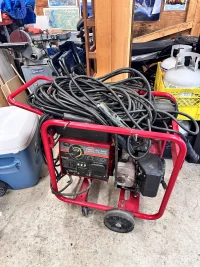
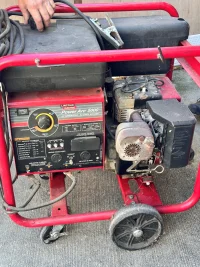
Had this AC stick welder given to me recently. I haven't had time to test it out yet. Came with what looks like 50ft of heavy duty welding cable that IIRC came from the local pulp mill in the 80's. Also came with an impressive box of many different types of welding rod, some I've never even seen before. One such type of rod was 3/32" and of unknown age meant for welding cast aluminum. I used it to make a couple small welds while modifying a cheap amazon full wrap handle for a chainsaw. I used my esab and had it down around 18-19 amps because of how thin the aluminum handle was.

I do like that this welder can double as a 100% duty cycle generator, rural living on a small island demands a backup power source 😅

welder2.webpwelder1.webp

I have a 10 year old ESAB EMP215IC multi-process that handles all my welding needs. I don't have a designated spot for my welder so it gets put in "storage mode" whenever its not in use... Pain in the ass but that's the way she goes.

I took a 10 month welding course after highschool and achieved essentially what used to be the equivalent of a level C ticket between what I did at the course and the hours I accumulated rebuilding excavator buckets and welding 6" well casings.

Most of what I do now is just average hobbyist stuff; mild steel stuff like body panels and brackets, a scattered amount of wire feed aluminum, and some stainless welding with 3/32" 309-16 rod (I'd love to learn stainless TIG) My ESAB came with a basic lift-tig setup that I haven't really played with yet. The manual knob for the gas and arc striking method bother me:ROFLMAO: but ESAB does sell (separately of course..) a foot pedal for doing TIG.
 
Very basic question from an absolute beginner: I got a little 110v Lincoln a couple years ago and have used it a little, but it’s been having wire feed issues. I thought it was the roller but last night it did this:

IMG_8996.webp


Does that mean there’s too much resistance in the gun? What’s my next step to remedy?

1782996300750.webp
 
Pull out the tip, clear out the birdsnest, and pull new wire through.
Install a new tip and run it a little without welding to see if it does it agsin.
More than likely its a plugged tip but could also be a bad spot in the liner.

When you coil up your gun after use, be careful not to kink the liner.
Big loops are your friend.
Same thing when it's in use- protect the cable from shit falling on it because a small kink in the liner can and will screw you up.
 
Bird-nesting can be very frustrating to deal with because there are many causes, but you're on the right track. It happens when the resistance to flow through the liner is so high that the wire isn't stiff enough when pushed against it. Ideas to investigate:
  1. Check all your gun parts for damage that will "pinch the wire." As MtPockets noted, replace those parts as necessary.
  2. Are you using flux-core or solid wire? For flux-core, use the knurled groove and for solid, use the v-groove.
  3. Make sure you don't have so much tension on the upper roller that it's crushing the wire (it is possible to have too much tension.) Crushed wire gets wider and can be pinched downstream. This isn't likely to be a problem with solid steel wire, though.
  4. Make sure that your spool tension is just enough to prevent free-wheeling, but not overly tight.
  5. On my Miller, the end of the liner projects to the pinch point of the rollers inside a conical plastic holder. That holder's position is adjustable, and I always try to get it as close to the pinch point as possible. With smaller wire (.023"), this can make a huge difference because is so easily bent. Here's a drawing showing what I mean:
1782997878889.webp
 
Bird-nesting can be very frustrating to deal with because there are many causes, but you're on the right track. It happens when the resistance to flow through the liner is so high that the wire isn't stiff enough when pushed against it. Ideas to investigate:
  1. Check all your gun parts for damage that will "pinch the wire." As MtPockets noted, replace those parts as necessary.
  2. Are you using flux-core or solid wire? For flux-core, use the knurled groove and for solid, use the v-groove.
  3. Make sure you don't have so much tension on the upper roller that it's crushing the wire (it is possible to have too much tension.) Crushed wire gets wider and can be pinched downstream. This isn't likely to be a problem with solid steel wire, though.
  4. Make sure that your spool tension is just enough to prevent free-wheeling, but not overly tight.
  5. On my Miller, the end of the liner projects to the pinch point of the rollers inside a conical plastic holder. That holder's position is adjustable, and I always try to get it as close to the pinch point as possible. With smaller wire (.023"), this can make a huge difference because is so easily bent. Here's a drawing showing what I mean:
View attachment 697479

All very good points!

Machine setup can be touchy and if it hasn't been working well could very well be the issue.
Especially roller tension. A lot of inexperienced folks just crank them down tight.

My method for determining the proper tension- after setting minimum tension just freewheeling, I put my hand in front of the gun at about a 45° angle and run the wire. Let it curl off the hand. Adjust the tension until it curls easily but the feed can be stopped by turning the hand into the coil.
I hope that makes sense...
 
Thanks for all the info! Lots of good advice to try. I think this machine was lightly used but poorly maintained. I probably have the roller too tight.

It’s solid wire, 0.030 i think.
 
  • Like
Reactions: sab and Woodrow