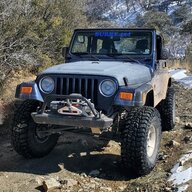
Rockjock (Currie) front spring updates

I'll have to see which fronts I received from Savvy a week or two back. I know they sent me 4.5" rears so I was concerned I may end up with too much rake. Looks fine to me...
20211029_195702.webp
 
  • Like
Reactions: JMT
Here are the springs I received from Savvy for the CE-9801HSR kit, shipped on 10/18/21:

front= CE-9132FP which states on the box 5 in. lift for 2 door TJ/LJ/JK, 4 in. lift for 4 door JK
rear= CE-9131RH3P which states on the box 4 1/2 in. lift for TJ, 4 in. lift for LJ
 
Last edited:
  • Like
Reactions: JDM and JMT
Piggy-backing again instead of a new thread.

Here's questions I sent to Savvy. Been looking hard at Currie 4" spring to replace the conglomeration I now have but notice Savvy has a 3" option that might work. I hope this note below makes some sense so ya'll might advise. Yup, it all depends on what I find under the ACOS.
An additional question: Is the rear relo necessary for 4 - 4.5" rear springs? How much offset from vertical is acceptable?

"PO Installed

Nth Degree Tummy Tuck
1.25" BL
MML

4.5" Rubicon Express lift
ACOS Front adjusted +3/4" (which nets additional 2" lift)
TNT Rear spring relocation brackets (additional 1.5" lift)
Total lift by my calculation is 6.5+"
Bilstein shocks (too short by my measurements)

It's unknown right now whether the OEM front upper spring towers were removed at the time of ACOS install. TBD soon, I hope.
If the OEM towers are in place I suspect I can remove those and the bolt-in TNT rear relos, go to a 4" spring and have sufficient lift for 35" tires.

If the towers are gone and I want to try to lower the LJ, is it advisable to just leave the ACOS in place at a minimum adjustment of 1.5" and get 3" springs up front, remove the rear relo, keeping 4.5" rear springs? Should net a total lift of 4.5" if I'm correct. 4.5" is expected to be more manageable, controllable, and accessible for short folks (top of sliders are 31" off the floor now).

What performance differences can I expect between the two setups (3" + ACOS/Relo * 4" springs with OEM mounting)? Flex, driveability, etc.?
 
Exactly.

The Rockjock springs will sit an inch different on two rigs that have 140 pounds difference between them on the front axle. Those 4.5" RE springs could take over 400 pounds difference to make that much change in ride height.

Whether or not it's intentional, it reflects a different philosophy between the two companies. Rockjock is trying to produce a spring with the best travel potential including rigs with midarms and shock relocations at the cost of variability in ride height results, while RE is trying to produce a spring that provides the most consistent ride height regardless of the rig configuration, at the cost of needing spring retainers to keep the coils from falling out when paired with anything as long or longer than an 11" Rancho.

Wouldn’t that affect ride quality? I know most of ride quality is in shocks, but 70lbs of compression means they’d move more from the psi impact of a speed bump. Where as hitting a speed bump at the same speed and same psi pressure upwards, wouldn’t compress a spring with 140 lbs of compression thus lifting the tub of the vehicle sitting on that spring more.

Surely a lower spring rate will translate to a smoother ride on logging roads at any kind of speed.
 
Wouldn’t that affect ride quality? I know most of ride quality is in shocks, but 70lbs of compression means they’d move more from the psi impact of a speed bump. Where as hitting a speed bump at the same speed and same psi pressure upwards, wouldn’t compress a spring with 140 lbs of compression thus lifting the tub of the vehicle sitting on that spring more.

Surely a lower spring rate will translate to a smoother ride on logging roads at any kind of speed.

No
 
Wouldn’t that affect ride quality? I know most of ride quality is in shocks, but 70lbs of compression means they’d move more from the psi impact of a speed bump. Where as hitting a speed bump at the same speed and same psi pressure upwards, wouldn’t compress a spring with 140 lbs of compression thus lifting the tub of the vehicle sitting on that spring more.

Surely a lower spring rate will translate to a smoother ride on logging roads at any kind of speed.

Say in either case the speed bump is 2" tall and 12" wide, and you're going 25mph. One set of springs applies 260lbs more pressure to the frame, for 1/36th of a second. If you had no shocks, it wouldn't even be perceptible beyond a soft, relatively slow bounce. On the other hand, the shocks respond to piston speed. That piston just tried to move 2" in 1/72nd of a second, which is pretty dang fast, and the viscosity of the oil just isn't gonna let that happen, so the piston moves as fast as it's able and the excess gets transferred to the chassis.

 
Say in either case the speed bump is 2" tall and 12" wide, and you're going 25mph. One set of springs applies 260lbs more pressure to the frame, for 1/36th of a second. If you had no shocks, it wouldn't even be perceptible beyond a soft, relatively slow bounce. On the other hand, the shocks respond to piston speed. That piston just tried to move 2" in 1/72nd of a second, which is pretty dang fast, and the viscosity of the oil just isn't gonna let that happen, so the piston moves as fast as it's able and the excess gets transferred to the chassis.


So by that reasoning, the quality of the piston of the shock is in the speed the faster the reaction of the piston, the less is transferred to the chassis.
I’m just thinking, the spring exerts force both up and down, so it can compress both up and down. So hitting a speed bump would temporarily compress it from the bottom. If the vehicle rests on it then it will compress
 
So by that reasoning, the quality of the piston of the shock is in the speed the faster the reaction of the piston, the less is transferred to the chassis.

I’m just thinking, the spring exerts force both up and down, so it can compress both up and down. So hitting a speed bump would temporarily compress it from the bottom. If the vehicle rests on it then it will compress

The spring is reacting to the weight sitting on top of it. Nothing more. It's job is to hold up that weight at the desired ride height. It isn't more complicated than that.

Shocks and sway bars control the movements.
 
  • Like
Reactions: psrivats and RINC
So by that reasoning, the quality of the piston of the shock is in the speed the faster the reaction of the piston, the less is transferred to the chassis.
I’m just thinking, the spring exerts force both up and down, so it can compress both up and down. So hitting a speed bump would temporarily compress it from the bottom. If the vehicle rests on it then it will compress

Not sure quality is the word I'd use there, but tuning. A stiffer tune won't bottom out as much on larger events but might feel too aggressive on smaller events, or a softer tune would feel more cushy on smaller events but bottom out more often on bigger ones.

Both spring and shock impart an acceleration on the chassis during an event, but the spring is applying fractions of a G while the shock is applying multiple Gs.
 
I have swapped various springs and shocks on a 4Runner. The shock makes big difference but the spring rate did make a noticeable difference in ride quality. A stiffer spring transmitted more small imperfections and ended the notorious OEM brake dive. I swapped to a softer spring and found just a little better ride but also a little bit of the brake dive returned.
On the Jeep I haven’t noticed a bit difference, aside from ride height, across the three sets of springs and two types of shocks that I have had over the years.