Electric TJ?

I restore Coleman lanterns that run on white gas. I really enjoy running them and when I "car camp" I often bring one. I use them all the time at home when I'm grilling or enjoying an evening outdoors. They really strike a chord with me, reliable and run all night on a tank of white gas. Really cool ultra reliable equipment, a real window into the past. When I backpack I use LED headlamps almost exclusively, same when I use the outhouse at night "car camping." Anybody get where I'm going with this?

 
  • Like
Reactions: Woodrow
I restore Coleman lanterns that run on white gas. Really cool ultra reliable equipment, a real window into the past. When I backpack I use LED headlamps almost exclusively, same when I use the outhouse at night "car camping." Anybody get where I'm going with this?

No. Is this Jen Psaki ?(aka Female Chucky). I use solar.
jen-chk.jpg
 
Last edited:
Electric should totally dominate rock crawling. Racing is tougher but this will help development. Could be awesome!
In a course type environment, yes it may. But for the weekend warrior type trails, range will be a limiting factor. Mechanically the technology is there, however it would be like driving with a 7 gallon tank that takes an hour to fill.

 
  • Like
Reactions: Woodrow and srimes
In a course type environment, yes it may. But for the weekend warrior type trails, range will be a limiting factor. Mechanically the technology is there, however it would be like driving with a 7 gallon tank that takes an hour to fill.
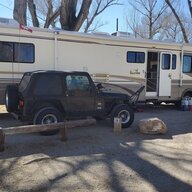
Agree. Most of us don't have a team waiting for us with spare battery packs and equipment to swap them out.

We're always seeing incremental improvements to battery technology, usually touted as "world changing". But these little 2% or 5% improvements are going to take decades before they add up enough to solve the range problem. I keep watching for a battery breakthrough with 80% improvement, but I don't really expect it to happen.
 
  • Like
Reactions: Gollywomper
I wouldn't mind being able to put in an electric engine. However, in California they're very strict with changing the engine. I know a guy that put a V8 in his TJ and then couldn't register it. Ended up selling it to someone out of state and then he bought a JL.

Maybe it would work in other states that don't have all these fucked up smog laws.
 
I won't be surprised if jeep releases ejeep. I've been hearing rumors since 2019 but I'm not sure if their first model of ejeep will be that quality...
 
What's the water rating on these electric motors? Will they handle being submerged for periods of time? Asking for a friend.
I was watching that Motor Mythbusters yesterday, and to test this they drove some little electric car into a pit of water. 24 seconds into the submersion, the thing quit. They actually got it deep enough into the water that the back of the car started to float.
 
  • Like
Reactions: JMT
I went down the rabbit hole a few years ago trying to figure out if a DIY LJ conversion was feasible. A Korean company had taken an EV Jeep (TJ I think) to SEMA, they ran one across the Rubicon trail, and they were planning to market a complete DIY kit. It looked like maybe the technology was there if you knew what you were doing. Digging a little deeper I found they had packed a portable generator across the Rubicon to charge at night and the Rubicon trail is only 22 miles long. I was hoping they carried the generator just for insurance and that their range was limited by building a TJ instead of a LJ and just maybe they had screwed up by keeping the transmission.

(As an aside they did eventually come out with a complete kit but it was for a JK and now it looks like they only sell JL conversion components)

There are off the shelf motor and controller combinations that will make plenty of torque for driving and wheeling a Jeep without doing anything exotic. It doesn't require dual motors or the need to hack in something from Tesla. That part is easy. The watt hour per mile power consumption to motivate a 4WD big tire TJ with the aerodynamics of a barn door is horrific so at a minimum the transmission has to go to reduce drive train losses. Automatics are real power hogs and even a manual transmission wastes far too much power. What you need in its place is a reduction gear off the motor matched to your differential gears so your final drive ratio is around 9 to 1 or 10 to 1. Maybe deeper depending on tire size and weight? I think many single speed EVs are set up at around 9 to 1. One manufacturer was selling a motor that was more powerful than what we need with a reduction gear but it was really expensive. I'm sure somebody smarter than I am could come up with a suitable reduction gear setup. From the reduction gear power would go through a divorced two speed (?) transfer case to get power to the front axle and to efficiently crawl on the rocks and trails. That part should be easy too. The battery monitoring system, power steering, basic motor cooling, accessory power, charging systems, cabin heat, and etc are all off the shelf. Securing the batteries and electrical connections for rough offroad use should also be doable. Thermal management for the batteries if needed might be difficult but somebody with more skills than I have could probably figure it out. So far so good. I think you could even build the Jeep so that pushing through two or three feet of water for short distances on a trail is possible. Putting everything together so you could cross rivers? I really have no idea but suspect that would be very difficult to impossible for a DIYer.

Where it looks like we hit trouble is with the batteries. The battery packs in current factory EV cars weigh around 800 lbs and more and I think the current crop of EVs are using high voltage high tech that isn't readily available to the DIY market. The F 150 Lightning battery pack weighs something like 1,800 lbs!! EV cars and trucks are designed around the battery packs and the cars are aerodynamic roller skates without solid axles, transfer cases, big heavy tires, a full steel frame, a heavy tub, armor, etc. All those things eat power like crazy. Where in the hell do we put batteries that weigh 1,000 lbs or more in a LJ or worse yet a TJ? And if you do, how do you set up the suspension so it performs with all that weight and screwed up weight distribution? So is it feasible to do a TJ or LJ EV conversion? I am a total amateur and don't even know enough to be dangerous but think it depends on what you want the Jeep to do. I put together a spreadsheet to try and calculate battery weight, voltage, and range and it looks to me like the best case with the current technology lithium chemistry batteries is you can make a functional short range pavement princess that can screw around on the farm or make short day trips on a trail if the Jeep is trailered. I priced everything out and it was far more expensive than I had imagined. That kind of Jeep isn't something I'm interested in. But if somebody finally develops a battery chemistry with 4x the energy density of the batteries we have now I will rob a bank to afford trying to do an LJ conversion.

Edit - This is the Korean company and their Jeep EV project. My memory was bad and it was a JK.
https://www.emvcon.com/electric-vehicle-conversion. Looks like they make a traction motor with gear reduction too.
 
Last edited:
  • Like
Reactions: Woodrow and JMT
I was watching that Motor Mythbusters yesterday, and to test this they drove some little electric car into a pit of water. 24 seconds into the submersion, the thing quit. They actually got it deep enough into the water that the back of the car started to float.
I saw that too but I had also previously seen videos of EV cars driving through flood waters. Here are three.
https://insideevs.com/news/351925/video-tesla-model-3-amphibious-water/https://insideevs.com/news/544732/porsche-taycan-drive-deep-flood/https://insideevs.com/news/524488/xpeng-p7-drives-flooded-streets/We should probably reclassify that myth as plausible under the right conditions but always monumentally stupid to attempt.
 
  • Like
Reactions: Woodrow