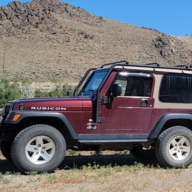
Very good example of over inflation!!!Yep and the gravel dust in the picture I posted showed this 35 psi was too much so no gravel dust on the outer edges just the center. Hence why I ran closer to 25 on those tires.


Very good example of over inflation!!!Yep and the gravel dust in the picture I posted showed this 35 psi was too much so no gravel dust on the outer edges just the center. Hence why I ran closer to 25 on those tires.
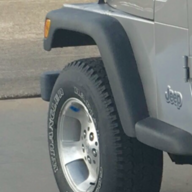
Funny...they get their calculations from the Tire and Rim Association....the same guys that also say no lower than door placard pressure.Going back to @RMETeeJay 's post would be a good starting point. Keeping in mind exactly what the following image says at the bottom... If the tires you are looking at are "standard load" (aka passenger rated) then I wouldn't go any lower than 22. The method I described above will work for any tire and wheel combo.
View attachment 298106
Their recommendations for door pressure guidelines assumes you are staying with OE tire sizes.Funny...they get their calculations from the Tire and Rim Association....the same guys that also say no lower than door placard pressure.

Those air pressures are ONLY for the various sizes of factory-size tires listed on the placard on the door jamb. Once you go up in size like to 31, 32, 33, or 35" the correct air pressures will be lower than what is on the factory placard.Funny...they get their calculations from the Tire and Rim Association....the same guys that also say no lower than door placard pressure.
Negative, that is for changing tire size from factory - larger or smaller.Their recommendations for door pressure guidelines assumes you are staying with OE tire sizes.

So when the 40’s go on my LJ what pressure should I run?Negative, that is for changing tire size from factory - larger or smaller.
No it's not! It is specific to the tires that are on the sticker. Factory actually recommends not going outside of those tire parameters...Negative, that is for changing tire size from factory - larger or smaller.
That doesn't even make sense, if you changed to a factory size tire there would be no need to figure out a new pressure.
When you go to 40's, you dont give a fuck about safety, handling, steering, scrub radius, vibration, gas mileage, rollover tendency, spring rate, tire wear- so run whatever makes you feel warm and fuzzy inside. You are so outside the designed vehicle dynamics for driving on the road it doesn't matter.So when the 40’s go on my LJ what pressure should I run?
Why wouldn’t I? Scrub radius is planned and I plan to be able to daily drive it. I’d rather not roll over, hate vibration and need it to be well handling.When you go to 40's, you dont give a fuck about safety, handling, steering, scrub radius, vibration, gas mileage, rollover tendency, spring rate, tire wear- so run whatever makes you feel warm and fuzzy inside.
What's funny is you stated this earlierFunny...they get their calculations from the Tire and Rim Association....the same guys that also say no lower than door placard pressure.
Yet you refute their recommendations of 22 psi??? What makes you smarter than the T&R Association, to tell him to run no less than 29 psi? Also "or higher if required"??? Really?? So you're suggesting that I go higher then the 80 PSI that is recommended on my truck if I want to haul more weight?That is the recommendation from the Tire and Rim Association. The standardizing body in the US - tire placard or higher if required.
Oh you mean people such as yourself.Been down this road before...forum people seem to think they know better than engineers that spend their entire careers on tires and wheels. That's why I said just do whatever makes you feel good.
ONLY for the SPECIFIC tire sizes shown on the placard. Those tire pressures are not correct for anything any bigger or smaller than what's on the placard.Negative, that is for changing tire size from factory - larger or smaller.
How are your toe-in and caster angles? Are they up to snuff?I run 26 in my 31 10.50 15 duratracs, any less it seems to get pretty loose at 50mph of more
It doesn't effing matter how or why Jeep engineering in combination with the tire suppliers came up with those recommended tire pressures. That's what they officially recommend, don't be trying to come up with your own tire pressures you think are more correct than theirs based on their load ratings. The same exact tire will have different correct air pressures depending on the vehicle weight and type.Why does Jeep specify 33 psi for stock tires? The load capacity for P215-75R15 is 1690lbs. (x4)
Does a TJ have a 6760lb gvwr?
Why does Jeep specify 29psi for factory LT 30-9.50R15? That is a load capacity of 1,376lb each. Totally different load capacity than the P-tires for the exact same vehicle. hmmmm weird...
Maybe there are other factors besides load carrying capacity that go into deciding the "best" tire pressure.
There is a note on their tables that say something similar to "no lower than placard pressure". It's that simple.Yet you refute their recommendations of 22 psi??? What makes you smarter than the T&R Association, to tell him to run no less than 29 psi? Also "or higher if required"???
Yes, exactly!That's what they officially recommend, don't be trying to come up with your own tire pressures you think are more correct than theirs based on their load ratings.
It is so simple. Hilarious.The same exact tire will have different correct air pressures depending on the vehicle weight and type.
Minimum?? You're ignorance is astounding....It is so simple. Hilarious.
The pressure to carry the vehicle weight is a MINIMUM. Not the ideal/best/recommended pressure.
MINIMUM. Nothing more, nothing less. So easy a caveman can do it.
Reading comprehension is hard for some people like youMinimum?? You're ignorance is astounding....
So 80 psi, is on what's indicated on my trucks, by your accounting I should put more pressure in my tires if I plan on hauling more weight and I should never have less than that pressure under any circumstances?
SMH... Not only is that wrong it's completely idiotic!
You are back and forth all over the place and very little, if any of the things you have said is relevant let alone accurate.





