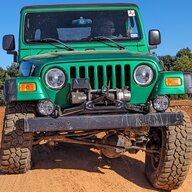
High skids meaning tummy tuck?Rubicons get driveshaft bind at droop with high skids and 4" lifts. But that can be addressed with a center limit strap.
Gonna have to look at/for "center limit strap" now. Sounds simple enough.


High skids meaning tummy tuck?Rubicons get driveshaft bind at droop with high skids and 4" lifts. But that can be addressed with a center limit strap.
Hang the suspension from the shocks first and try bolting the driveshaft onto the pinion twice after a 90deg turn before solving a problem you might not have.High skids meaning tummy tuck?
Gonna have to look at/for "center limit strap" now. Sounds simple enough.
It's a problem with short driveshafts. The TJ Rubicon happens to have one of those.Yeah, I meant research how to find out if it's an issue and what might be done if it is, since I never heard of it. Makes sense it could happen, but probably not real common.
Arm length doesn't affect the amount of travel we can get on a TJ or LJ. I've outboarded rear 12s on both short and mid and converted an existing outboarded short arm to a mid. The practical limits become ones of packaging the shock, as well as axle width with reasonable wheel backspacing. That is why 11s tend to be where we stop on the front. Squeezing a 12 in there is nowhere near as easy as the rear is.
Rubicons get driveshaft bind at droop with high skids and 4" lifts. But that can be addressed with a center limit strap.
Most people don't put themselves into situations where control arm jacking matters. But that is one of the primary reasons to put longer arms up front.

All of that together and more adds up to why ~4" is the practical limit on stock axles and stock wheelbase. Skyjacker doesn't care, though.I didn't mean into imply that it was, I was mainly just musing on why we don't see many quality suspension lifts over 4". And I agree the arm length doesn't limit travel, but I do think it places bounds around practical lift height due to things like instant center/antisquat, clearance issues vs loss of wheelbase arising from the arc of the rear axle, etc.
Gotta be careful though, don't want to turn this into another geometry correction thread.

It's clear that many don't care!Skyjacker doesn't care, though.
There are TJs that come in close to 1200 per corner with lots of steel armor, tools, and gear.Looking at the quoted free lengths and spring rates of the OME 941 and 942 rear springs is very confusing, to me at least.
The 941 has a free length of 15.53" and a spring rate of 140lbs. The 942 has a free length of 14.96" and a spring rate of 160lbs. Based on those figures with an sprung load per spring of 650lbs each spring yields a compressed spring height of:
941 = 10.89"
942 = 10.90"
Increase that load per spring to 750lbs and you get:
941 = 10.17"
942 = 10.27"
Increase that load per spring even more to 850lbs and you get:
941 = 9.46"
942 = 9.65"
Indeed, if you want to get to a 1/2" difference in the springs the load needs to be at 1200lbs per spring:
941 = 6.96"
942 = 7.46"
At which point the Jeep is lower than stock.
In short, at any reasonable sprung load per corner, the additional length of the 941 seems to almost completely compensate for the higher spring rate of the 942. If the table is showing correct values then what is the point of the two different springs and how should somebody choose between them?
Heck, that is an awful lot of sprung weight. If that is the sprung weight, how much do those TJs weigh in at in total? With 1200lbs sprung weight in the rear corners the figures quoted on page 1 for the Skyjacker 6" lift spring would only yield about a 3" lift, so what springs are these people using to run 35s or bigger?!? Are you sure you are referring to sprung weight?There are TJs that come in close to 1200 per corner with lots of steel armor, tools, and gear.
There probably aren't many TJs with only 850 per corner. Maybe an SE with no top or doors and no aftermarket anything.
Most are probably around 1000.
1200lbs sprung weight per corner is oppressively heavy even for an over loaded TJ.There are TJs that come in close to 1200 per corner with lots of steel armor, tools, and gear.
There probably aren't many TJs with only 850 per corner. Maybe an SE with no top or doors and no aftermarket anything.
Most are probably around 1000.
....
In short, at any reasonable sprung load per corner, the additional length of the 941 seems to almost completely compensate for the higher spring rate of the 942. If the table is showing correct values then what is the point of the two different springs and how should somebody choose between them?
Sorry jjvw, which weights lean towards excessive? The ones in my first post on this? I started at 650lbs per rear corner, is that still high?In short, these are sprung weight scenarios that lean towards the excessive side.
1200lbs sprung weight per corner is oppressively heavy even for an over loaded TJ.
Mine is about 4600lbs overall with a rear corner weight no more than 950lbs.That's true. I was just thinking back to seeing some 4800 pounders in the weight threads and didn't think about taking unsprung weight out of the equation.
On a typical 30/44 TJ, that's probably what, 200 ish per corner? So the OP is onto something with there not being much of a difference in the two springs in question.
1200lbs is pretty high.Sorry jjvw, which weights lean towards excessive? The ones in my first post on this? I started at 650lbs per rear corner, is that still high?
Heck, that is an awful lot of sprung weight. If that is the sprung weight, how much do those TJs weigh in at in total? With 1200lbs sprung weight in the rear corners the figures quoted on page 1 for the Skyjacker 6" lift spring would only yield about a 3" lift, so what springs are these people using to run 35s or bigger?!? Are you sure you are referring to sprung weight?
But that aside, for a TJ of those epic proportions the point is both of these springs would be useless anyway, as they would be giving negative lift versus a stock TJ anyway. That is my point, in the useable range, based on the figures quoted on page 1 they seem to yield essentially the same result. That is not the case for the equivalent front springs.
Relatable post.The problem with OME is that there are too many options. Too many options creates analysis paralysis.




