I've been reassured that installing the Coyotes won't be as bad as I think it will be.Have you ever installed a set? Doing 120 bolts at three torque stages is no picnic!



I've been reassured that installing the Coyotes won't be as bad as I think it will be.Have you ever installed a set? Doing 120 bolts at three torque stages is no picnic!

Don’t forget the anti-seize. I install them in the living room while watching tv. Sounds like I can install some this weekend since my tires are waiting for me to pick them up!!!Have you ever installed a set? Doing 120 bolts at three torque stages is no picnic!
Anecdotally, each pound of rotating mass you can save is roughly equal to a 5 hp gain. That was the rule of thumb we used back in FSAE days. Heavy wheels and tires make have a HUGE impact to the whole vehicle.Doesn't seem like that much but it all adds up and weight usually hurts.
Here's a write up -
Why Does Unsprung Weight Matter?
Unsprung weight has a huge effect on any vehicle's acceleration, braking, and cornering abilities. It's even said that at a drag strip, adding a single pound of unsprung weight to a car has the same effect as adding two or more pounds to the body. Check out the diagrams below to see why it makes such a big difference.
View attachment 330064Acceleration
In Fig. 1 above, we see a Camaro with a set of small, lightweight wheels. In order to get the car moving, the engine only has to spin 30-pound wheels, so it doesn't have to work very hard. Putting less strain on the engine means faster acceleration. It's that simple.
In Fig. 2, you'll see the Camaro is sporting some bigger, heavier wheels. If you drove the car, you'd notice it feels sluggish, since the engine is working harder to turn the 50-pound wheels. This results in slower acceleration and reduced fuel economy.
View attachment 330065
Braking
Just like the engine has to work harder to get the 50-pound wheels spinning, the brakes also struggle to bring them to a halt. A heavy set of wheels can increase stopping distance, and even wear out your brakes faster than light wheels.
Cornering & Ride
Wheel weight can also have a dramatic effect on handling and ride comfort. Check out the diagram below to see why.
View attachment 330066
So, let's say you're driving down the road, and you hit a bump. This bump must be absorbed by your tire, wheel, axle, and suspension components. If, as seen in Fig. 3, your car's wheel weighs 30 pounds, 60 pounds of force must be absorbed by your suspension.
In Fig. 4, the wider 50-pound wheels would exert 100 pounds of force on your car's suspension when you hit this same bump. More force passed into your suspension means you'll feel a bigger bump, and your springs and shocks will experience more wear over time.
View attachment 330067
This same logic applies to cornering, since going around a turn causes the wheels to move up or down as the car leans into the curve. Lighter wheels are also able to "bounce back" faster after bumps, allowing your tires to stay in contact with the road longer, and providing more grip. The end result is confidence-inspiring handling and improved cornering speed.
https://news.classicindustries.com/restoration-tips/wheel-weight-matters-unsprung/
Oh man...I love those classic slot wheels. One of my all time favorites. 5 x 5.5 pattern though, aren't they....The 17" Walker Evans beadlocks and 35" Mickey Thompson tires I previously had weighed 107.6 lbs each.
View attachment 330087
As a comparison, I also had a set of 17" classic slotted wheels and 35" Duratracs, weighing in at 87.4 lbs. The 20 lb per tire difference was very noticeable when driving around. If I had a dedicated trail rig, I'd run beadlocks. If I was daily commuting in the Jeep I would not. What they took away from performance wasn't acceptable to me.
View attachment 330088
It is interesting they come up with that ratio since backpackers say one pound on your foot is the same as five pounds in your pack.Anecdotally, each pound of rotating mass you can save is roughly equal to a 5 hp gain. That was the rule of thumb we used back in FSAE days. Heavy wheels and tires make have a HUGE impact to the whole vehicle.

They are.Oh man...I love those classic slot wheels. One of my all time favorites. 5 x 5.5 pattern though, aren't they....
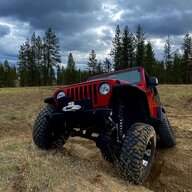
IThe 17" Walker Evans beadlocks and 35" Mickey Thompson tires I previously had weighed 107.6 lbs each.
View attachment 330087
As a comparison, I also had a set of 17" classic slotted wheels and 35" Duratracs, weighing in at 87.4 lbs. The 20 lb per tire difference was very noticeable when driving around. If I had a dedicated trail rig, I'd run beadlocks. If I was daily commuting in the Jeep I would not. What they took away from performance wasn't acceptable to me.
View attachment 330088
 the Walker Evans.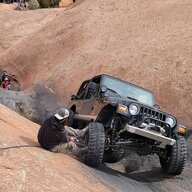
I was at 10psi on non beadlocks on Pritchett.And fodeez!
I've pretty much decided I'm going to a 17" wheel. I really wanted to stay with 15", and I have plenty of tire choices that I would be happy with, but after more research I think the pros of a 17" wheel outweigh those of a 15". It doesn't even have much to do with the direction of the market or load, it's probably mainly in more on-road stability with a 8-9" sidewall height over 10". I don't think there is much if any advantage aired down on a 15 vs 17 with a 35" tire. The other thing is that wheels are getting so expensive that I'm already at $225 or so just for a regular sucky wheel, so why not spend twice that and go to beadlocks. That said, I won't do it just yet, though I do have two sets picked out. I'm currently riding on a set of 35 KM3's with about 4K on them. I could sell them and go all in on 17" beadlocks and tires, but I'm in no hurry. Other things like welding projects for this year and some more painting if I can. I've got a bulged disc pinching a nerve and it pretty much debilitates me, so I have to get that all worked out. Plus I have the Rubicon to get in order before end of Summer, so I'm plenty busy. At any rate, thought I would share that. There's a lot more to the discussion and reasoning.
No Rich, but I am very aware of what is involved in each type of install and beadlocks are easier by orders of magnitude. There are extra tools involved, more wrestling with the tires, drilling, setting the Coyote, and much more. Then there’s nothing to protect the rim. Destroy that and I need to replace a wheel. Then we get to do it all again next year, minus the drilling.Have you ever installed a set? Doing 120 bolts at three torque stages is no picnic!
I want to be able to go lower here in the snow and ice. 4-6 is not uncommon. I won’t probably go below 7 in Moab, but I also just need and want new wheels and like adding some functionality whenever I cough up some dough. If 10psi is all I need, great. I can do that. I run 9psi here. I’m kind of looking for some more functionality on very loose soil too.I was at 10psi on non beadlocks on Pritchett.
Working on it. My wife is a masseuse and a good friend is a chiropractor. My X-rays are very good, so next step is MRI on the 21st. Thanks for your concern. Constant pain is mind numbing. No joke.Find yourself a good chiropractor and get your back straighten out before it gets worse and potentially irreversible.
NITB is a good hardcore group. NIJ is mostly a social club, but they do go out a lot, just not many hard trails.You need to hang with the Idaho boys some more.
Anecdotally, each pound of rotating mass you can save is roughly equal to a 5 hp gain. That was the rule of thumb we used back in FSAE days. Heavy wheels and tires make have a HUGE impact to the whole vehicle.
I also have a neck injury that is affecting my arm and anything that requires the kind of labor Coyotes do is not possible for me. I think they are great though. I have no qualms with the design or function
you have a tens unit? have you tried traction?Working on it. My wife is a masseuse and a good friend is a chiropractor. My X-rays are very good, so next step is MRI on the 21st. Thanks for your concern. Constant pain is mind numbing. No joke.
Crawling is one of the few things where additional unsprung weight helps more than it hurts.I get this part for some types of things and as Irun has pointed out he noticed a difference by going to heavier rims and I realize if you drive on the street and if it's a DD it is more noticeable.
It's been talked about before and I don't know that it has been totally covered but for the off-road side of things does having heavier wheels/tire combo help any in some situations? Not trying to derail JMT's thread. I know for things like tractor pulling and even some of the buggy guys put water in their tires.
Being in pain is no JOKE and anyone who tells you to just walk it off hasn't even been in true pain. I truly hope you can get this fixed and get back to being able to do things again. I know how it can interfere with your life and enjoyment.
Get well buddy.
I can see where having more weight down low might make a rig more stable. Compare riding a Harley with a big v twin down low in the frame vs an old UJM. Those four cylinders carry a lot of their weight high. It makes them much tougher to balance at a stop light and you can feel it when you lay it over in a turn too.I get this part for some types of things and as Irun has pointed out he noticed a difference by going to heavier rims and I realize if you drive on the street and if it's a DD it is more noticeable.
It's been talked about before and I don't know that it has been totally covered but for the off-road side of things does having heavier wheels/tire combo help any in some situations? Not trying to derail JMT's thread. I know for things like tractor pulling and even some of the buggy guys put water in their tires.
I have a neck pro unit that is providing traction. It’s a job in itself doing ice, taking anti-inflammatory’s, and traction every hour, not to mention going to appointments. I’m glad my masseuse lives in house!you have a tens unit? have you tried traction?
Ya'll really need to stop doing that. Your tire pressure is fully useless for anyone else unless they run the exact same tire and rim combo with similar everything else. In perspective, I've run 6-7 different tires in JV, not one of them worked at 5-6 psi, all worked at 7-8.I was varying pressures on the trip to compare but I didn't get to run the same lines multiple times. It would be interesting to do. The day we ran Cliffhanger and Moab Rim I was at 6 psi and felt I had good traction.
It only takes installing one set of beadkocks to know it doesn’t actually work this way - at least to do it correctly.…
As for the bead locks, I’ve watched Raceline’s install and there’s no need to torque 3x’s. Once you get the tire on. Just set your clutch on 1 and star pattern them all in, then torque to 14-17. Check at oil changes. All I need is a socket and a torque wrench.
…